Crit Care. 2011;15(6):1007. doi: 10.1186/cc10482. Epub 2011 Dec 2.
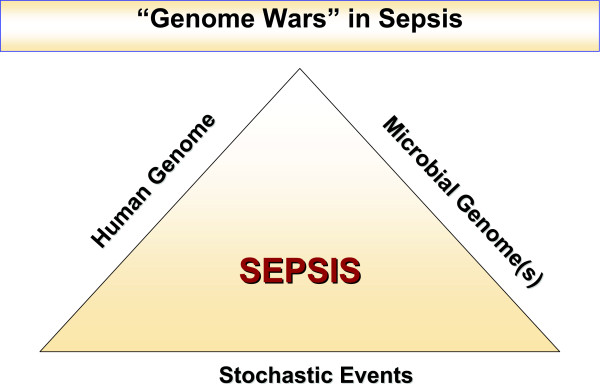
Sepsis continues to pose a clear challenge as one of the most difficult and costly problems to treat and prevent. Sepsis is caused by systemic or localized infections that damage the integrity of microcirculation in multiple organs. The challenge of sepsis and its long-term sequelae was addressed by the National Institutes of Health National Heart Lung and Blood Institute Division of Blood Diseases and Resources. Defining sepsis as severe endothelial dysfunction syndrome that causes multiorgan failure in response to intravascular or extravascular microbial agents, the National Heart Lung and Blood Institute panel proposed the concept of genome wars as a platform for new diagnostic, therapeutic, and preventive approaches to sepsis.
败血症仍然是一个极具挑战性且代价高昂的问题,无论是治疗还是预防都存在困难。败血症是由系统性或局部感染引起的,这些感染会损害多个器官的微循环完整性。美国国立卫生研究院国家心肺血液研究所血液疾病和资源分部针对败血症及其长期后遗症提出了应对方案。该方案将败血症定义为严重的内皮功能障碍综合征,这种综合征会导致多器官衰竭,其病因是血管内或血管外微生物制剂。国家心肺血液研究所专家组提出了基因组战争的概念,将其作为败血症新的诊断、治疗和预防方法的平台。