Department of Experimental Psychology, University of Oxford, South Parks Road Oxford OX1 3UD, United Kingdom.
Brain Lang. 2012 Mar;120(3):310-20. doi: 10.1016/j.bandl.2011.10.006. Epub 2011 Dec 1.
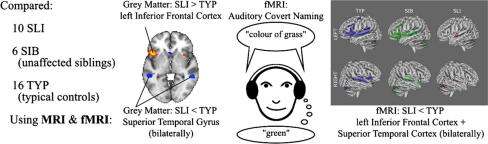
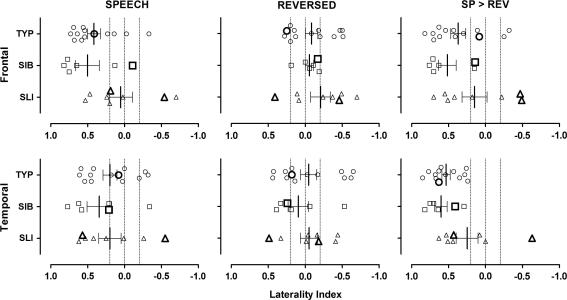
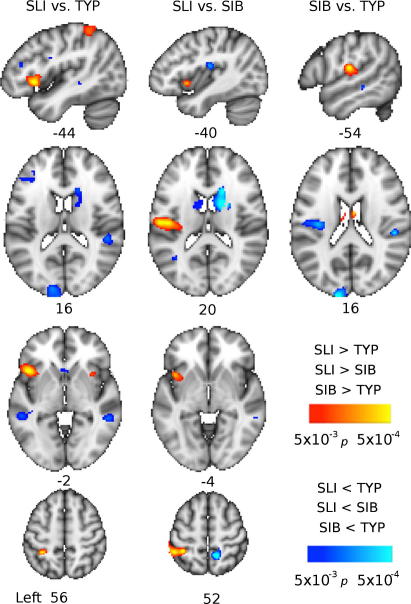
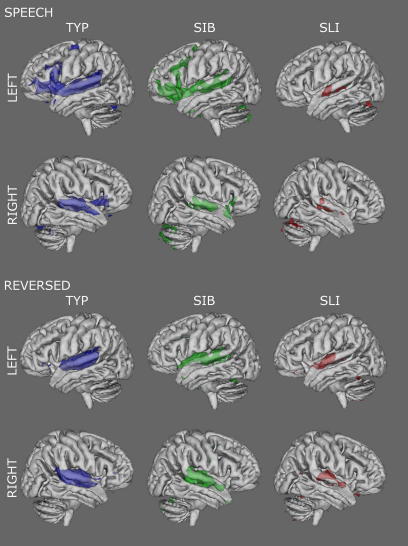
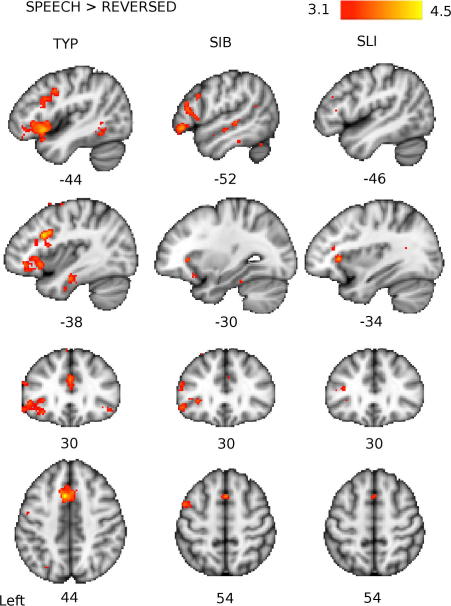
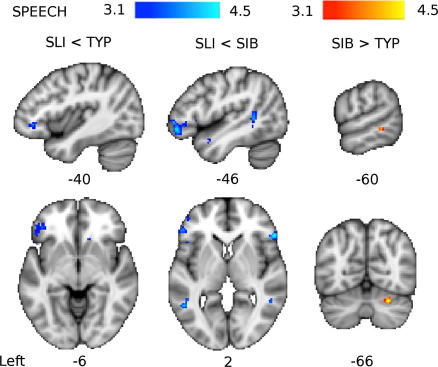
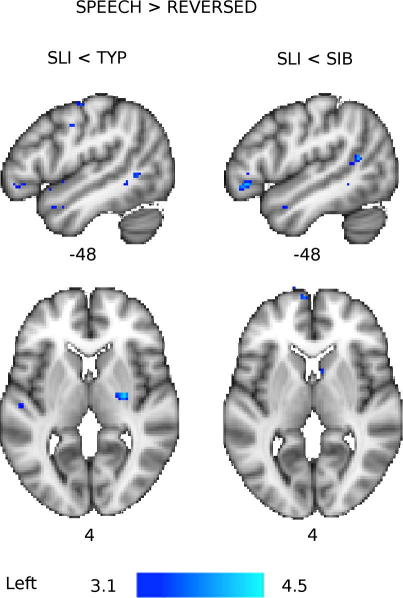
We assessed the relationship between brain structure and function in 10 individuals with specific language impairment (SLI), compared to six unaffected siblings, and 16 unrelated control participants with typical language. Voxel-based morphometry indicated that grey matter in the SLI group, relative to controls, was increased in the left inferior frontal cortex and decreased in the right caudate nucleus and superior temporal cortex bilaterally. The unaffected siblings also showed reduced grey matter in the caudate nucleus relative to controls. In an auditory covert naming task, the SLI group showed reduced activation in the left inferior frontal cortex, right putamen, and in the superior temporal cortex bilaterally. Despite spatially coincident structural and functional abnormalities in frontal and temporal areas, the relationships between structure and function in these regions were different. These findings suggest multiple structural and functional abnormalities in SLI that are differently associated with receptive and expressive language processing.
我们评估了 10 名特定语言障碍(SLI)患者、6 名未受影响的兄弟姐妹和 16 名语言正常的无关对照组的大脑结构与功能之间的关系。基于体素的形态测量学显示,与对照组相比,SLI 组的左额下回灰质增加,右侧尾状核和双侧颞上回灰质减少。未受影响的兄弟姐妹的尾状核灰质也比对照组减少。在听觉隐蔽命名任务中,SLI 组的左侧额下回、右侧壳核和双侧颞上回的激活减少。尽管在额颞区存在空间上一致的结构和功能异常,但这些区域的结构和功能之间的关系不同。这些发现表明 SLI 存在多种结构和功能异常,与接受性和表达性语言处理的关系不同。