Section on Cellular Signaling, Program in Developmental Neuroscience, NICHD, National Institutes of Health, Bethesda, MD 20892-4510, United States.
Cell Calcium. 2012 Mar-Apr;51(3-4):212-21. doi: 10.1016/j.ceca.2011.11.003. Epub 2011 Dec 3.
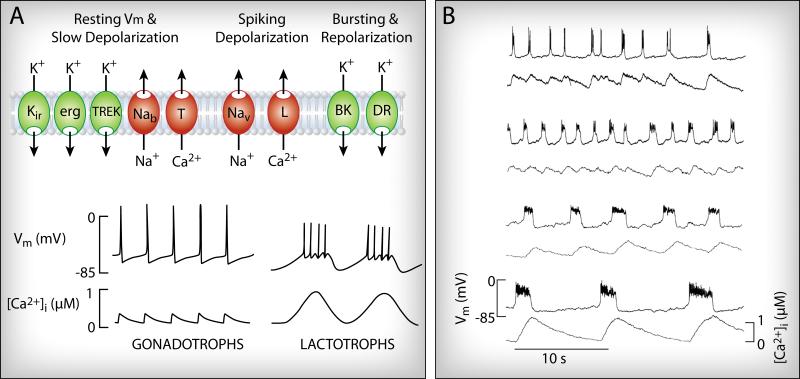
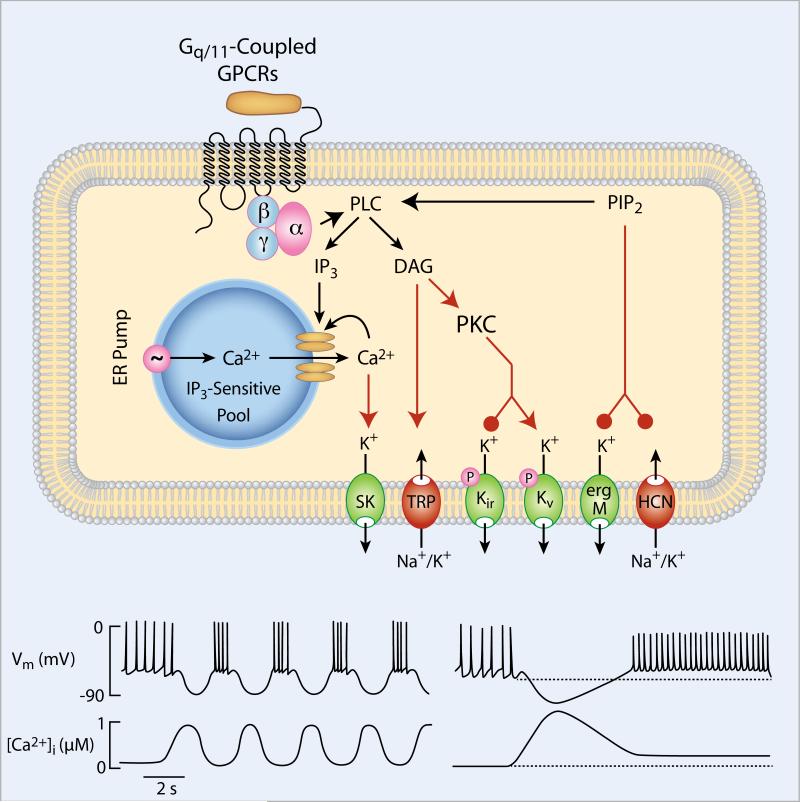
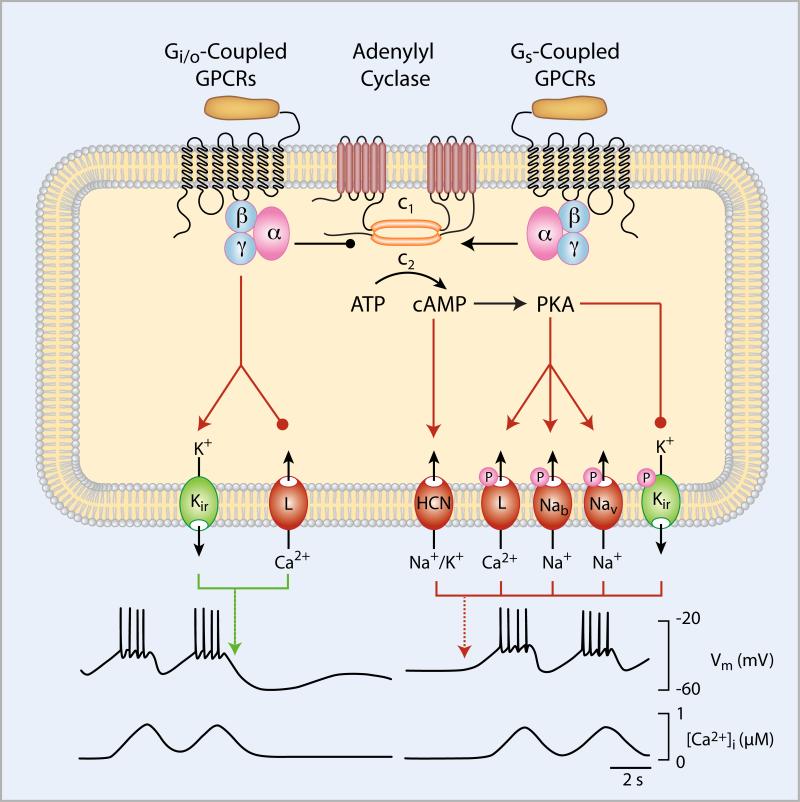
Endocrine pituitary cells express numerous voltage-gated Na(+), Ca(2+), K(+), and Cl(-) channels and several ligand-gated channels, and they fire action potentials spontaneously. Depending on the cell type, this electrical activity can generate localized or global Ca(2+) signals, the latter reaching the threshold for stimulus-secretion coupling. These cells also express numerous G-protein-coupled receptors, which can stimulate or silence electrical activity and Ca(2+) influx through voltage-gated Ca(2+) channels and hormone release. Receptors positively coupled to the adenylyl cyclase signaling pathway stimulate electrical activity with cAMP, which activates hyperpolarization-activated cyclic nucleotide-regulated channels directly, or by cAMP-dependent kinase-mediated phosphorylation of K(+), Na(+), Ca(2+), and/or non-selective cation-conducting channels. Receptors that are negatively coupled to adenylyl cyclase signaling pathways inhibit spontaneous electrical activity and accompanied Ca(2+) transients predominantly through the activation of inwardly rectifying K(+) channels and the inhibition of voltage-gated Ca(2+) channels. The Ca(2+)-mobilizing receptors activate inositol trisphosphate-gated Ca(2+) channels in the endoplasmic reticulum, leading to Ca(2+) release in an oscillatory or non-oscillatory manner, depending on the cell type. This Ca(2+) release causes a cell type-specific modulation of electrical activity and intracellular Ca(2+) handling.
内分泌垂体细胞表达众多电压门控 Na(+)、Ca(2+)、K(+) 和 Cl(-) 通道以及几种配体门控通道,并且它们会自发地产生动作电位。根据细胞类型的不同,这种电活动可以产生局部或全局 Ca(2+)信号,后者达到刺激-分泌偶联的阈值。这些细胞还表达众多 G 蛋白偶联受体,其可以通过电压门控 Ca(2+)通道和激素释放来刺激或沉默电活动和 Ca(2+)内流。与腺苷酸环化酶信号通路正耦联的受体通过 cAMP 刺激电活动,cAMP 可直接激活超极化激活环核苷酸调节通道,或通过 cAMP 依赖性激酶介导的 K(+)、Na(+)、Ca(2+)和/或非选择性阳离子通道的磷酸化来激活。与腺苷酸环化酶信号通路负耦联的受体通过激活内向整流 K(+)通道和抑制电压门控 Ca(2+)通道来抑制自发的电活动和伴随的 Ca(2+)瞬变,主要是通过激活内向整流 K(+)通道和抑制电压门控 Ca(2+)通道。Ca(2+)动员受体激活内质网中的三磷酸肌醇门控 Ca(2+)通道,从而根据细胞类型以振荡或非振荡方式释放 Ca(2+)。这种 Ca(2+)释放导致电活动和细胞内 Ca(2+)处理的特定于细胞类型的调制。