University of Seville, Spain.
Med Oral Patol Oral Cir Bucal. 2012 May 1;17(3):e435-41. doi: 10.4317/medoral.17647.
In the first place, to evaluate skeletal changes of the maxilla and mandible induced by surgical-orthodontic correction of malocclusions class III with long-face syndrome and secondly, to analyze the stability of these skeletal changes in the long term (more than 6 years).
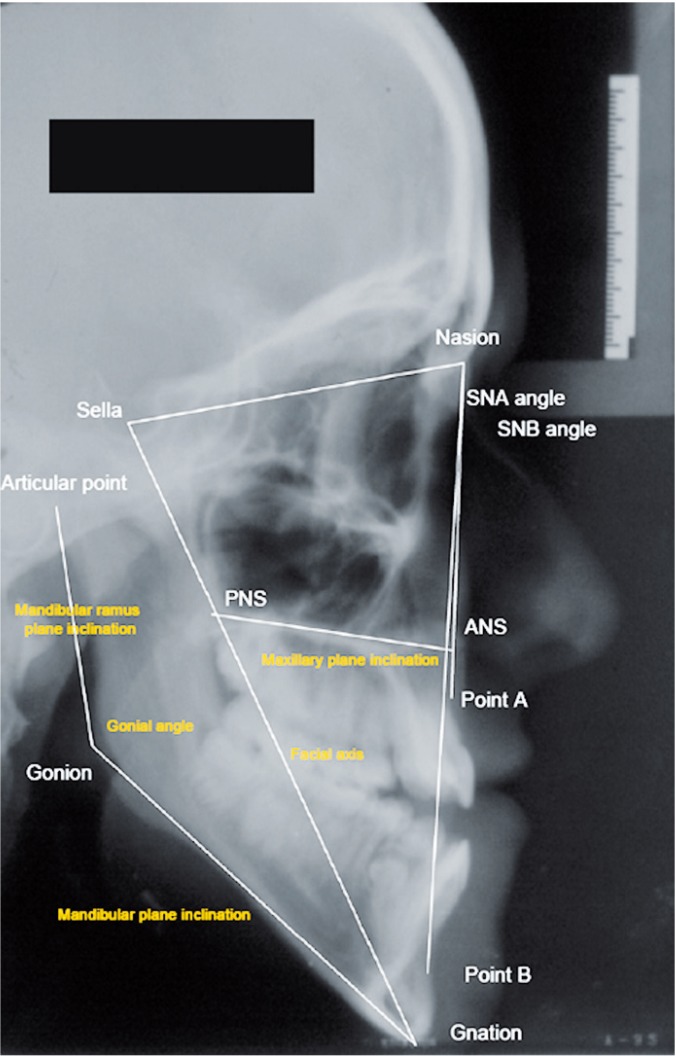
A retrospective, unicentric and longitudinal study of 19 patients who had undergone surgical and orthodontic therapy for class III skeletal malocclusion with long-face syndrome was undertaken. A cephalometric analysis based on 8 angle measurements, and statistical analyses at three different points in time (before orthodontic treatment, after orthognathic surgery and after a retention period of at least 6 years) were carried out.
The changes produced following surgery show that, with the exception of the maxillary plane and the facial axis, all other variables presented changes of great statistical difference.
Skeletal changes after orthodontic-surgical correction present maxillary advance, mandibular regression and mandibular anterorotation. The angles that represent the mandibular vertical position (ramus angle, goniac angle and mandibular plane angle) showed statistically significant relapses and no stability in contrast to the facial axis.
首先,评估因长面综合征的 III 类错[牙合]畸形而进行的正颌-正畸矫正引起的上颌和下颌的骨骼变化;其次,分析这些骨骼变化在长期(超过 6 年)内的稳定性。
对 19 例因长面综合征的 III 类骨骼错[牙合]畸形而接受正颌-正畸治疗的患者进行回顾性、单中心、纵向研究。进行基于 8 个角度测量的头影测量分析,并在三个不同时间点(正畸治疗前、正颌手术后和至少 6 年的保持期后)进行统计分析。
手术引起的变化表明,除了上颌平面和面部轴外,所有其他变量都表现出具有统计学意义的差异。
正畸-正颌矫正后的骨骼变化表现为上颌前突、下颌后退和下颌前旋转。代表下颌垂直位置的角度(髁突角、下颌角和下颌平面角)表现出统计学上显著的复发,与面部轴相比没有稳定性。