Eskandarizadeh Ali, Shahpasandzadeh Mohammad Hossein, Shahpasandzadeh Mahdieh, Torabi Molok, Parirokh Masoud
Restorative Dentistry Department, Oral and Dental Diseases Research Center, Kerman, Iran.
J Conserv Dent. 2011 Oct;14(4):351-5. doi: 10.4103/0972-0707.87196.
Vital pulp therapy has been known as one of the treatment options to preserve pulp after being exposed by trauma or caries.
To investigate human pulpal response to white and grey mineral trioxide aggregate (WMTA, GMTA) and Dycal (MTA) as pulp capping agents.
Human volunteers were participated in this randomized clinical trial.
This study was conducted on 90 intact first and second premolars of human maxillary and mandibular teeth. The teeth were randomly assigned into three groups of 30 each. Under local anesthesia, teeth were exposed and capped either with GMTA, WMTA, or Dycal. After 30, 60, and 90 days 10 teeth of each group were extracted and prepared for histologic observation.
Histopathologic data were analyzed by χ(2), Kruskal Wallis and Mann Whitney tests.
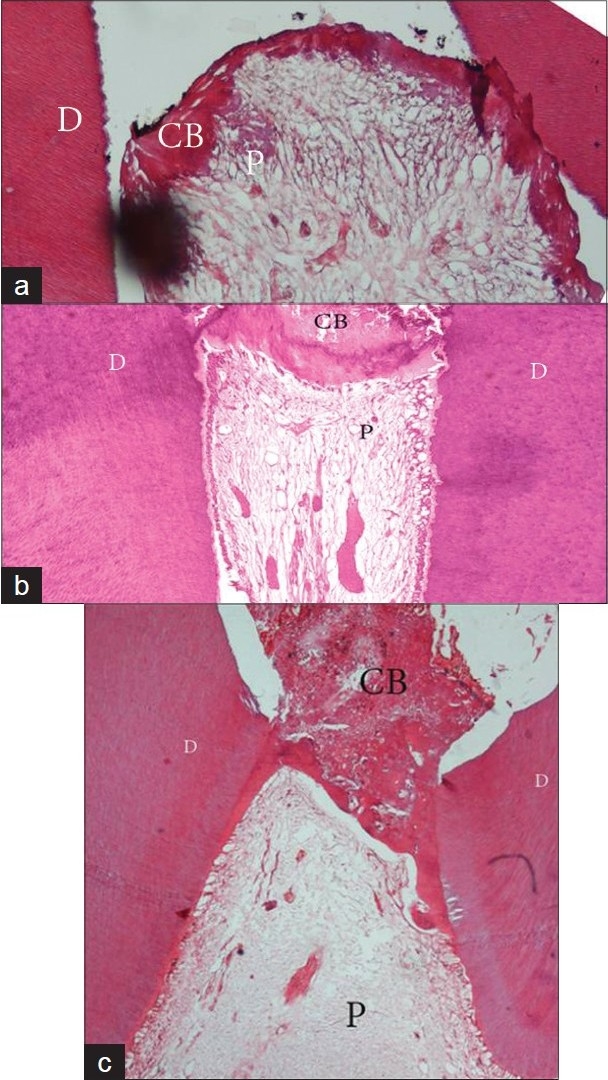
the calcified bridge in teeth that were capped with GMTA was significantly thicker than Dycal at 30 and 60 days (P= 0.015 and P=0.002, respectively); whereas WMTA showed significantly thicker calcified bridge than Dycal at 90 days (P=0.02). In addition, GMTA specimens showed significantly less inflammation compared to Dycal samples at 90 days interval (P=0.019). No significant difference was found between GMTA and WMTA in terms of calcified bridge thickness and pulp inflammatory response to the capping materials (P>0.05).
Based on the result of this study, both types of MTA can be suggested as the materials of choice for direct pulp capping procedure instead of Dycal as hard setting calcium hydroxide cement.
活髓治疗一直被认为是外伤或龋齿暴露后保存牙髓的治疗选择之一。
研究人体牙髓对白色和灰色三氧化矿物凝聚体(WMTA、GMTA)以及Dycal(MTA)作为盖髓剂的反应。
人类志愿者参与了这项随机临床试验。
本研究针对90颗完整的人类上颌和下颌第一、二前磨牙进行。牙齿被随机分为三组,每组30颗。在局部麻醉下,暴露牙齿并用GMTA、WMTA或Dycal进行盖髓。30、60和90天后,每组提取10颗牙齿并制备用于组织学观察。
组织病理学数据通过χ²检验、Kruskal Wallis检验和Mann Whitney检验进行分析。
在30天和60天时,用GMTA盖髓的牙齿中钙化桥明显比Dycal厚(分别为P = 0.015和P = 0.002);而在90天时,WMTA显示钙化桥比Dycal明显更厚(P = 0.02)。此外,在90天的间隔期,GMTA标本与Dycal样本相比炎症明显更少(P = 0.019)。在钙化桥厚度和牙髓对盖髓材料的炎症反应方面,GMTA和WMTA之间未发现显著差异(P>0.05)。
基于本研究结果,两种类型的MTA都可被建议作为直接盖髓术的首选材料,而非作为硬固化氢氧化钙水门汀的Dycal。