
溶菌酶对中性粒细胞功能的调节。炎症的潜在负反馈系统。
Modulation of neutrophil function by lysozyme. Potential negative feedback system of inflammation.
作者信息
Gordon L I, Douglas S D, Kay N E, Yamada O, Osserman E F, Jacob H S
出版信息
J Clin Invest. 1979 Jul;64(1):226-32. doi: 10.1172/JCI109443.
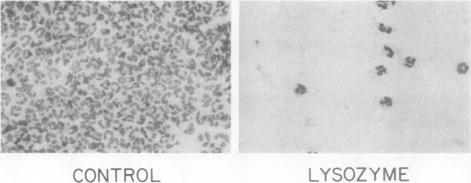
Host responses to infectious organisms should be modulated so that tissue-damaging products of inflammatory cells do not produce excessive destruction of normal tissue. Lysozyme, which is continuously secreted by monocytes, which, in turn, migrate relatively late to inflammatory areas, was found to significantly dampen several responses of neutrophils to inflammatory stimulants. Thus, human lysozyme obtained and purified from the urine of patients with monocytic leukemia (but not its structurally similar and comparably cationic analogue, eggwhite lysozyme) depresses chemotaxis of normal neutrophils to activated complement, bacterial supernate, and N-formylmethionyl-phenylalanine. In addition, human (but not eggwhite) lysozyme depresses oxidative metabolism (hexose monophosphate shunt activity) and superoxide generation of neutrophils. The specificity of the suppressive effects was indicated by inhibition studies with rabbit antihuman lysozyme antibody, and with the trisaccharide of N-acetylglucosamine, a specific inhibitor of lysozyme. The results suggest that lysozyme, a product of inflammatory cells themselves, may function in a negative feedback system to modulate the inflammatory response.
宿主对感染性生物体的反应应得到调节,以使炎性细胞的组织损伤产物不会对正常组织造成过度破坏。溶菌酶由单核细胞持续分泌,而单核细胞相对较晚迁移至炎症区域,研究发现它能显著抑制中性粒细胞对炎症刺激物的多种反应。因此,从单核细胞白血病患者尿液中获取并纯化得到的人溶菌酶(而非其结构相似且具有相当阳离子性的类似物蛋清溶菌酶)可抑制正常中性粒细胞对活化补体、细菌上清液和N-甲酰甲硫氨酰-苯丙氨酸的趋化作用。此外,人溶菌酶(而非蛋清溶菌酶)可抑制中性粒细胞的氧化代谢(磷酸己糖旁路活性)和超氧化物生成。用兔抗人溶菌酶抗体以及溶菌酶的特异性抑制剂N-乙酰葡糖胺三糖进行的抑制研究表明了抑制作用的特异性。结果表明,溶菌酶作为炎性细胞自身的产物,可能在负反馈系统中发挥作用,调节炎症反应。

 Zotero 插件