Division of Gastroenterology, Massachusetts General Hospital and Harvard Medical School, Boston, Massachusetts 02214, USA.
Gastroenterology. 2012 Mar;142(3):482-9. doi: 10.1053/j.gastro.2011.11.040. Epub 2011 Dec 9.
BACKGROUND & AIMS: Vitamin D influences innate immunity, which is believed to be involved in the pathogenesis of Crohn's disease (CD) and ulcerative colitis (UC). However, data examining vitamin D status in relation to risk of CD and UC are lacking.
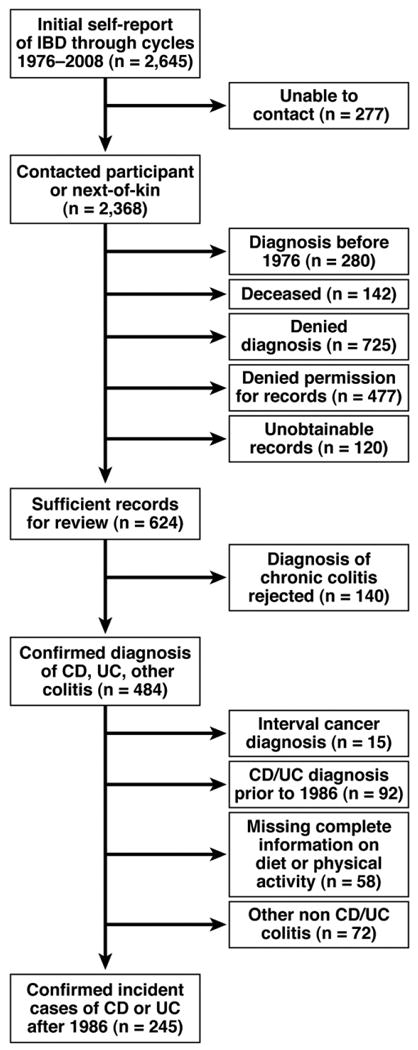
We conducted a prospective cohort study of 72,719 women (age, 40-73 y) enrolled in the Nurses' Health Study. In 1986, women completed an assessment of diet and lifestyle, from which a 25-hydroxy vitamin D [25(OH)D] prediction score was developed and validated against directly measured levels of plasma 25(OH)D. Through 2008, we confirmed reported diagnoses of incident CD or UC through medical record review. We used Cox proportional hazards modeling to examine the hazard ratio (HR) for incident CD or UC after adjusting for potential confounders.
During 1,492,811 person-years of follow-up evaluation, we documented 122 incident cases of CD and 123 cases of UC. The median predicted 25(OH)D level was 22.3 ng/mL in the lowest and 32.2 ng/mL in the highest quartiles. Compared with the lowest quartile, the multivariate-adjusted HR associated with the highest quartile of vitamin D was 0.54 (95% confidence interval [CI], 0.30-.99) for CD (P(trend) = .02) and 0.65 (95% CI, 0.34-1.25) for UC (P(trend) = .17). Compared with women with a predicted 25(OH)D level less than 20 ng/mL, the multivariate-adjusted HR was 0.38 (95% CI, 0.15-0.97) for CD and 0.57 (95% CI, 0.19-1.70) for UC for women with a predicted 25(OH)D level greater than 30 ng/mL. There was a significant inverse association between dietary and supplemental vitamin D and UC, and a nonsignificant reduction in CD risk.
Higher predicted plasma levels of 25(OH)D significantly reduce the risk for incident CD and nonsignificantly reduce the risk for UC in women.
维生素 D 可影响先天免疫,而先天免疫被认为与克罗恩病(CD)和溃疡性结肠炎(UC)的发病机制有关。然而,目前尚缺乏评估维生素 D 状态与 CD 和 UC 风险之间关系的数据。
我们对 72719 名年龄在 40-73 岁的参加护士健康研究的女性进行了前瞻性队列研究。1986 年,女性完成了饮食和生活方式评估,由此开发并验证了 25-羟维生素 D [25(OH)D] 预测评分与血浆 25(OH)D 直接测量水平的相关性。通过 2008 年,我们通过病历审查确认了报告的 CD 或 UC 新发病例的诊断。我们使用 Cox 比例风险模型来检验潜在混杂因素调整后 CD 或 UC 新发病例的风险比(HR)。
在 1492811 人年的随访评估期间,我们记录了 122 例 CD 和 123 例 UC 新发病例。最低和最高四分位数的中位预测 25(OH)D 水平分别为 22.3ng/ml 和 32.2ng/ml。与最低四分位数相比,维生素 D 最高四分位数与 CD 相关的多变量调整 HR 为 0.54(95%置信区间 [CI],0.30-0.99)(P 趋势=.02),与 UC 相关的 HR 为 0.65(95%CI,0.34-1.25)(P 趋势=.17)。与预测 25(OH)D 水平<20ng/ml 的女性相比,预测 25(OH)D 水平>30ng/ml 的女性发生 CD 的多变量调整 HR 为 0.38(95%CI,0.15-0.97),UC 为 0.57(95%CI,0.19-1.70)。饮食和补充维生素 D 与 UC 呈显著负相关,而 CD 风险则无显著降低。
较高的预测血浆 25(OH)D 水平可显著降低女性 CD 和 UC 的发病风险。