Norwegian Centre for Integrated Care and Telemedicine, University Hospital of North Norway, Tromsø, Norway.
Glob Health Action. 2011;4. doi: 10.3402/gha.v4i0.7214. Epub 2011 Dec 6.
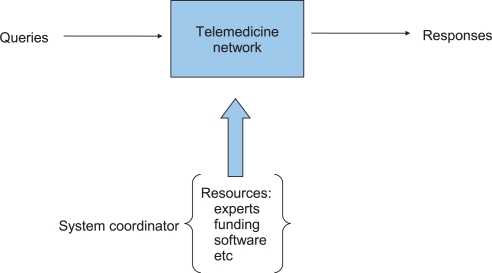
Telemedicine has been used for many years to support doctors in the developing world. Several networks provide services in different settings and in different ways. However, to draw conclusions about which telemedicine networks are successful requires a method of evaluating them. No general consensus or validated framework exists for this purpose.
To define a basic method of performance measurement that can be used to improve and compare teleconsultation networks; to employ the proposed framework in an evaluation of three existing networks; to make recommendations about the future implementation and follow-up of such networks.
Analysis based on the experience of three telemedicine networks (in operation for 7-10 years) that provide services to doctors in low-resource settings and which employ the same basic design.
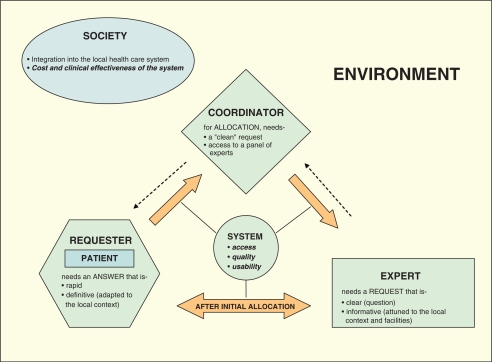
Although there are many possible indicators and metrics that might be relevant, five measures for each of the three user groups appear to be sufficient for the proposed framework. In addition, from the societal perspective, information about clinical- and cost-effectiveness is also required. The proposed performance measurement framework was applied to three mature telemedicine networks. Despite their differences in terms of activity, size and objectives, their performance in certain respects is very similar. For example, the time to first reply from an expert is about 24 hours for each network. Although all three networks had systems in place to collect data from the user perspective, none of them collected information about the coordinator's time required or about ease of system usage. They had only limited information about quality and cost.
Measuring the performance of a telemedicine network is essential in understanding whether the network is working as intended and what effect it is having. Based on long-term field experience, the suggested framework is a practical tool that will permit organisations to assess the performance of their own networks and to improve them by comparison with others. All telemedicine systems should provide information about setup and running costs because cost-effectiveness is crucial for sustainability.
远程医疗已经使用了多年,以支持发展中国家的医生。有几个网络在不同的环境中以不同的方式提供服务。然而,要得出关于哪些远程医疗网络是成功的结论,需要有一种评估它们的方法。目前还没有为此目的而达成的共识或经过验证的框架。
定义一种基本的绩效衡量方法,可用于改进和比较远程咨询网络;在对三个现有网络的评估中使用拟议框架;就这些网络的未来实施和后续行动提出建议。
基于三个远程医疗网络(运营 7-10 年)的经验进行分析,这些网络为资源匮乏环境中的医生提供服务,并采用相同的基本设计。
尽管可能有许多相关的指标和指标,但对于所提出的框架,每个用户组似乎有五个措施就足够了。此外,从社会角度来看,还需要有关临床和成本效益的信息。所提出的绩效衡量框架应用于三个成熟的远程医疗网络。尽管它们在活动、规模和目标方面存在差异,但它们在某些方面的表现非常相似。例如,每个网络的专家首次回复的时间约为 24 小时。尽管所有三个网络都有从用户角度收集数据的系统,但没有一个网络收集有关协调员所需时间或系统易用性的信息。它们只有关于质量和成本的有限信息。
衡量远程医疗网络的性能对于了解网络是否按预期运行以及它产生了什么影响至关重要。基于长期的实地经验,建议的框架是一个实用的工具,它将使组织能够评估自己网络的性能,并通过与其他网络进行比较来改进它们。所有远程医疗系统都应提供有关设置和运行成本的信息,因为成本效益对于可持续性至关重要。