Chemistry Laboratory, Agricultural University of Athens, 75 Iera Odos, 118 55 Athens, Greece.
Sensors (Basel). 2010;10(8):7089-98. doi: 10.3390/s100807089. Epub 2010 Jul 27.
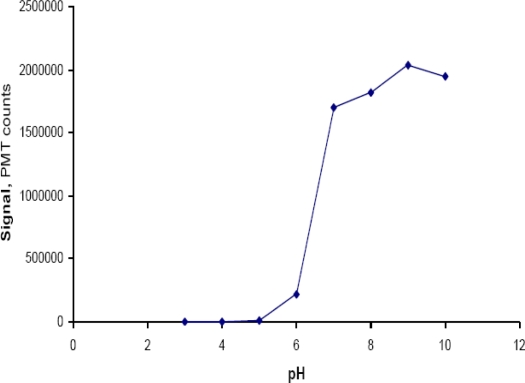
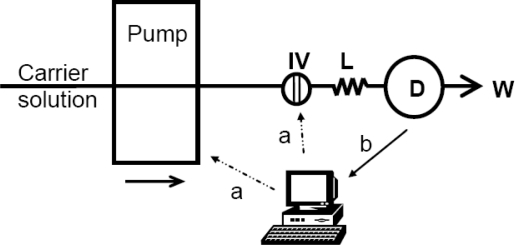
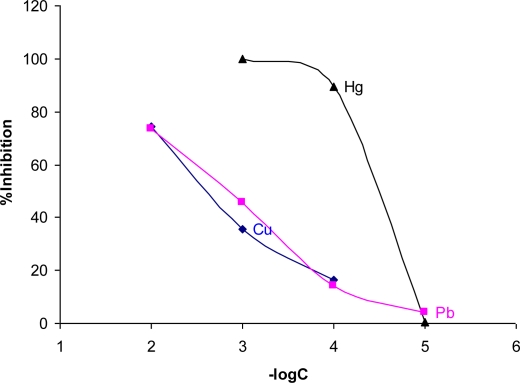
This paper describes the development of an automated Flow Injection analyzer for water toxicity assessment. The analyzer is validated by assessing the toxicity of heavy metal (Pb(2+), Hg(2+) and Cu(2+)) solutions. One hundred μL of a Vibrio fischeri suspension are injected in a carrier solution containing different heavy metal concentrations. Biosensor cells are mixed with the toxic carrier solution in the mixing coil on the way to the detector. Response registered is % inhibition of biosensor bioluminescence due to heavy metal toxicity in comparison to that resulting by injecting the Vibrio fischeri suspension in deionised water. Carrier solutions of mercury showed higher toxicity than the other heavy metals, whereas all metals show concentration related levels of toxicity. The biosensor's response to carrier solutions of different pHs was tested. Vibrio fischeri's bioluminescence is promoted in the pH 5-10 range. Experiments indicate that the whole cell biosensor, as applied in the automated fluidic system, responds to various toxic solutions.
本文介绍了一种用于水质毒性评估的自动化流动注射分析仪的开发。该分析仪通过评估重金属(Pb(2+)、Hg(2+)和 Cu(2+))溶液的毒性进行验证。将 100μL 发光菌悬液注入含有不同重金属浓度的载液中。在混合线圈中,生物传感器细胞与有毒载液混合,然后流至检测器。与将发光菌悬液注入去离子水相比,记录的响应是重金属毒性对生物传感器生物发光的抑制百分比。汞的载液显示出比其他重金属更高的毒性,而所有金属都显示出与浓度相关的毒性水平。测试了生物传感器对不同 pH 值载液的响应。发光菌的生物发光在 pH 值 5-10 范围内得到促进。实验表明,应用于自动化流体系统的全细胞生物传感器对各种有毒溶液有响应。