Phenomena Wave Group, Electronic Engineering Department, Universitat Politècnica de València, Spain.
Sensors (Basel). 2011;11(5):4702-20. doi: 10.3390/s110504702. Epub 2011 Apr 28.
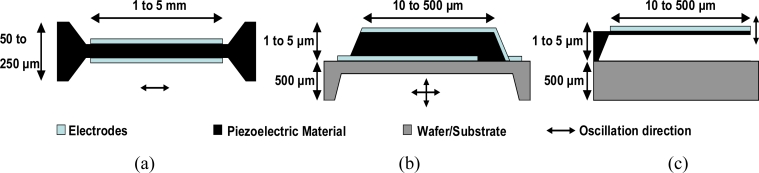
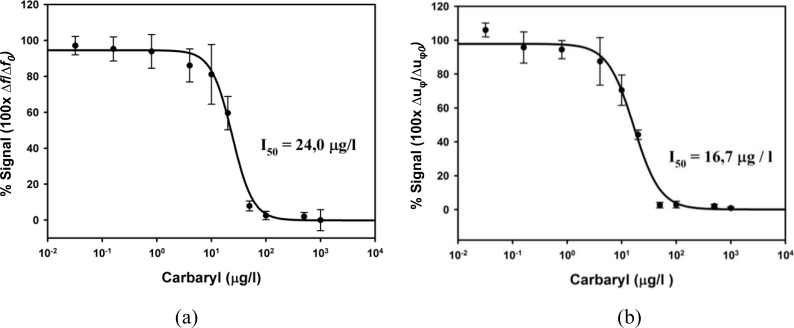
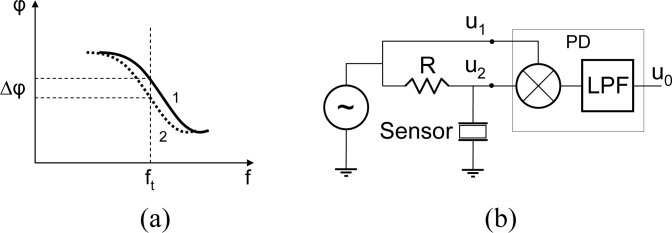
Acoustic wave resonator techniques are widely used in in-liquid biochemical applications. The main challenges remaining are the improvement of sensitivity and limit of detection, as well as multianalysis capabilities and reliability. The sensitivity improvement issue has been addressed by increasing the sensor frequency, using different techniques such as high fundamental frequency quartz crystal microbalances (QCMs), surface generated acoustic waves (SGAWs) and film bulk acoustic resonators (FBARs). However, this sensitivity improvement has not been completely matched in terms of limit of detection. The decrease on frequency stability due to the increase of the phase noise, particularly in oscillators, has made it impossible to increase the resolution. A new concept of sensor characterization at constant frequency has been recently proposed based on the phase/mass sensitivity equation: Δφ/Δm ≈ -1/m(L), where m(L) is the liquid mass perturbed by the resonator. The validation of the new concept is presented in this article. An immunosensor application for the detection of a low molecular weight pollutant, the insecticide carbaryl, has been chosen as a validation model.
声波谐振器技术在液体生化分析中得到了广泛的应用。目前主要面临的挑战是提高灵敏度和检测限,以及实现多分析能力和可靠性。通过提高传感器的频率,使用不同的技术,如高频石英晶体微天平(QCM)、表面声波(SGAW)和薄膜体声波谐振器(FBAR),已经解决了灵敏度提高的问题。然而,在检测限方面,这种灵敏度的提高并没有得到完全匹配。由于相位噪声的增加,频率稳定性的下降,特别是在振荡器中,使得分辨率无法提高。最近,基于相位/质量灵敏度方程,提出了一种新的传感器在恒定频率下的特性描述概念:Δφ/Δm ≈ -1/m(L),其中 m(L) 是被谐振器扰动的液体质量。本文对新概念进行了验证。选择了一种用于检测低分子量污染物——杀虫剂西维因的免疫传感器应用作为验证模型。