Georgy Ehab E
Faculty of Physiotherapy, Cairo University, Cairo, Egypt.
Asian Spine J. 2011 Dec;5(4):201-7. doi: 10.4184/asj.2011.5.4.201. Epub 2011 Nov 28.
A control group cross-sectional design.
To compare the difference in repositioning accuracy, as a measure of lumbar proprioception, between patients with back dysfunction and healthy subjects.
Evidence suggests that spinal stability might be compromised in patients with back dysfunction. Lumbar proprioception in back dysfunction has not, however, been adequately investigated.
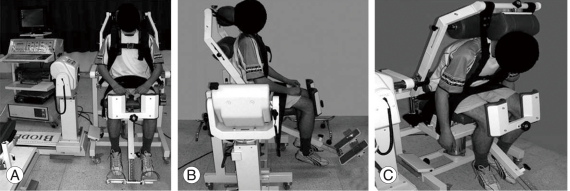
Forty-five participants, representing three groups, took part in the study. Subjects in group one (n = 15) were healthy subjects. Subjects in group two (n = 15) had a history of non-specific mechanical back dysfunction, while subjects in group three (n = 15) had discogenic back dysfunction. Subjects were required to reproduce a target position of 30° lumbar flexion and the absolute error (AE) was calculated.
The AEs between target and reproduced positions were calculated. The average repositioning AEs were 2.8, 7.5, and 7.1° for the control, mechanical, and discogenic back dysfunction groups respectively. Analysis of variance revealed significant difference between the three groups (p < 0.0002). The AEs were greater in the two back dysfunction groups compared to the control group. Post-hoc tests revealed significant difference in AEs between the control and mechanical group (p < 0.0003), and discogenic group (p < 0.0001), while there was no significant difference between the mechanical and discogenic back dysfunction groups (p = 0.73).
Differences in proprioception do exist between subjects with back dysfunction and normal subjects. The proprioceptive deficits do exist regardless of the cause of the back dysfunction, and may represent an important aspect of the patho-physiology of such a condition.
对照组横断面设计。
比较背部功能障碍患者与健康受试者之间在重新定位准确性(作为腰椎本体感觉的一种衡量指标)方面的差异。
有证据表明,背部功能障碍患者的脊柱稳定性可能受损。然而,背部功能障碍患者的腰椎本体感觉尚未得到充分研究。
45名参与者代表三组参与了该研究。第一组(n = 15)的受试者为健康受试者。第二组(n = 15)的受试者有非特异性机械性背部功能障碍病史,而第三组(n = 15)的受试者有椎间盘源性背部功能障碍。要求受试者重现30°腰椎前屈的目标位置,并计算绝对误差(AE)。
计算目标位置与重现位置之间的AE。对照组、机械性背部功能障碍组和椎间盘源性背部功能障碍组的平均重新定位AE分别为2.8°、7.5°和7.1°。方差分析显示三组之间存在显著差异(p < 0.0002)。与对照组相比,两个背部功能障碍组的AE更大。事后检验显示对照组与机械性背部功能障碍组(p < 0.0003)和椎间盘源性背部功能障碍组(p < 0.0001)之间的AE存在显著差异,而机械性背部功能障碍组与椎间盘源性背部功能障碍组之间无显著差异(p = 0.73)。
背部功能障碍受试者与正常受试者之间确实存在本体感觉差异。无论背部功能障碍的原因如何,本体感觉缺陷确实存在,并且可能代表了这种病症病理生理学的一个重要方面。