Biomedical Sciences Research Complex, University of St Andrews, North Haugh, St Andrews, Fife KY16 9ST, UK.
Biochem J. 2012 Feb 15;442(1):77-84. doi: 10.1042/BJ20111903.
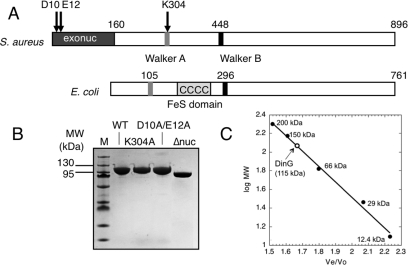
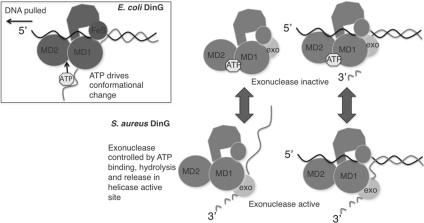
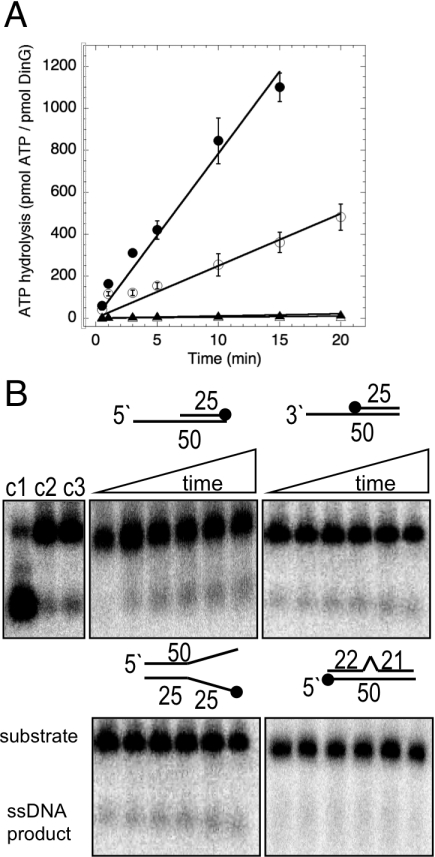
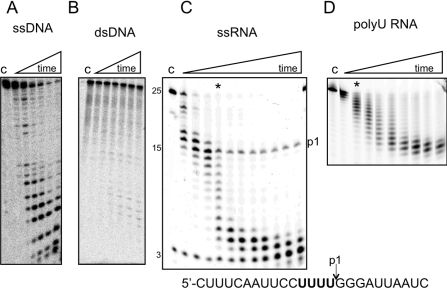
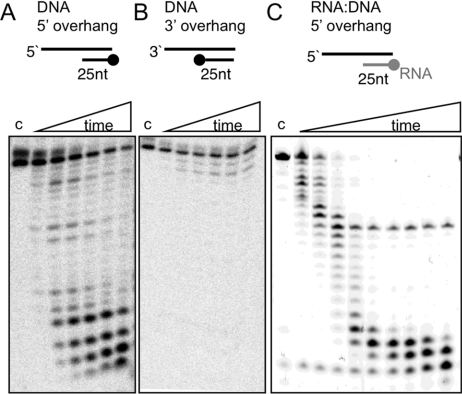
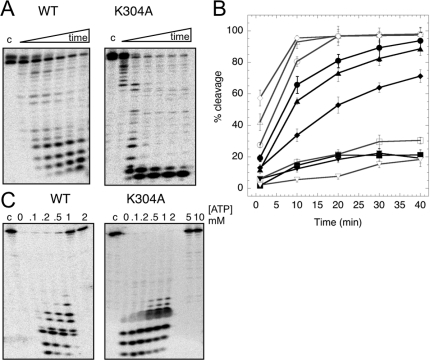
DinG (damage inducible gene G) is a bacterial superfamily 2 helicase with 5′→3′ polarity. DinG is related to the XPD (xeroderma pigmentosum complementation group D) helicase family, and they have in common an FeS (iron–sulfur)-binding domain that is essential for the helicase activity. In the bacilli and clostridia, the DinG helicase has become fused with an N-terminal domain that is predicted to be an exonuclease. In the present paper we show that the DinG protein from Staphylococcus aureus lacks an FeS domain and is not a DNA helicase, although it retains DNA-dependent ATP hydrolysis activity. Instead, the enzyme is an active 3′→5′ exonuclease acting on single-stranded DNA and RNA substrates. The nuclease activity can be modulated by mutation of the ATP-binding cleft of the helicase domain, and is inhibited by ATP or ADP, suggesting a modified role for the inactive helicase domain in the control of the nuclease activity. By degrading rather than displacing RNA or DNA strands, the S. aureus DinG nuclease may accomplish the same function as the canonical DinG helicase.
DinG(损伤诱导基因 G)是一种具有 5'→3'极性的细菌超家族 2 解旋酶。DinG 与 XPD(着色性干皮病互补组 D)解旋酶家族有关,它们共同具有一个 FeS(铁-硫)结合域,该域对于解旋酶活性是必需的。在芽孢杆菌和梭菌中,DinG 解旋酶与预测为外切核酸酶的 N 端结构域融合。在本文中,我们表明金黄色葡萄球菌的 DinG 蛋白缺乏 FeS 结构域,不是 DNA 解旋酶,尽管它保留了依赖 DNA 的 ATP 水解活性。相反,该酶是一种具有活性的 3'→5'外切核酸酶,可作用于单链 DNA 和 RNA 底物。核酸酶活性可通过突变解旋酶结构域的 ATP 结合裂缝来调节,并且受到 ATP 或 ADP 的抑制,这表明无活性的解旋酶结构域在控制核酸酶活性方面具有修饰作用。通过降解而不是置换 RNA 或 DNA 链,金黄色葡萄球菌 DinG 核酸酶可能完成与规范的 DinG 解旋酶相同的功能。