Department of Microbiology, Gdańsk University of Technology, Narutowicza 11/12, Gdańsk, Poland.
Microb Cell Fact. 2011 Dec 13;10:108. doi: 10.1186/1475-2859-10-108.
β-D-Galactosidases (EC 3.2.1.23) catalyze the hydrolysis of terminal non-reducing β-D-galactose residues in β-D-galactosides. Cold-active β-D-galactosidases have recently become a focus of attention of researchers and dairy product manufactures owing to theirs ability to: (i) eliminate of lactose from refrigerated milk for people afflicted with lactose intolerance, (ii) convert lactose to glucose and galactose which increase the sweetness of milk and decreases its hydroscopicity, and (iii) eliminate lactose from dairy industry pollutants associated with environmental problems. Moreover, in contrast to commercially available mesophilic β-D-galactosidase from Kluyveromyces lactis the cold-active counterparts could make it possible both to reduce the risk of mesophiles contamination and save energy during the industrial process connected with lactose hydrolysis.
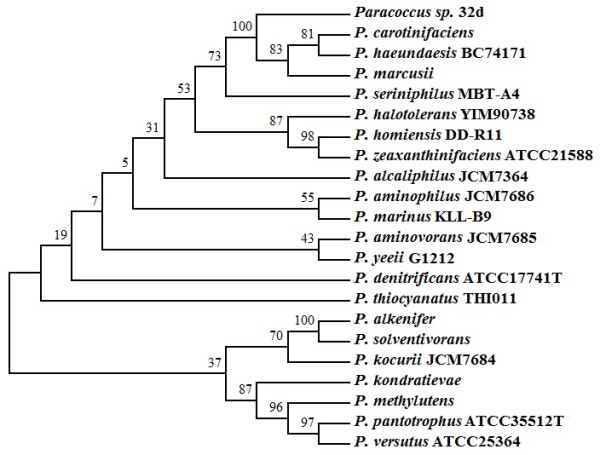
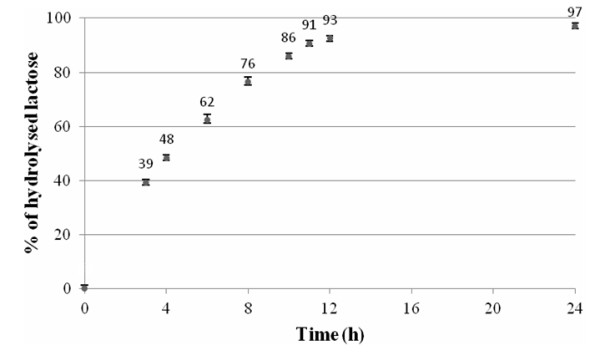
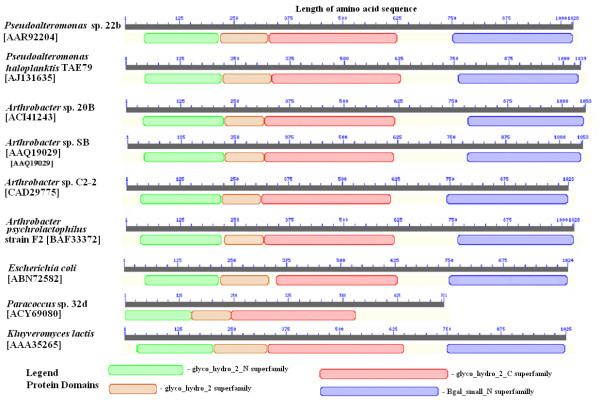
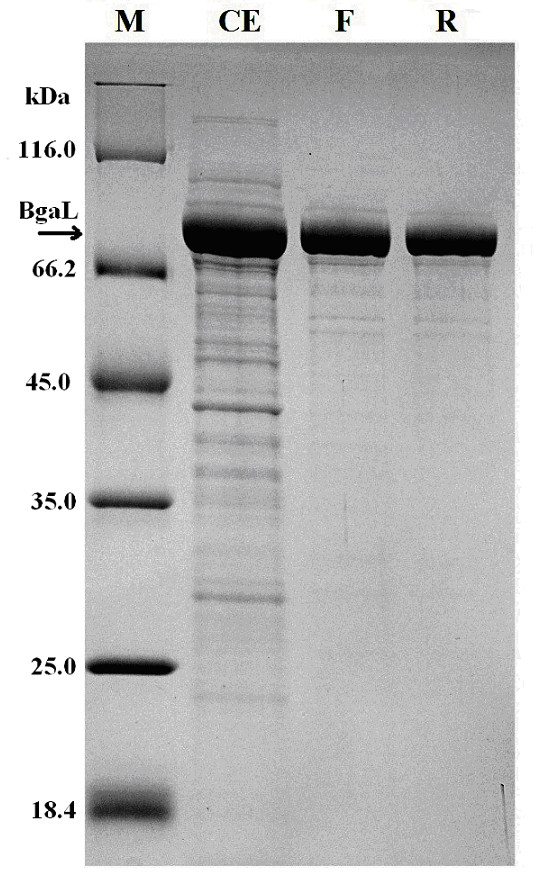
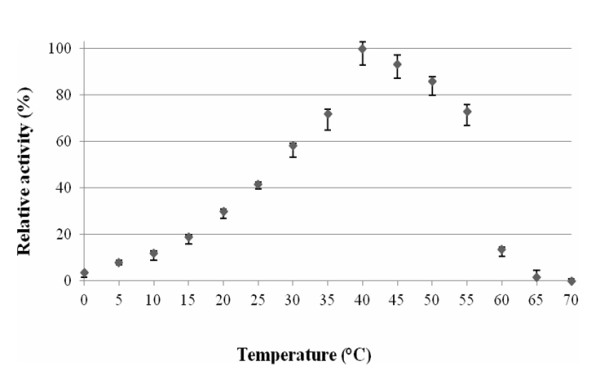
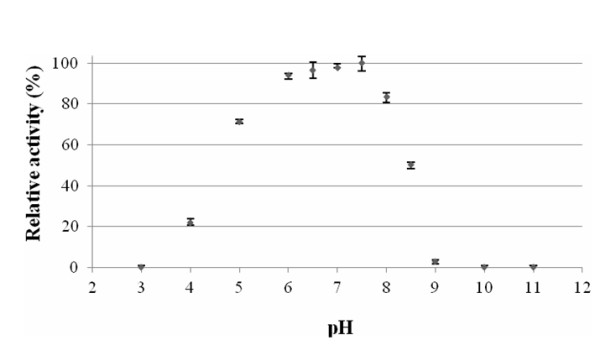
A genomic DNA library was constructed from soil bacterium Paracoccus sp. 32d. Through screening of the genomic DNA library on LB agar plates supplemented with X-Gal, a novel gene encoding a cold-active β-D-galactosidase was isolated. The in silico analysis of the enzyme amino acid sequence revealed that the β-D-galactosidase Paracoccus sp. 32d is a novel member of Glycoside Hydrolase Family 2. However, owing to the lack of a BGal_small_N domain, the domain characteristic for the LacZ enzymes of the GH2 family, it was decided to call the enzyme under study 'BgaL'. The bgaL gene was cloned and expressed in Escherichia coli using the pBAD Expression System. The purified recombinant BgaL consists of two identical subunits with a combined molecular weight of about 160 kDa. The BgaL was optimally active at 40°C and pH 7.5. Moreover, BgaL was able to hydrolyze both lactose and o-nitrophenyl-β-D-galactopyranoside at 10°C with Km values of 2.94 and 1.17 mM and kcat values 43.23 and 71.81 s-1, respectively. One U of the recombinant BgaL would thus be capable hydrolyzing about 97% of the lactose in 1 ml of milk in 24 h at 10°C.
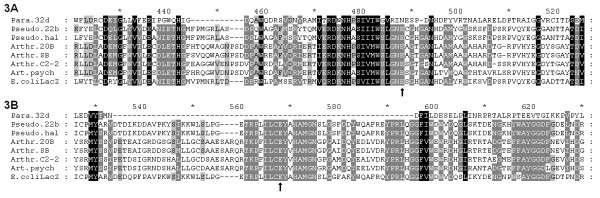
A novel bgaL gene was isolated from Paracoccus sp. 32d encoded a novel cold-active β-D-galactosidase. An E. coli expression system has enabled efficient production of soluble form of BgaL Paracoccus sp. 32d. The amino acid sequence analysis of the BgaL enzyme revealed notable differences in comparison to the result of the amino acid sequences analysis of well-characterized cold-active β-D-galactosidases belonging to Glycoside Hydrolase Family 2. Finally, the enzymatic properties of Paracoccus sp. 32d β-D-galactosidase shows its potential for being applied to development of a new industrial biocatalyst for efficient lactose hydrolysis in milk.
β-D-半乳糖苷酶(EC 3.2.1.23)催化β-D-半乳糖苷中末端非还原β-D-半乳糖残基的水解。由于其能够:(i)消除乳糖不耐受人群冷藏牛奶中的乳糖,(ii)将乳糖转化为葡萄糖和半乳糖,从而增加牛奶的甜度并降低其吸湿性,以及(iii)消除与环境问题相关的乳制品行业污染物中的乳糖,因此,低温β-D-半乳糖苷酶最近成为研究人员和乳制品制造商关注的焦点。此外,与商业上可获得的来自乳糖乳球菌的嗜温β-D-半乳糖苷酶相比,低温活性对应物可以降低嗜温菌污染的风险,并在与乳糖水解相关的工业过程中节省能源。
从土壤细菌副球菌属 32d 中构建了基因组 DNA 文库。通过在补充有 X-Gal 的 LB 琼脂平板上筛选基因组 DNA 文库,分离到一个编码低温活性β-D-半乳糖苷酶的新基因。对酶氨基酸序列的计算机分析表明,副球菌属 32d 的β-D-半乳糖苷酶是糖苷水解酶家族 2 的新成员。然而,由于缺乏 GH2 家族 LacZ 酶特有的 BGal_small_N 结构域,因此决定将研究中的酶称为“BgaL”。使用 pBAD 表达系统在大肠杆菌中克隆和表达了 bgaL 基因。纯化的重组 BgaL 由两个相同的亚基组成,分子量约为 160 kDa。BgaL 的最适活性温度为 40°C,最适 pH 为 7.5。此外,BgaL 能够在 10°C 下水解乳糖和邻硝基苯-β-D-半乳糖吡喃糖苷,Km 值分别为 2.94 和 1.17 mM,kcat 值分别为 43.23 和 71.81 s-1。重组 BgaL 的 1 个单位能够在 10°C 下 24 小时内将 1 毫升牛奶中的乳糖水解约 97%。
从副球菌属 32d 中分离到一个新的 bgaL 基因,该基因编码一种新型低温活性β-D-半乳糖苷酶。大肠杆菌表达系统能够有效地生产可溶性形式的 BgaL 副球菌属 32d。BgaL 酶的氨基酸序列分析表明,与属于糖苷水解酶家族 2 的经过充分表征的低温活性β-D-半乳糖苷酶的氨基酸序列分析结果存在显著差异。最后,副球菌属 32dβ-D-半乳糖苷酶的酶学性质表明其在开发用于有效水解牛奶中乳糖的新型工业生物催化剂方面具有潜力。