Division of Neonatal Medicine, Department of Pediatrics, Federal University of São Paulo, Brazil.
Clinics (Sao Paulo). 2011;66(9):1597-603. doi: 10.1590/s1807-59322011000900016.
Prenatal tobacco exposure interferes with neonatal outcomes.
To determine the neonatal neurobehavioral effects of in utero tobacco exposure.
This prospective cross-sectional study included healthy, term, with birth weight appropriate for gestacional age neonates without exposure to alcohol, drugs, or infections, born to adolescent mothers without psychiatric disorders or post-traumatic stress. Infants were classified according to in utero tobacco exposure, as identified by the Composite International Diagnostic Interview administered to mothers. Neurobehavior was assessed by the Neonatal Intensive Care Unit Network Neurobehavioral Scale. Both tools were administered between 24 and 72 hours after birth. Neurobehavioral outcomes were compared between exposed and nonexposed infants by ANOVA. The associations between neurobehavioral scores and number of cigarettes smoked were studied by linear correlation.
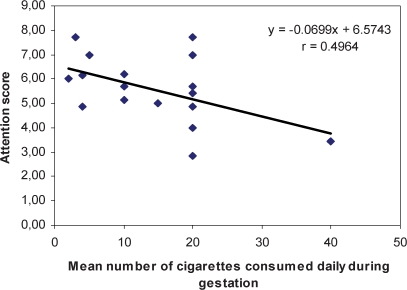
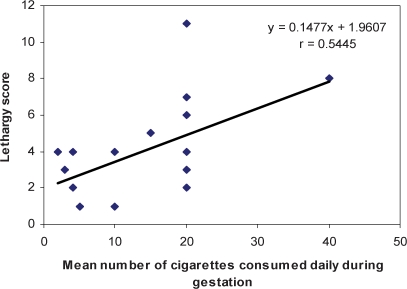
During the study, 928 newborns of adolescent mothers were born, and 388 were included in the study. Of these, 23 were exposed to tobacco, and 365 neonates were not exposed. There were no differences between the groups in gestational age, birth weight, post-natal age at the exam, or time between last feeding and exam. Exposed neonates showed higher scores on arousal (p = 0.004), excitability (p = 0.003), and stress/abstinence signals (p = 0.019) and a lower score on regulation (p = 0.025). After adjusting for the type of anesthesia, mode of delivery, gender, age at neurologic exam, exam duration and time between last feeding and exam, differences in arousal and excitability remained significant. The mean number of cigarettes consumed daily was positively correlated with lethargy (p = 0.013) and inversely with attention (p = 0.043).
Neonates exposed in utero to tobacco showed worse neurobehavioral performance between 24 and 48 hours of life.
产前烟草暴露会干扰新生儿结局。
确定宫内烟草暴露对新生儿神经行为的影响。
本前瞻性横断面研究纳入了健康、足月、出生体重与胎龄相符、无酒精、药物或感染暴露、无青少年母亲精神障碍或创伤后应激的新生儿。根据母亲接受的复合国际诊断访谈,将婴儿分为宫内烟草暴露组和非暴露组。通过新生儿重症监护病房网络神经行为量表评估神经行为。这两种工具均在出生后 24 至 72 小时内使用。采用方差分析比较暴露组和非暴露组婴儿的神经行为结果。采用线性相关研究神经行为评分与吸烟数量之间的关系。
在研究期间,共有 928 名青少年母亲分娩,其中 388 名纳入研究。其中 23 名婴儿暴露于烟草,365 名婴儿未暴露。两组在胎龄、出生体重、检查时的产后年龄、上次喂养与检查之间的时间等方面无差异。暴露组婴儿在觉醒(p=0.004)、兴奋(p=0.003)和应激/戒断信号(p=0.019)方面得分较高,而在调节(p=0.025)方面得分较低。在校正麻醉类型、分娩方式、性别、神经检查年龄、检查持续时间和上次喂养与检查之间的时间后,觉醒和兴奋方面的差异仍然显著。每日平均吸烟数量与嗜睡(p=0.013)呈正相关,与注意力(p=0.043)呈负相关。
宫内暴露于烟草的新生儿在出生后 24 至 48 小时的神经行为表现较差。