Department of Epidemiology, University of Alabama at Birmingham, School of Public Health, USA.
Lipids Health Dis. 2011 Dec 19;10:237. doi: 10.1186/1476-511X-10-237.
The presence of smaller low-density lipoproteins (LDL) has been associated with atherosclerosis risk, and the insulin resistance (IR) underlying the metabolic syndrome (MetS). In addition, some research has supported the association of very low-, low- and high-density lipoprotein (VLDL HDL) particle diameters with components of the metabolic syndrome (MetS), although this has been the focus of less research. We aimed to explore the relationship of VLDL, LDL and HDL diameters to MetS and its features, and by clustering individuals by their diameters of VLDL, LDL and HDL particles, to capture information across all three fractions of lipoprotein into a unified phenotype.
We used nuclear magnetic resonance spectroscopy measurements on fasting plasma samples from a general population sample of 1,036 adults (mean ± SD, 48.8 ± 16.2 y of age). Using latent class analysis, the sample was grouped by the diameter of their fasting lipoproteins, and mixed effects models tested whether the distribution of MetS components varied across the groups.
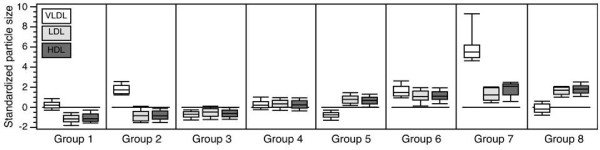
Eight discrete groups were identified. Two groups (N = 251) were enriched with individuals meeting criteria for the MetS, and were characterized by the smallest LDL/HDL diameters. One of those two groups, one was additionally distinguished by large VLDL, and had significantly higher blood pressure, fasting glucose, triglycerides, and waist circumference (WC; P < .001). However, large VLDL, in the absence of small LDL and HDL particles, did not associate with MetS features. These associations held after additionally controlling for VLDL, LDL and HDL particle concentrations.
While small LDL diameters remain associated with IR and the MetS, the occurrence of these in conjunction with a shift to overall larger VLDL diameter may identify those with the highest fasting glucose, TG and WC within the MetS. If replicated, the association of this phenotype with more severe IR-features indicated that it may contribute to identifying of those most at risk for incident type II diabetes and cardiometabolic disease.
较小的低密度脂蛋白(LDL)的存在与动脉粥样硬化风险有关,而代谢综合征(MetS)的胰岛素抵抗(IR)也是如此。此外,一些研究支持极低密度脂蛋白(VLDL)、低密度脂蛋白(LDL)和高密度脂蛋白(HDL)颗粒直径与代谢综合征(MetS)成分之间的关联,尽管这方面的研究较少。我们旨在探讨 VLDL、LDL 和 HDL 直径与 MetS 及其特征的关系,并通过对个体的 VLDL、LDL 和 HDL 颗粒直径进行聚类,将脂蛋白的所有三个部分的信息纳入一个统一的表型中。
我们使用核磁共振光谱法对 1036 名成年人(平均年龄 ± 标准差,48.8 ± 16.2 岁)的空腹血浆样本进行了测量。使用潜在类别分析,根据空腹脂蛋白的直径将样本分组,并使用混合效应模型测试 MetS 成分在各组中的分布是否存在差异。
确定了 8 个离散组。两组(N = 251)符合 MetS 标准,其 LDL/HDL 直径最小。其中一组的 VLDL 较大,且具有显著更高的血压、空腹血糖、甘油三酯和腰围(WC;P <.001)。然而,只有大 VLDL 而没有小 LDL 和 HDL 颗粒与 MetS 特征无关。这些关联在另外控制了 VLDL、LDL 和 HDL 颗粒浓度后仍然存在。
虽然 LDL 直径小仍然与 IR 和 MetS 相关,但如果同时存在这种情况,并伴有总体 VLDL 直径的增大,可能会识别出 MetS 中空腹血糖、TG 和 WC 最高的人群。如果得到复制,这种表型与更严重的 IR 特征的关联表明,它可能有助于识别出发生 II 型糖尿病和心血管代谢疾病风险最高的人群。