Department of Veterinary Population Medicine, College of Veterinary Medicine, University of Minnesota, 385 Animal Science/Veterinary Medicine building, 1988 Fitch Avenue, St Paul, MN 55108, USA.
Vet Res. 2011 Dec 20;42(1):120. doi: 10.1186/1297-9716-42-120.
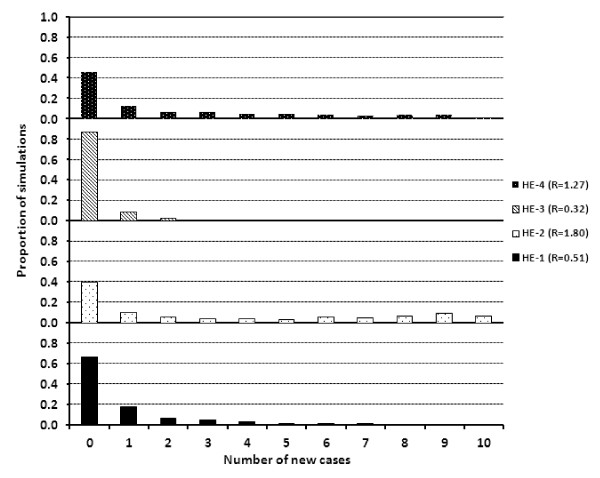
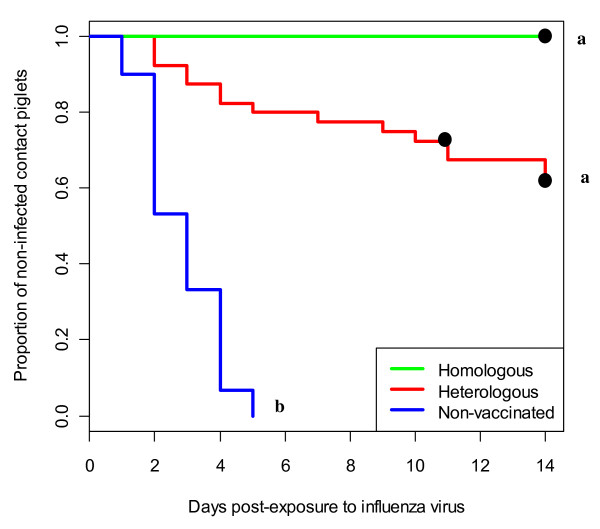
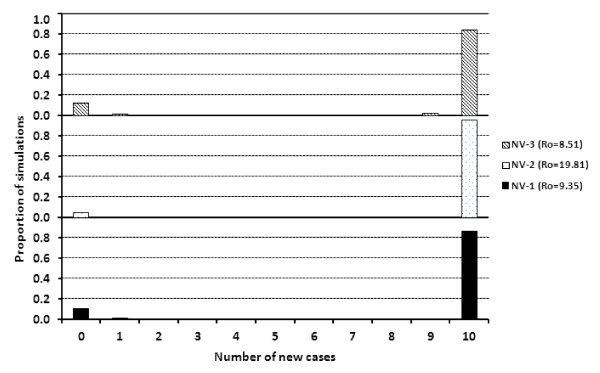
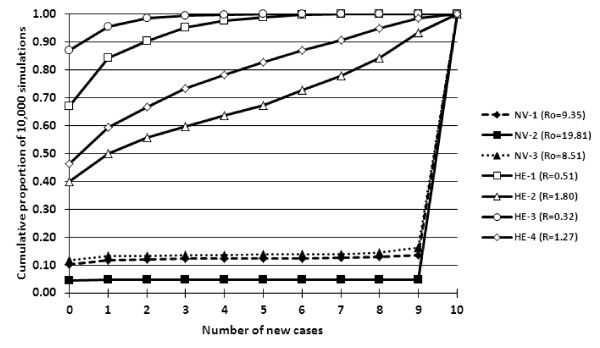
Limited information is available on the transmission and spread of influenza virus in pig populations with differing immune statuses. In this study we assessed differences in transmission patterns and quantified the spread of a triple reassortant H1N1 influenza virus in naïve and vaccinated pig populations by estimating the reproduction ratio (R) of infection (i.e. the number of secondary infections caused by an infectious individual) using a deterministic Susceptible-Infectious-Recovered (SIR) model, fitted on experimental data. One hundred and ten pigs were distributed in ten isolated rooms as follows: (i) non-vaccinated (NV), (ii) vaccinated with a heterologous vaccine (HE), and (iii) vaccinated with a homologous inactivated vaccine (HO). The study was run with multiple replicates and for each replicate, an infected non-vaccinated pig was placed with 10 contact pigs for two weeks and transmission of influenza evaluated daily by analyzing individual nasal swabs by RT-PCR. A statistically significant difference between R estimates was observed between vaccinated and non-vaccinated pigs (p < 0.05). A statistically significant reduction in transmission was observed in the vaccinated groups where R (95%CI) was 1 (0.39-2.09) and 0 for the HE and the HO groups respectively, compared to an Ro value of 10.66 (6.57-16.46) in NV pigs (p < 0.05). Transmission in the HE group was delayed and variable when compared to the NV group and transmission could not be detected in the HO group. Results from this study indicate that influenza vaccines can be used to decrease susceptibility to influenza infection and decrease influenza transmission.
关于具有不同免疫状态的猪群中流感病毒的传播和扩散,可用的信息有限。在这项研究中,我们通过使用确定性易感性-感染-恢复(SIR)模型来评估不同的传播模式,并通过估计感染的繁殖率(R)(即一个感染个体引起的二次感染数量)来量化三重重配 H1N1 流感病毒在未接种和接种疫苗的猪群中的传播,该模型是根据实验数据拟合的。110 头猪被分配到 10 个隔离房间中,如下所示:(i)未接种(NV),(ii)用异源疫苗(HE)接种,和(iii)用同源灭活疫苗(HO)接种。该研究进行了多次重复,对于每次重复,将一只感染的未接种疫苗的猪与 10 只接触猪放在一起两周,并通过分析个体鼻拭子的 RT-PCR 每天评估流感的传播。在接种疫苗和未接种疫苗的猪之间观察到 R 估计值存在统计学显著差异(p < 0.05)。在接种疫苗的组中观察到传播显著减少,其中 R(95%CI)分别为 1(0.39-2.09)和 0,而在 NV 猪中 Ro 值为 10.66(6.57-16.46)(p < 0.05)。与 NV 组相比,HE 组的传播延迟且变化不定,而在 HO 组中则无法检测到传播。这项研究的结果表明,流感疫苗可用于降低流感感染的易感性并减少流感的传播。