Department of Surgical Sciences, Orthopedics, Uppsala University, Uppsala, Sweden.
J Bone Miner Res. 2012 Apr;27(4):797-807. doi: 10.1002/jbmr.1498.
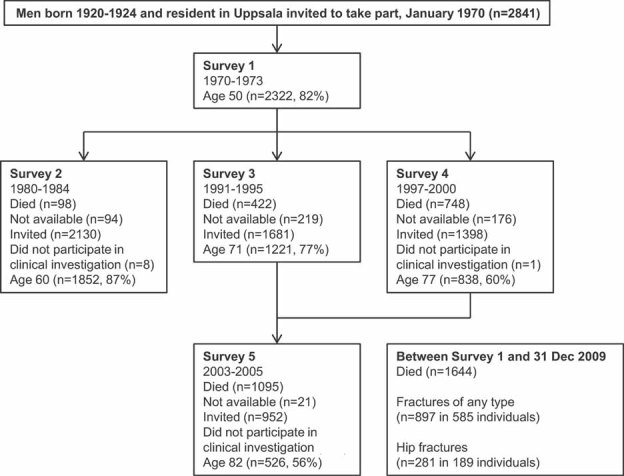
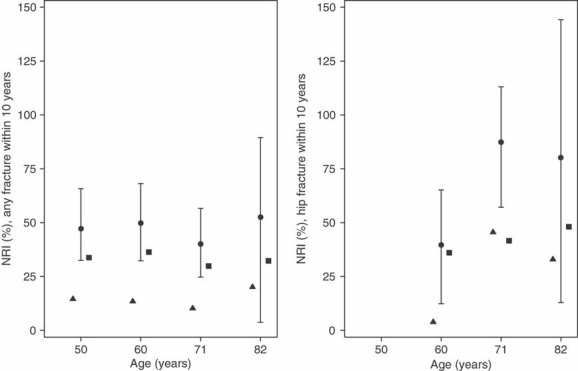
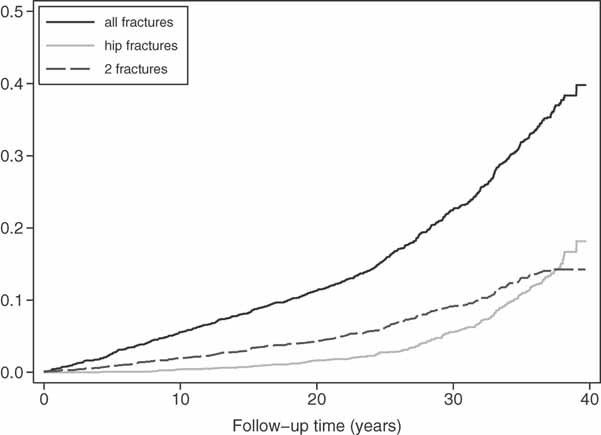
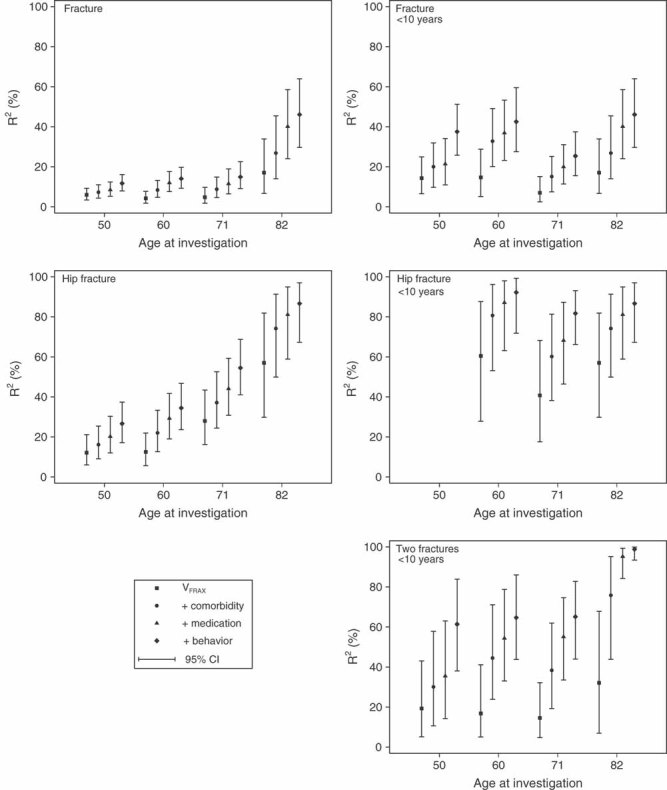
FRAX is a tool that identifies individuals with high fracture risk who will benefit from pharmacological treatment of osteoporosis. However, a majority of fractures among elderly occur in people without osteoporosis and most occur after a fall. Our aim was to accurately identify men with a high future risk of fracture, independent of cause. In the population-based Uppsala Longitudinal Study of Adult Men (ULSAM) and using survival analysis we studied different models' prognostic values (R(2)) for any fracture and hip fracture within 10 years from age 50 (n = 2322), 60 (n = 1852), 71 (n = 1221), and 82 (n = 526) years. During the total follow-up period from age 50 years, 897 fractures occurred in 585 individuals. Of these, 281 were hip fractures occurring in 189 individuals. The rates of any fracture were 5.7/1000 person-years at risk from age 50 years and 25.9/1000 person-years at risk from age 82 years. Corresponding hip fractures rates were 2.9 and 11.7/1000 person-years at risk. The FRAX model included all variables in FRAX except bone mineral density. The full model combining FRAX variables, comorbidity, medications, and behavioral factors explained 25% to 45% of all fractures and 80% to 92% of hip fractures, depending on age. The corresponding prognostic values of the FRAX model were 7% to 17% for all fractures and 41% to 60% for hip fractures. Net reclassification improvement (NRI) comparing the full model with the FRAX model ranged between 40% and 53% for any fracture and between 40% and 87% for hip fracture. Within the highest quintile of predicted fracture risk with the full model, one-third of the men will have a fracture within 10 years after age 71 years and two-thirds after age 82 years. We conclude that the addition of comorbidity, medication, and behavioral factors to the clinical components of FRAX can substantially improve the ability to identify men at high risk of fracture, especially hip fracture.
FRAX 是一种工具,可识别出骨折风险较高且将从骨质疏松症药物治疗中获益的个体。然而,老年人中的大多数骨折发生在没有骨质疏松症的人群中,大多数发生在跌倒后。我们的目的是准确识别出未来骨折风险较高的男性,而不论其病因如何。在基于人群的乌普萨拉男性纵向研究(ULSAM)中,我们使用生存分析研究了不同模型对 50 岁(n=2322)、60 岁(n=1852)、71 岁(n=1221)和 82 岁(n=526)时 10 年内任何骨折和髋部骨折的预后价值(R²)。在从 50 岁开始的总随访期间,585 名患者发生了 897 例骨折。其中,189 名患者发生了 281 例髋部骨折。50 岁时的任何骨折发生率为每 1000 人年 5.7 例,82 岁时为每 1000 人年 25.9 例。相应的髋部骨折发生率为每 1000 人年 2.9 和 11.7 例。FRAX 模型除了骨密度外还包含了所有 FRAX 变量。结合 FRAX 变量、合并症、药物和行为因素的完整模型解释了所有骨折的 25%至 45%和髋部骨折的 80%至 92%,具体取决于年龄。FRAX 模型的相应预后值为所有骨折的 7%至 17%和髋部骨折的 41%至 60%。与 FRAX 模型相比,完整模型的净重新分类改善(NRI)在所有骨折中为 40%至 53%,在髋部骨折中为 40%至 87%。在完整模型的最高预测骨折风险五分位组中,三分之一的男性将在 71 岁后 10 年内发生骨折,三分之二的男性将在 82 岁后发生骨折。我们得出的结论是,将合并症、药物和行为因素添加到 FRAX 的临床成分中可以大大提高识别骨折高风险男性的能力,尤其是髋部骨折。