Department of Cell and Molecular Physiology, University of North Carolina School of Medicine, Chapel Hill, North Carolina 27599, USA.
Nature. 2011 Dec 21;481(7380):185-9. doi: 10.1038/nature10726.
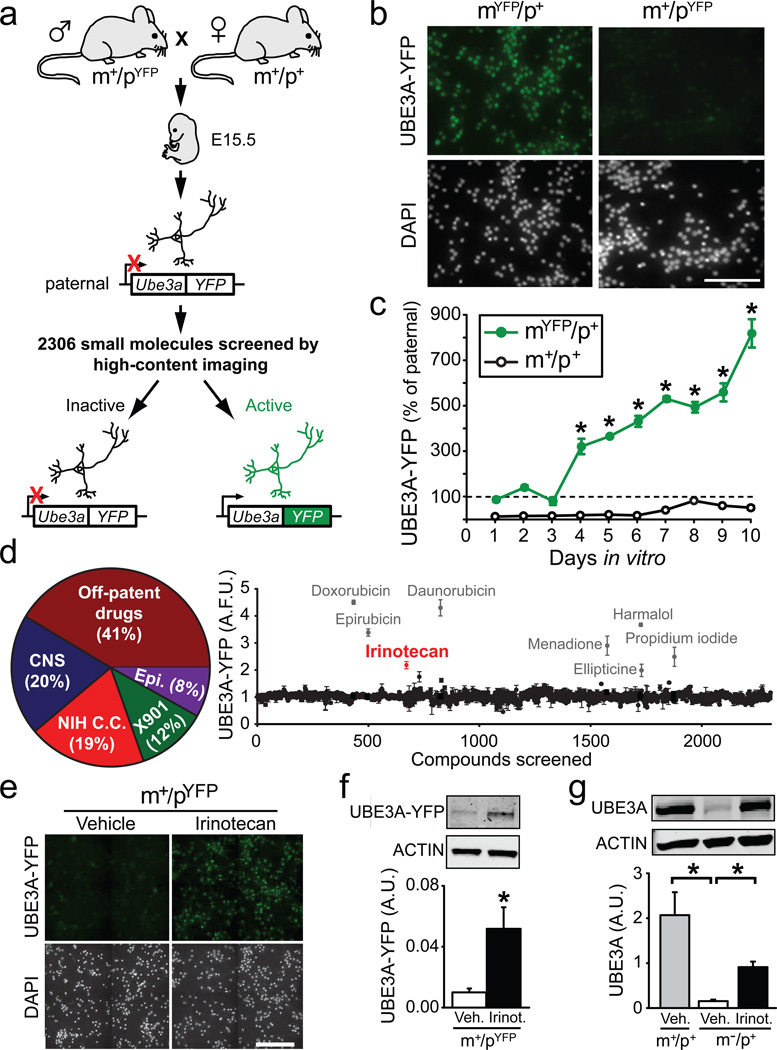
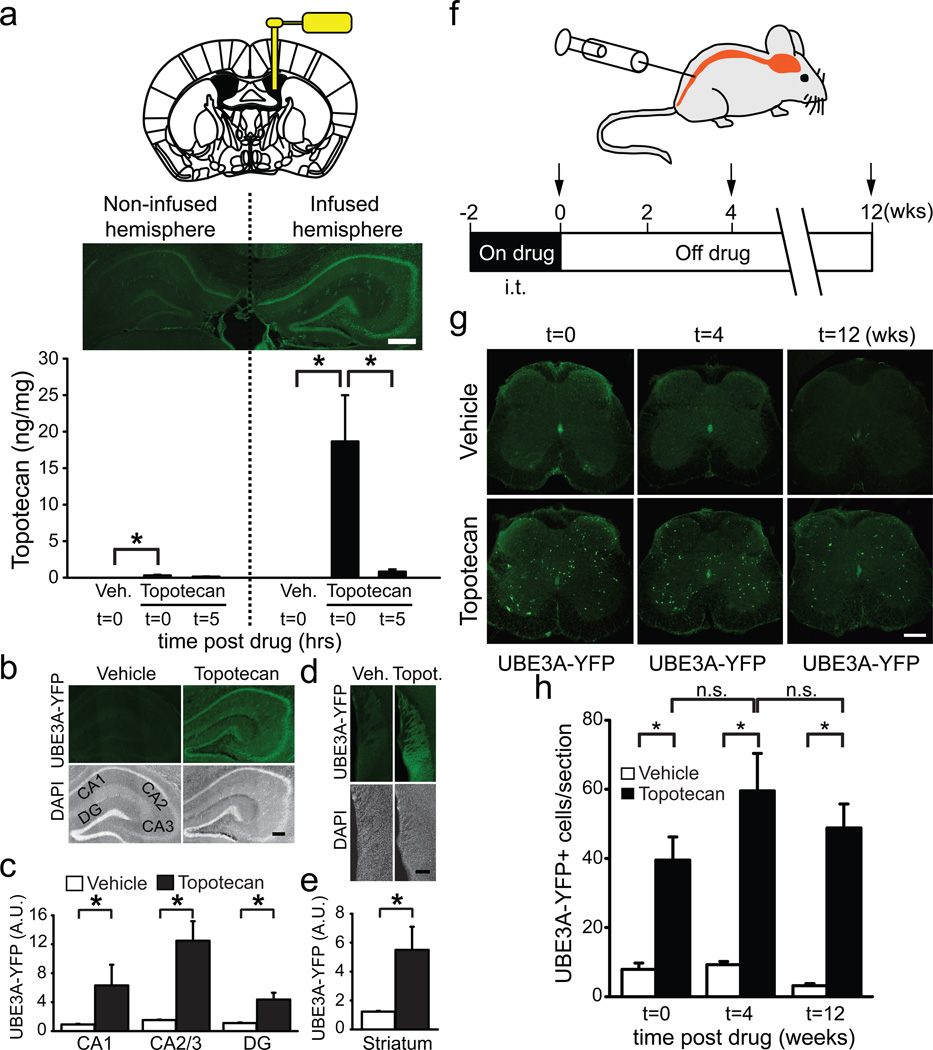
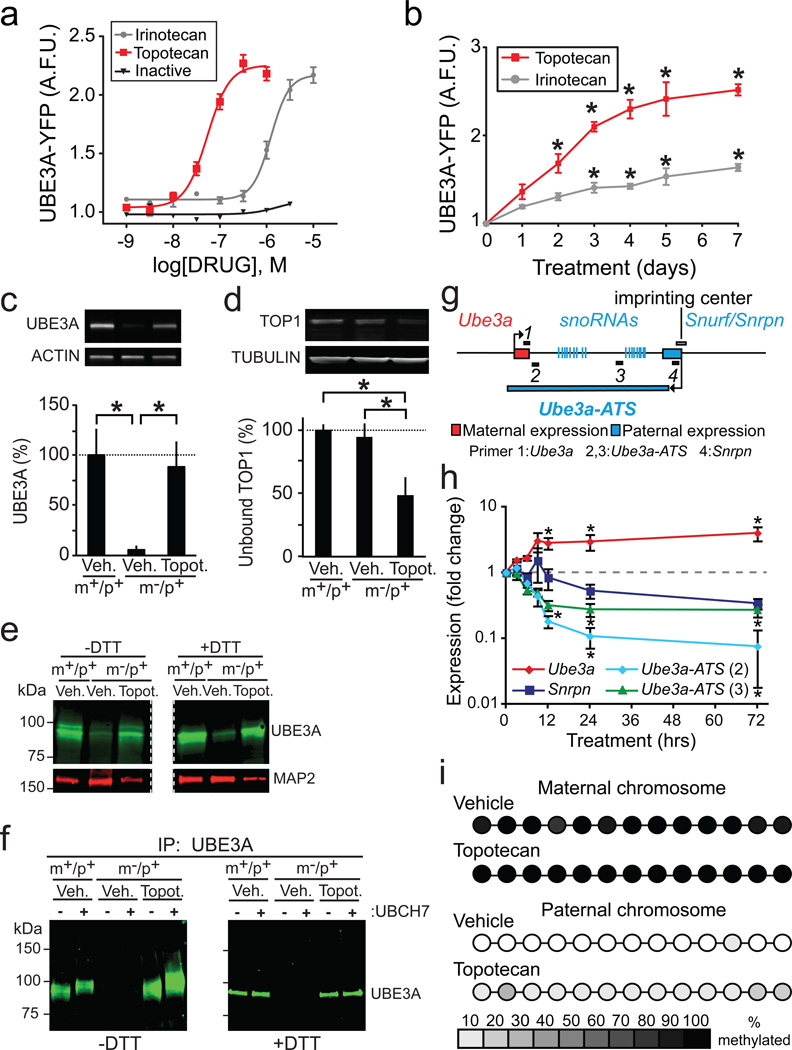
Angelman syndrome is a severe neurodevelopmental disorder caused by deletion or mutation of the maternal allele of the ubiquitin protein ligase E3A (UBE3A). In neurons, the paternal allele of UBE3A is intact but epigenetically silenced, raising the possibility that Angelman syndrome could be treated by activating this silenced allele to restore functional UBE3A protein. Using an unbiased, high-content screen in primary cortical neurons from mice, we identify twelve topoisomerase I inhibitors and four topoisomerase II inhibitors that unsilence the paternal Ube3a allele. These drugs included topotecan, irinotecan, etoposide and dexrazoxane (ICRF-187). At nanomolar concentrations, topotecan upregulated catalytically active UBE3A in neurons from maternal Ube3a-null mice. Topotecan concomitantly downregulated expression of the Ube3a antisense transcript that overlaps the paternal copy of Ube3a. These results indicate that topotecan unsilences Ube3a in cis by reducing transcription of an imprinted antisense RNA. When administered in vivo, topotecan unsilenced the paternal Ube3a allele in several regions of the nervous system, including neurons in the hippocampus, neocortex, striatum, cerebellum and spinal cord. Paternal expression of Ube3a remained elevated in a subset of spinal cord neurons for at least 12 weeks after cessation of topotecan treatment, indicating that transient topoisomerase inhibition can have enduring effects on gene expression. Although potential off-target effects remain to be investigated, our findings suggest a therapeutic strategy for reactivating the functional but dormant allele of Ube3a in patients with Angelman syndrome.
天使综合征是一种严重的神经发育障碍,由泛素蛋白连接酶 E3A(UBE3A)母本等位基因缺失或突变引起。在神经元中,UBE3A 的父本等位基因是完整的,但被表观遗传沉默,这就提出了一种可能性,即通过激活这个沉默的等位基因来恢复功能性 UBE3A 蛋白,从而治疗天使综合征。我们在来自母鼠的原代皮质神经元中进行了一项无偏、高通量的筛选,鉴定出了 12 种拓扑异构酶 I 抑制剂和 4 种拓扑异构酶 II 抑制剂,它们可以使父本 Ube3a 等位基因去沉默化。这些药物包括托泊替康、伊立替康、依托泊苷和右雷佐生(ICRF-187)。在纳摩尔浓度下,托泊替康可上调母鼠 Ube3a 缺失型神经元中具有催化活性的 UBE3A。托泊替康同时下调了与父本 Ube3a 重叠的 Ube3a 反义转录本的表达。这些结果表明,托泊替康通过减少印迹性反义 RNA 的转录来顺式沉默 Ube3a。在体内给药时,托泊替康可使父本 Ube3a 等位基因在包括海马体、新皮层、纹状体、小脑和脊髓在内的神经系统的多个区域去沉默化。托泊替康治疗停止后至少 12 周,父本 Ube3a 在脊髓神经元的一部分中仍持续高表达,这表明短暂的拓扑异构酶抑制作用可对基因表达产生持久影响。尽管潜在的脱靶效应仍有待研究,但我们的发现为治疗天使综合征患者中功能性但休眠的 Ube3a 等位基因提供了一种治疗策略。