Department of Plant and Microbial Biology, University of California, Berkeley, California, United States of America.
PLoS One. 2011;6(12):e28765. doi: 10.1371/journal.pone.0028765. Epub 2011 Dec 14.
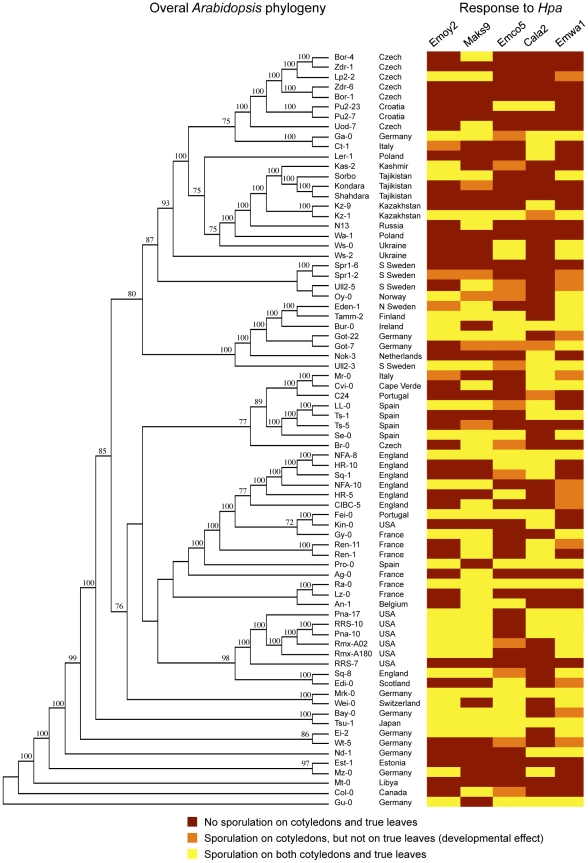
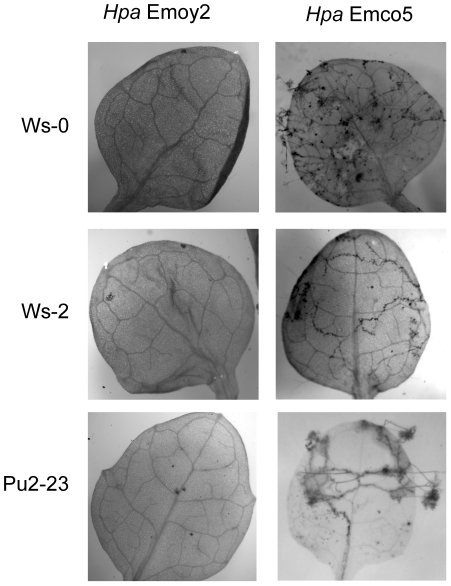
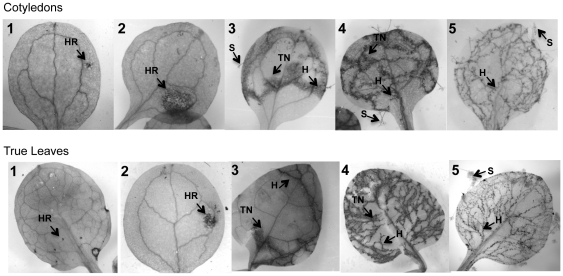
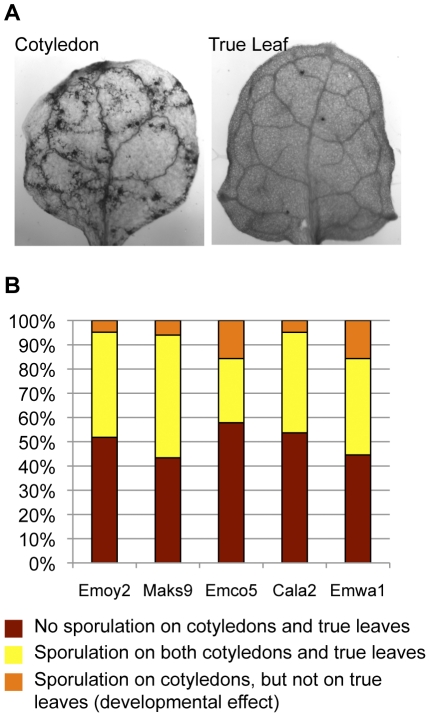
Interactions between Arabidopsis thaliana and its native obligate oomycete pathogen Hyaloperonospora arabidopsidis (Hpa) represent a model system to study evolution of natural variation in a host/pathogen interaction. Both Arabidopsis and Hpa genomes are sequenced and collections of different sub-species are available. We analyzed ∼400 interactions between different Arabidopsis accessions and five strains of Hpa. We examined the pathogen's overall ability to reproduce on a given host, and performed detailed cytological staining to assay for pathogen growth and hypersensitive cell death response in the host. We demonstrate that intermediate levels of resistance are prevalent among Arabidopsis populations and correlate strongly with host developmental stage. In addition to looking at plant responses to challenge by whole pathogen inoculations, we investigated the Arabidopsis resistance attributed to recognition of the individual Hpa effectors, ATR1 and ATR13. Our results suggest that recognition of these effectors is evolutionarily dynamic and does not form a single clade in overall Arabidopsis phylogeny for either effector. Furthermore, we show that the ultimate outcome of the interactions can be modified by the pathogen, despite a defined gene-for-gene resistance in the host. These data indicate that the outcome of disease and disease resistance depends on genome-for-genome interactions between the host and its pathogen, rather than single gene pairs as thought previously.
拟南芥与其本地专性卵菌病原体 Hyaloperonospora arabidopsidis(Hpa)之间的相互作用代表了一个研究宿主/病原体相互作用中自然变异进化的模型系统。拟南芥和 Hpa 的基因组都已测序,并且有不同亚种的集合。我们分析了不同拟南芥品系与 Hpa 的五个菌株之间的约 400 次相互作用。我们检查了病原体在给定宿主上的总体繁殖能力,并进行了详细的细胞化学染色,以测定宿主中的病原体生长和超敏细胞死亡反应。我们证明中间水平的抗性在拟南芥群体中很普遍,并且与宿主发育阶段密切相关。除了观察植物对整个病原体接种的反应外,我们还研究了拟南芥对单个 Hpa 效应物 ATR1 和 ATR13 的识别所赋予的抗性。我们的结果表明,这些效应物的识别在进化上是动态的,并且对于这两个效应物,在整个拟南芥系统发育中都没有形成单一的进化枝。此外,我们表明,尽管宿主中存在基因对基因抗性,但病原体可以改变相互作用的最终结果。这些数据表明,疾病和疾病抗性的结果取决于宿主与其病原体之间的基因组对基因组相互作用,而不是以前认为的单个基因对。