The Sainsbury Laboratory, John Innes Centre, Norwich, United Kingdom.
PLoS Pathog. 2011 Nov;7(11):e1002348. doi: 10.1371/journal.ppat.1002348. Epub 2011 Nov 3.
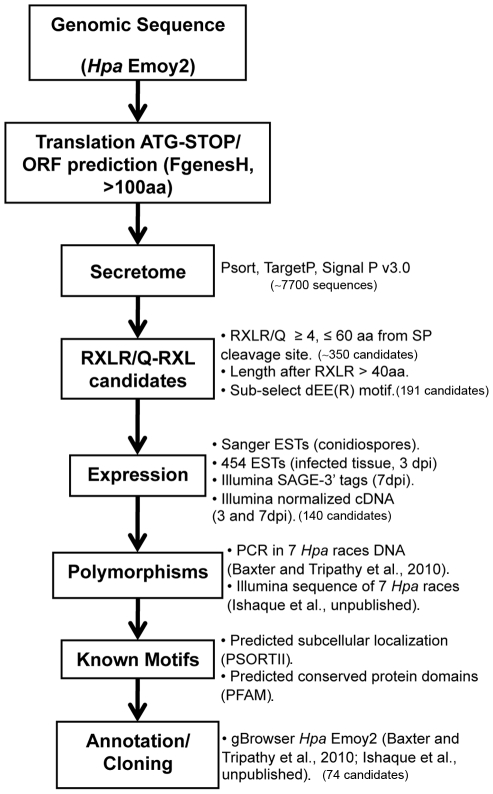
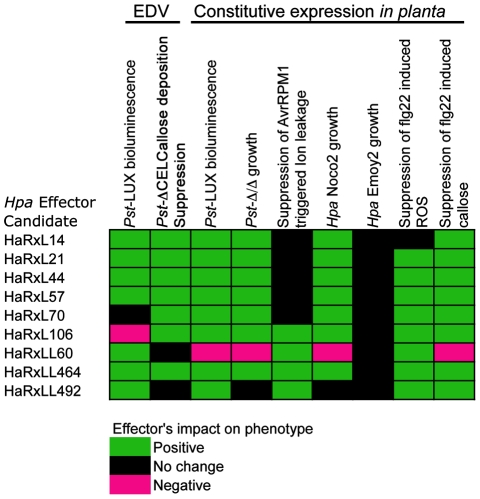
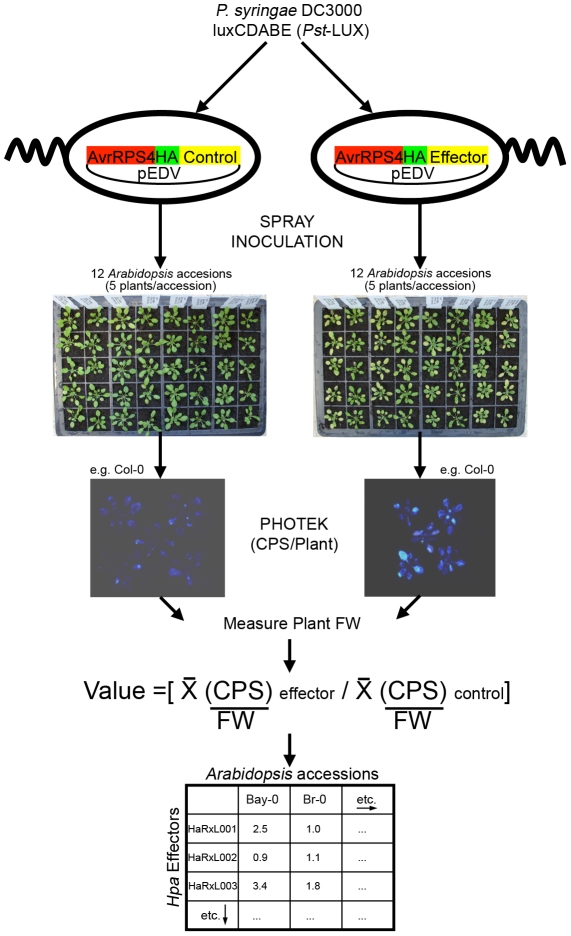
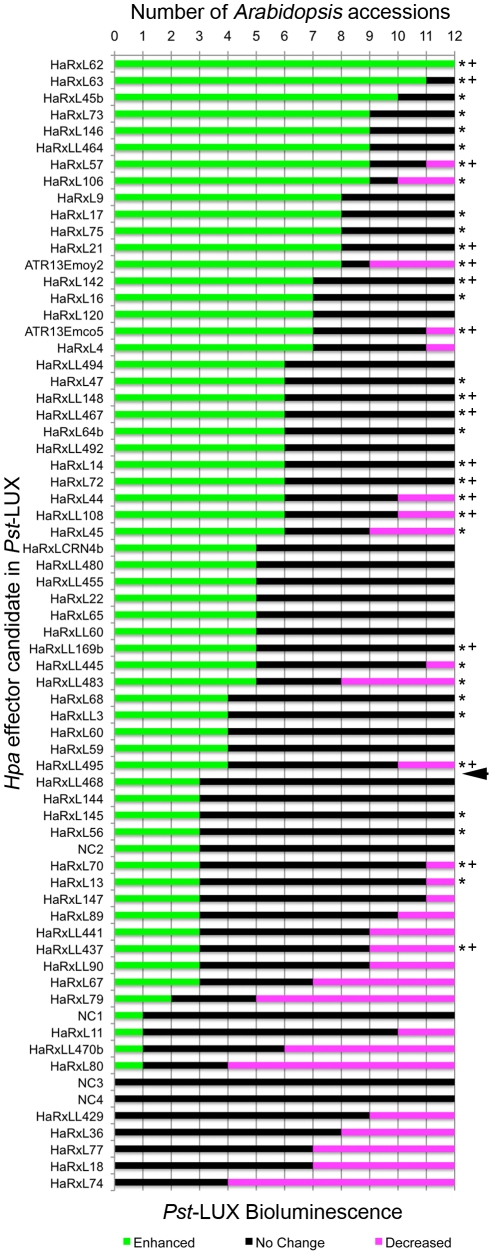
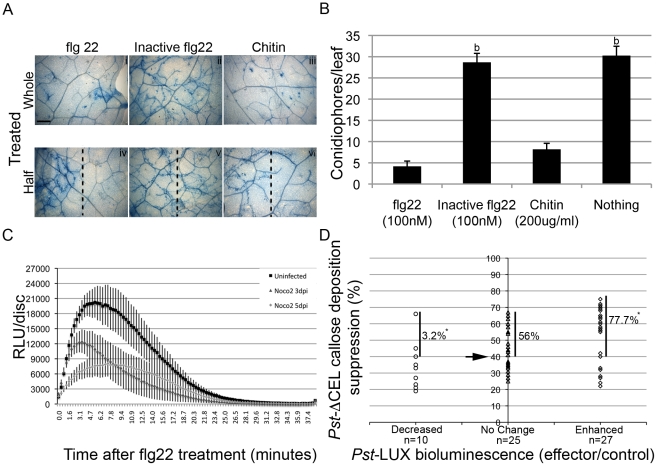
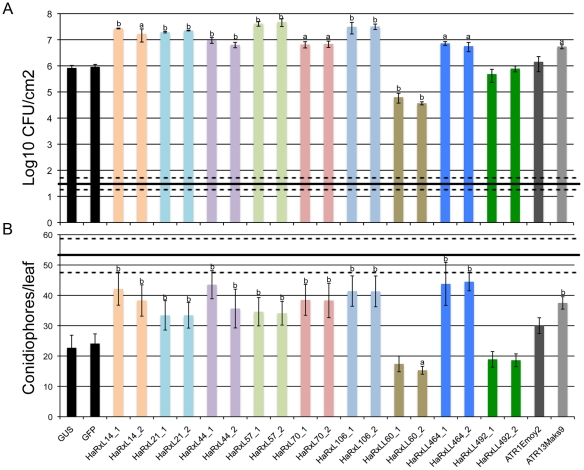
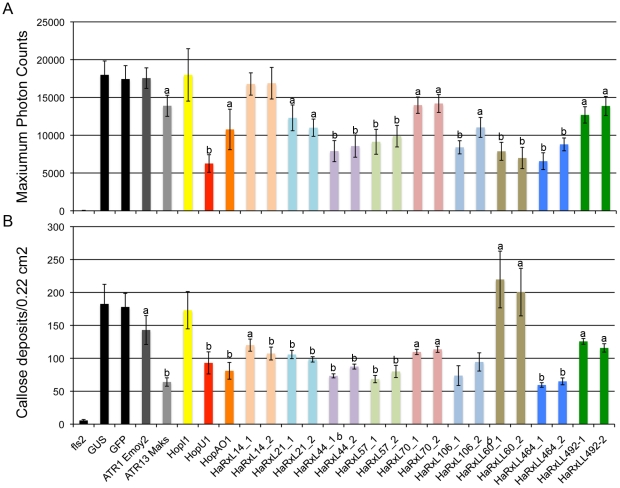
Oomycete pathogens cause diverse plant diseases. To successfully colonize their hosts, they deliver a suite of effector proteins that can attenuate plant defenses. In the oomycete downy mildews, effectors carry a signal peptide and an RxLR motif. Hyaloperonospora arabidopsidis (Hpa) causes downy mildew on the model plant Arabidopsis thaliana (Arabidopsis). We investigated if candidate effectors predicted in the genome sequence of Hpa isolate Emoy2 (HaRxLs) were able to manipulate host defenses in different Arabidopsis accessions. We developed a rapid and sensitive screening method to test HaRxLs by delivering them via the bacterial type-three secretion system (TTSS) of Pseudomonas syringae pv tomato DC3000-LUX (Pst-LUX) and assessing changes in Pst-LUX growth in planta on 12 Arabidopsis accessions. The majority (~70%) of the 64 candidates tested positively contributed to Pst-LUX growth on more than one accession indicating that Hpa virulence likely involves multiple effectors with weak accession-specific effects. Further screening with a Pst mutant (ΔCEL) showed that HaRxLs that allow enhanced Pst-LUX growth usually suppress callose deposition, a hallmark of pathogen-associated molecular pattern (PAMP)-triggered immunity (PTI). We found that HaRxLs are rarely strong avirulence determinants. Although some decreased Pst-LUX growth in particular accessions, none activated macroscopic cell death. Fewer HaRxLs conferred enhanced Pst growth on turnip, a non-host for Hpa, while several reduced it, consistent with the idea that turnip's non-host resistance against Hpa could involve a combination of recognized HaRxLs and ineffective HaRxLs. We verified our results by constitutively expressing in Arabidopsis a sub-set of HaRxLs. Several transgenic lines showed increased susceptibility to Hpa and attenuation of Arabidopsis PTI responses, confirming the HaRxLs' role in Hpa virulence. This study shows TTSS screening system provides a useful tool to test whether candidate effectors from eukaryotic pathogens can suppress/trigger plant defense mechanisms and to rank their effectiveness prior to subsequent mechanistic investigation.
卵菌病原体可引起多种植物病害。为了成功定殖其宿主,它们会分泌一系列效应蛋白,从而削弱植物的防御能力。在卵菌霜霉目中,效应蛋白带有信号肽和 RxLR 基序。Hy-aloperonospora arabidopsidis (Hpa) 可引起模式植物拟南芥 (Arabidopsis) 的霜霉病。我们研究了 Hpa 分离株 Emoy2 (HaRxLs) 基因组序列中预测的候选效应子是否能够在不同的拟南芥品系中操纵宿主防御。我们开发了一种快速灵敏的筛选方法,通过将 HaRxLs 递送至假单胞菌 pv 番茄 DC3000-LUX(Pst-LUX)的细菌 III 型分泌系统(TTSS)中,并在 12 个拟南芥品系上评估 Pst-LUX 在植物体内的生长变化,从而对 HaRxLs 进行测试。在 64 个候选者中,大多数 (~70%)在一个以上品系中对 Pst-LUX 的生长有促进作用,这表明 Hpa 的毒力可能涉及多个效应子,且对不同品系的影响较弱。进一步用 Pst 突变体(ΔCEL)筛选表明,允许增强 Pst-LUX 生长的 HaRxLs 通常会抑制几丁质的沉积,这是病原体相关分子模式(PAMP)触发免疫(PTI)的一个标志。我们发现 HaRxLs 很少是强无毒决定因子。虽然一些 HaRxLs 在特定品系中降低了 Pst-LUX 的生长,但没有一个 HaRxLs 引发了宏观细胞死亡。HaRxLs 赋予了黑芥更强的生长能力,黑芥是 Hpa 的非宿主,而有几个 HaRxLs 降低了其生长能力,这与黑芥对 Hpa 的非宿主抗性可能涉及一系列已识别的 HaRxLs 和无效的 HaRxLs 的观点一致。我们通过在拟南芥中组成型表达 HaRxLs 的一个子集来验证我们的结果。几个转基因系对 Hpa 的敏感性增加,且对拟南芥 PTI 反应的抑制作用减弱,这证实了 HaRxLs 在 Hpa 毒力中的作用。这项研究表明,TTSS 筛选系统为测试真核病原体的候选效应子是否能够抑制/触发植物防御机制,并在随后的机制研究之前对其有效性进行排序提供了一种有用的工具。