Department of Cardiothoracic and Vascular Surgery, Deutsches Herzzentrum Berlin, Berlin, Germany.
PLoS One. 2011;6(12):e28872. doi: 10.1371/journal.pone.0028872. Epub 2011 Dec 14.
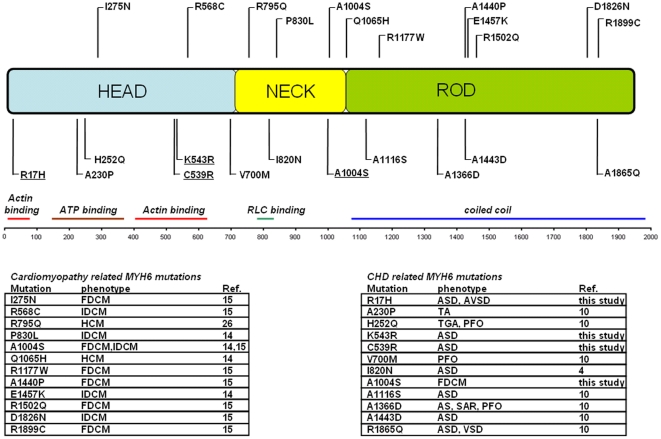
Secundum-type atrial septal defects (ASDII) account for approximately 10% of all congenital heart defects (CHD) and are associated with a familial risk. Mutations in transcription factors represent a genetic source for ASDII. Yet, little is known about the role of mutations in sarcomeric genes in ASDII etiology. To assess the role of sarcomeric genes in patients with inherited ASDII, we analyzed 13 sarcomeric genes (MYH7, MYBPC3, TNNT2, TCAP, TNNI3, MYH6, TPM1, MYL2, CSRP3, ACTC1, MYL3, TNNC1, and TTN kinase region) in 31 patients with familial ASDII using array-based resequencing. Genotyping of family relatives and control subjects as well as structural and homology analyses were used to evaluate the pathogenic impact of novel non-synonymous gene variants. Three novel missense mutations were found in the MYH6 gene encoding alpha-myosin heavy chain (R17H, C539R, and K543R). These mutations co-segregated with CHD in the families and were absent in 370 control alleles. Interestingly, all three MYH6 mutations are located in a highly conserved region of the alpha-myosin motor domain, which is involved in myosin-actin interaction. In addition, the cardiomyopathy related MYH6-A1004S and the MYBPC3-A833T mutations were also found in one and two unrelated subjects with ASDII, respectively. No mutations were found in the 11 other sarcomeric genes analyzed. The study indicates that sarcomeric gene mutations may represent a so far underestimated genetic source for familial recurrence of ASDII. In particular, perturbations in the MYH6 head domain seem to play a major role in the genetic origin of familial ASDII.
继发孔型房间隔缺损(ASDII)约占所有先天性心脏病(CHD)的 10%,并与家族风险相关。转录因子的突变代表 ASDII 的遗传来源。然而,关于肌节基因突变在 ASDII 发病机制中的作用知之甚少。为了评估肌节基因在遗传性 ASDII 患者中的作用,我们使用基于阵列的重测序分析了 31 名家族性 ASDII 患者的 13 个肌节基因(MYH7、MYBPC3、TNNT2、TCAP、TNNI3、MYH6、TPM1、MYL2、CSRP3、ACTC1、MYL3、TNNC1 和 TTN 激酶区)。通过对家族亲属和对照进行基因分型以及结构和同源性分析,评估了新的非同义基因突变的致病影响。在编码α-肌球蛋白重链的 MYH6 基因中发现了三个新的错义突变(R17H、C539R 和 K543R)。这些突变与家族中的 CHD 共分离,在 370 个对照等位基因中不存在。有趣的是,所有三个 MYH6 突变都位于α-肌球蛋白马达结构域的高度保守区域,该区域参与肌球蛋白-肌动蛋白相互作用。此外,在一个和两个无关的 ASDII 患者中还发现了与心肌病相关的 MYH6-A1004S 和 MYBPC3-A833T 突变。在分析的其他 11 个肌节基因中未发现突变。该研究表明,肌节基因突变可能是家族性 ASDII 复发的一个迄今为止被低估的遗传来源。特别是,MYH6 头部结构域的扰动似乎在家族性 ASDII 的遗传起源中起着主要作用。