Razmara Ehsan, Garshasbi Masoud
Department of Medical Genetics, Faculty of Medical Sciences, Tarbiat Modares University, Tehran, Iran.
Department of Medical Genetics, DeNA laboratory, Tehran, Iran.
BMC Cardiovasc Disord. 2018 Jul 3;18(1):137. doi: 10.1186/s12872-018-0867-4.
Myosin VI, encoded by MYH6, is expressed dominantly in human cardiac atria and plays consequential roles in cardiac muscle contraction and comprising the cardiac muscle thick filament. It has been reported that the mutations in the MYH6 gene associated with sinus venosus atrial septal defect (ASD type III), hypertrophic (HCM) and dilated (DCM) cardiomyopathies.
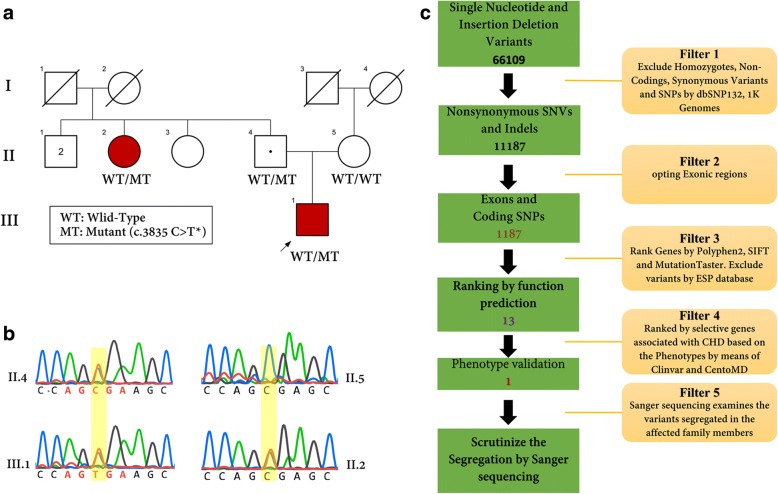
Two patients in an Iranian family have been identified who affected to Congenital Heart Disease (CHD). The male patient, besides CHD, shows that the thyroglossal sinus, refractive errors of the eye and mitral stenosis. The first symptoms emerged at the birth and diagnosis based on clinical features was made at about 5 years. The family had a history of ASD. For recognizing mutated gene (s), whole exome sequencing (WES) was performed for the male patient and variants were analyzed by autosomal dominant inheritance mode.
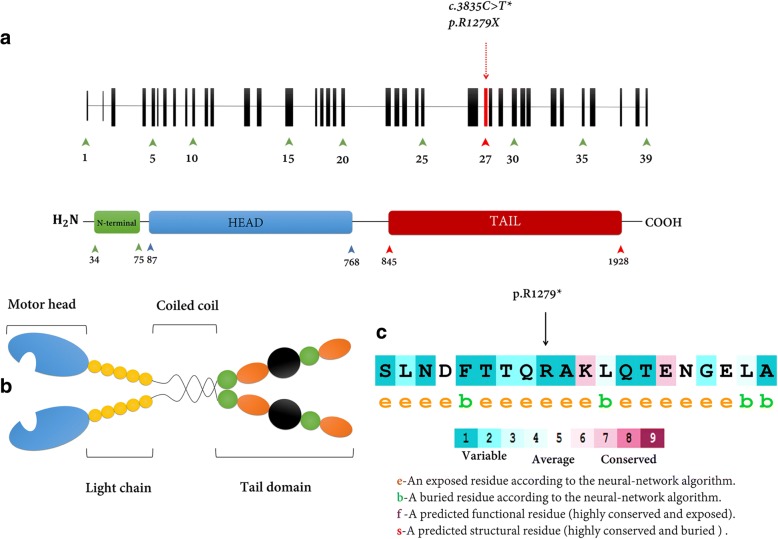
Eventually, by several filtering processes, a mutation in MYH6 gene (NM_002471.3), c.3835C > T; R1279X, was identified as the most likely disease-susceptibility variant and then confirmed by Sanger sequencing in the family. The mutation frequency was checked out in the local databases. This mutation results in the elimination of the 660 amino acids in the C-terminal of Myosin VI protein, including the vital parts of the coiled-coil structure of the tail domain.
Our study represents the first case of Sinus venosus defect caused directly by MYH6 stop codon mutation. Our data indicate that by increase haploinsufficiency of myosin VI, c.3835C > T mutation with reduced penetrance could be associated with CHD.
由MYH6编码的肌球蛋白VI在人类心脏心房中占主导性表达,在心肌收缩及构成心肌粗肌丝方面发挥着重要作用。据报道,MYH6基因的突变与静脉窦型房间隔缺损(III型房间隔缺损)、肥厚型心肌病(HCM)和扩张型心肌病(DCM)有关。
已确定一个伊朗家庭中有两名患者患有先天性心脏病(CHD)。男性患者除患有CHD外,还患有甲状舌管窦、眼屈光不正和二尖瓣狭窄。最初症状在出生时出现,基于临床特征在约5岁时确诊。该家族有房间隔缺损病史。为识别突变基因,对男性患者进行了全外显子组测序(WES),并通过常染色体显性遗传模式分析变异。
最终,经过多次筛选过程,在MYH6基因(NM_002471.3)中鉴定出一个突变,即c.3835C>T;R1279X,被确定为最可能的疾病易感性变异,随后在家族中通过桑格测序得到证实。在本地数据库中检查了该突变频率。此突变导致肌球蛋白VI蛋白C末端的660个氨基酸缺失,包括尾域卷曲螺旋结构的重要部分。
我们的研究代表了首例由MYH6终止密码子突变直接导致的静脉窦缺损病例。我们的数据表明,通过增加肌球蛋白VI的单倍体不足,具有降低外显率的c.3835C>T突变可能与CHD相关。