Center for Mind/Brain Sciences (CIMeC), University of Trento, Rovereto, Italy.
PLoS One. 2011;6(12):e29296. doi: 10.1371/journal.pone.0029296. Epub 2011 Dec 16.
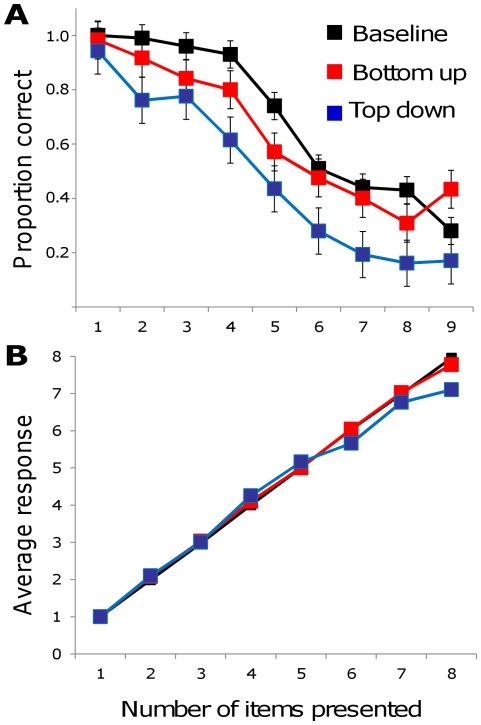
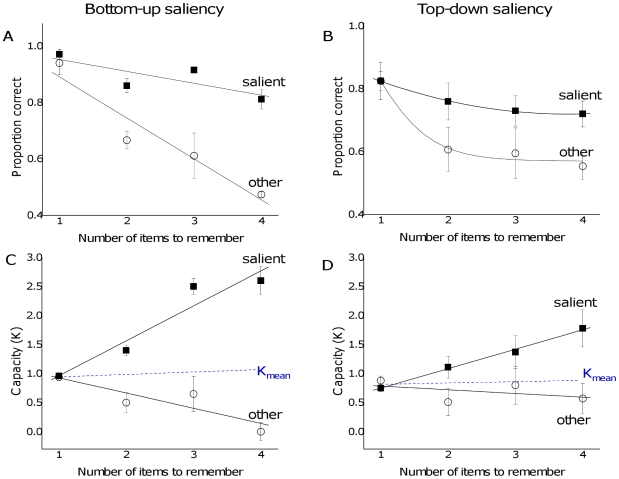
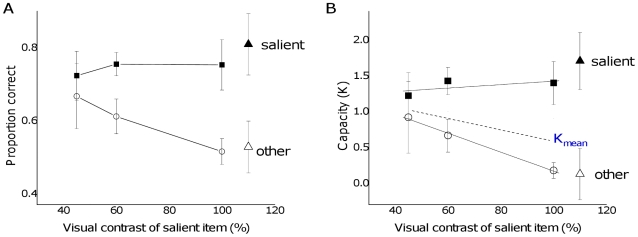
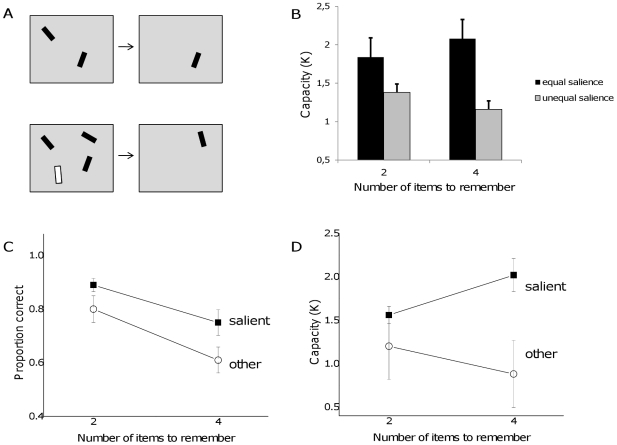
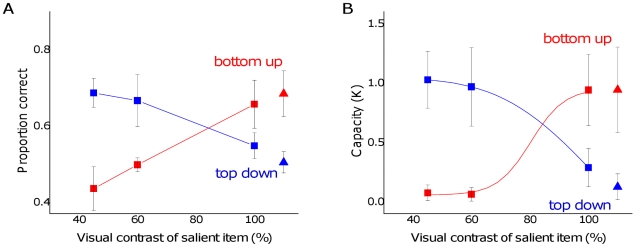
Many common tasks require us to individuate in parallel two or more objects out of a complex scene. Although the mechanisms underlying our abilities to count the number of items, remember the visual properties of objects and to make saccadic eye movements towards targets have been studied separately, each of these tasks require selection of individual objects and shows a capacity limit. Here we show that a common factor--salience--determines the capacity limit in the various tasks. We manipulated bottom-up salience (visual contrast) and top-down salience (task relevance) in enumeration and visual memory tasks. As one item became increasingly salient, the subitizing range was reduced and memory performance for all other less-salient items was decreased. Overall, the pattern of results suggests that our abilities to enumerate and remember small groups of stimuli are grounded in an attentional priority or salience map which represents the location of important items.
许多常见的任务要求我们在复杂场景中同时辨别出两个或更多的物体。尽管我们计数物体数量、记住物体视觉属性和进行眼跳运动以瞄准目标的能力的机制已被分别研究,但这些任务中的每一个都需要选择单独的物体,并显示出容量限制。在这里,我们表明,一个共同的因素——突显度——决定了各种任务的容量限制。我们在计数和视觉记忆任务中操纵了自下而上的突显度(视觉对比)和自上而下的突显度(任务相关性)。当一个项目变得越来越突出时,即刻识别范围减小,而对所有其他不那么突出的项目的记忆性能下降。总的来说,结果模式表明,我们计数和记忆小刺激组的能力基于一种注意力优先级或突显度图,该图代表重要项目的位置。