Department of Tumor Immunology, Nijmegen Centre for Molecular Life Sciences, Radboud University Nijmegen Medical Centre, P.O. Box 9101, 6500 HB, Nijmegen, The Netherlands.
Cell Mol Life Sci. 2012 Jun;69(11):1889-901. doi: 10.1007/s00018-011-0908-y. Epub 2011 Dec 28.
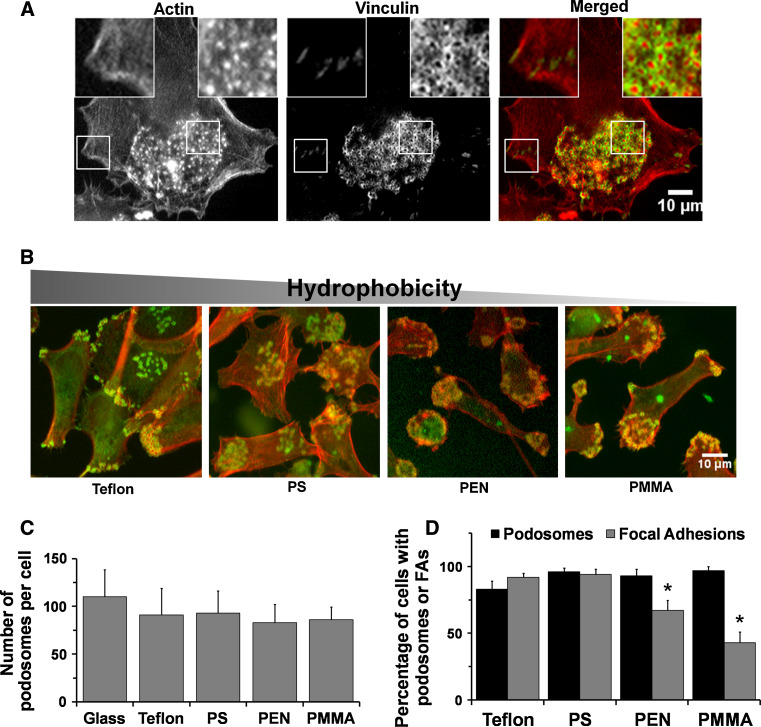
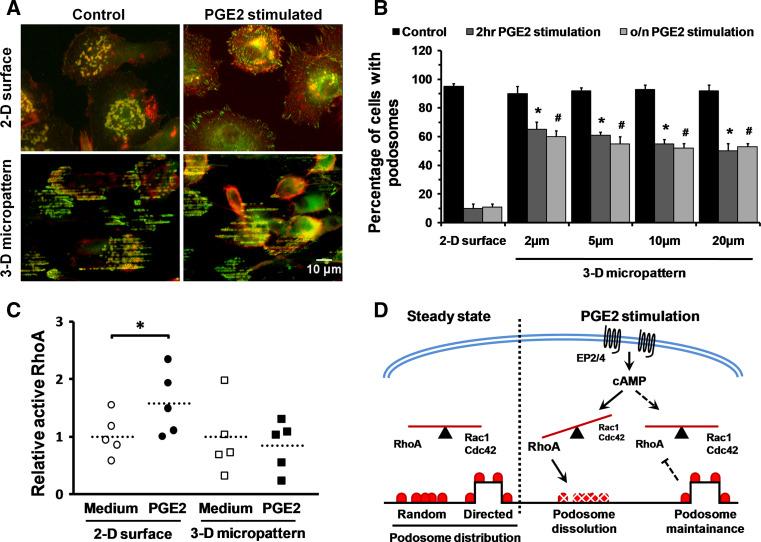
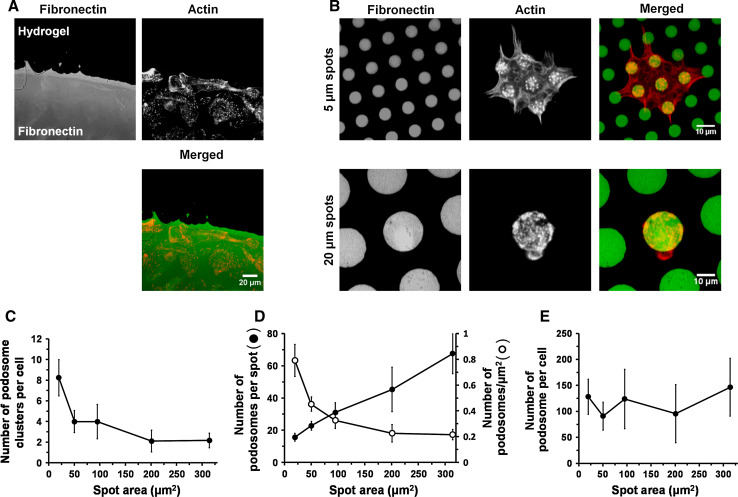
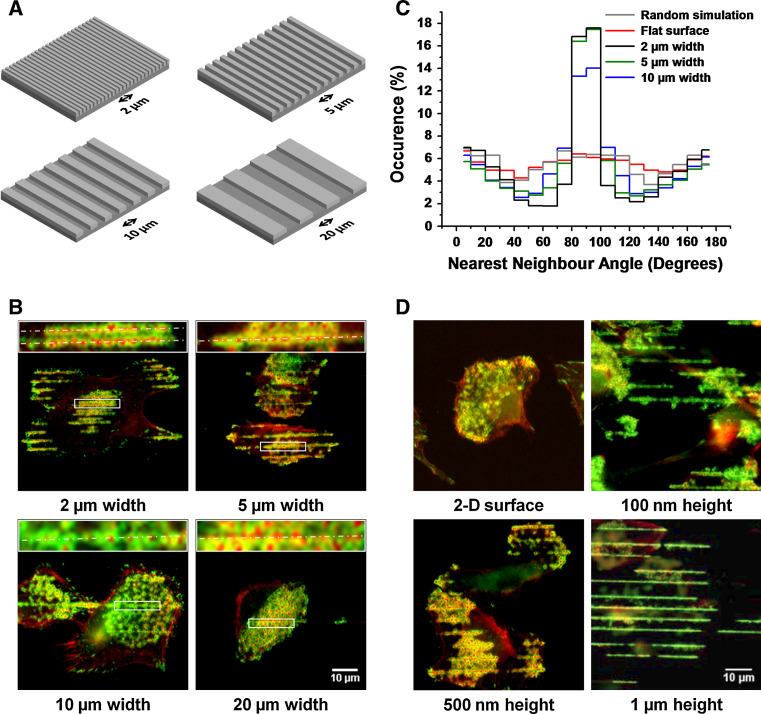
Assembly and disassembly of adhesion structures such as focal adhesions (FAs) and podosomes regulate cell adhesion and differentiation. On antigen-presenting dendritic cells (DCs), acquisition of a migratory and immunostimulatory phenotype depends on podosome dissolution by prostaglandin E(2) (PGE(2)). Whereas the effects of physico-chemical and topographical cues have been extensively studied on FAs, little is known about how podosomes respond to these signals. Here, we show that, unlike for FAs, podosome formation is not controlled by substrate physico-chemical properties. We demonstrate that cell adhesion is the only prerequisite for podosome formation and that substrate availability dictates podosome density. Interestingly, we show that DCs sense 3-dimensional (3-D) geometry by aligning podosomes along the edges of 3-D micropatterned surfaces. Finally, whereas on a 2-dimensional (2-D) surface PGE(2) causes a rapid increase in activated RhoA levels leading to fast podosome dissolution, 3-D geometric cues prevent PGE(2)-mediated RhoA activation resulting in impaired podosome dissolution even after prolonged stimulation. Our findings indicate that 2-D and 3-D geometric cues control the spatial organization of podosomes. More importantly, our studies demonstrate the importance of substrate dimensionality in regulating podosome dissolution and suggest that substrate dimensionality plays an important role in controlling DC activation, a key process in initiating immune responses.
粘着结构(如粘着斑和 Podosomes)的组装和拆卸调节细胞粘着和分化。在抗原呈递树突状细胞(DCs)上,获得迁移和免疫刺激表型取决于前列腺素 E(2)(PGE(2))对 Podosomes 的溶解。虽然物理化学和形貌线索的影响已经在粘着斑上得到了广泛的研究,但对于 Podosomes 如何响应这些信号知之甚少。在这里,我们表明,与粘着斑不同,Podosome 的形成不受底物物理化学性质的控制。我们证明细胞粘着是 Podosome 形成的唯一前提条件,并且底物可用性决定了 Podosome 的密度。有趣的是,我们表明 DCs 通过将 Podosomes 沿着 3-D 微图案化表面的边缘排列来感知 3-D 几何形状。最后,尽管在 2-D 表面上,PGE(2)导致快速增加激活的 RhoA 水平,从而导致快速 Podosomes 溶解,但 3-D 几何线索阻止了 PGE(2)介导的 RhoA 激活,导致即使在长时间刺激后 Podosomes 溶解受损。我们的发现表明 2-D 和 3-D 几何线索控制 Podosomes 的空间组织。更重要的是,我们的研究表明底物维度在调节 Podosomes 溶解中的重要性,并表明底物维度在控制 DC 激活中起着重要作用,DC 激活是引发免疫反应的关键过程。