Neonatal Unit, Hospital Clínic, IDIBAPS, Universitat de Barcelona, Barcelona, Spain.
Nutr J. 2011 Dec 29;10:140. doi: 10.1186/1475-2891-10-140.
To determine the effects of high dietary protein and energy intake on the growth and body composition of very low birth weight (VLBW) infants.
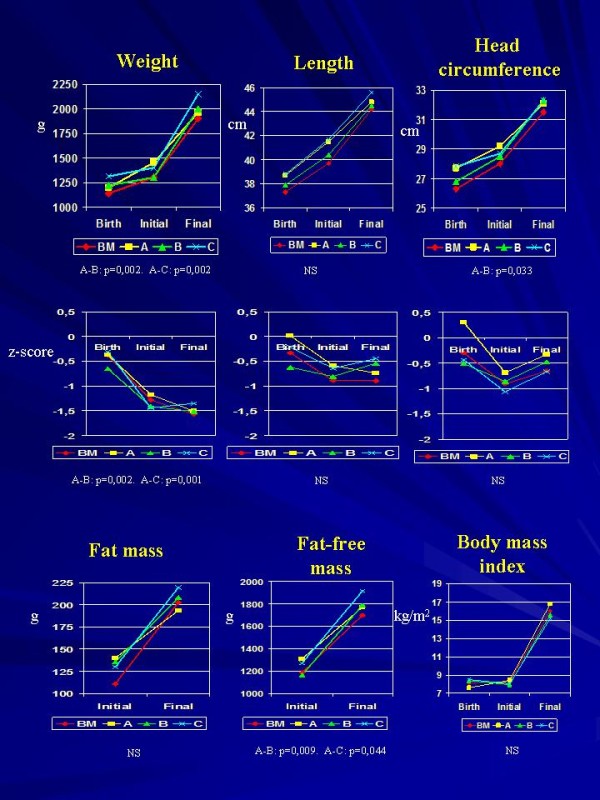
Thirty-eight VLBW infants whose weights were appropriate for their gestational ages were assessed for when they could tolerate oral intake for all their nutritional needs. Thirty-two infants were included in a longitudinal, randomized clinical trial over an approximate 28-day period. One control diet (standard preterm formula, group A, n = 8, 3.7 g/kg/d of protein and 129 kcal/kg/d) and two high-energy and high-protein diets (group B, n = 12, 4.2 g/kg/d and 150 kcal/kg/d; group C, n = 12, 4.7 g/kg/d and 150 kcal/kg/d) were compared. Differences among groups in anthropometry and body composition (measured with bioelectrical impedance analysis) were determined. An enriched breast milk group (n = 6) served as a descriptive reference group.
Groups B and C displayed greater weight gains and higher increases in fat-free mass than group A.
An intake of 150 kcal/kg/d of energy and 4.2 g/kg/d of protein increases fat-free mass accretion in VLBW infants.
确定高蛋白和高能量饮食对极低出生体重(VLBW)婴儿生长和身体成分的影响。
对 38 名体重符合其胎龄的 VLBW 婴儿进行评估,以确定他们何时能够通过口服摄入满足所有营养需求。32 名婴儿被纳入一项为期约 28 天的纵向随机临床试验。一组接受对照饮食(标准早产儿配方,A 组,蛋白质 3.7 g/kg/d,热量 129 kcal/kg/d),两组接受高蛋白和高能量饮食(B 组,蛋白质 4.2 g/kg/d,热量 150 kcal/kg/d;C 组,蛋白质 4.7 g/kg/d,热量 150 kcal/kg/d)。比较各组之间的人体测量学和身体成分(通过生物电阻抗分析测量)。一个富含母乳的组(n=6)作为描述性参考组。
B 组和 C 组的体重增加和去脂体重增加均高于 A 组。
VLBW 婴儿摄入 150 kcal/kg/d 的能量和 4.2 g/kg/d 的蛋白质可增加去脂体重的积累。