Division of Clinical Science, St George's, University of London, London, UK.
Respir Res. 2011 Dec 29;12(1):161. doi: 10.1186/1465-9921-12-161.
Relationships between improvements in lung function and other clinical outcomes in chronic obstructive pulmonary disease (COPD) are not documented extensively. We examined whether changes in trough forced expiratory volume in 1 second (FEV(1)) are correlated with changes in patient-reported outcomes.
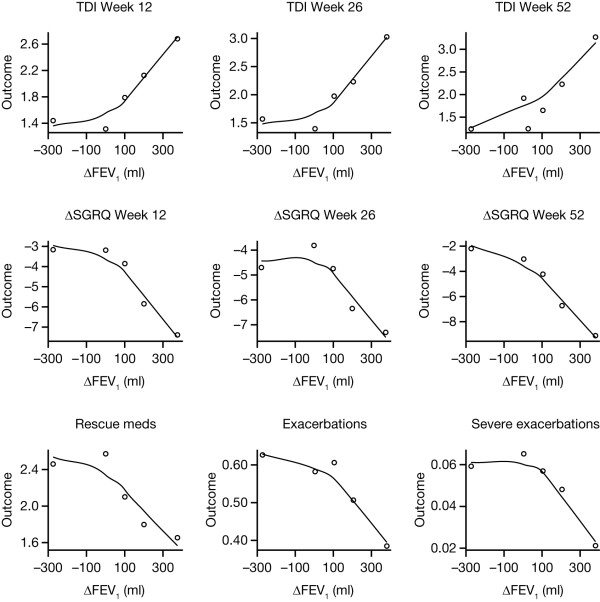
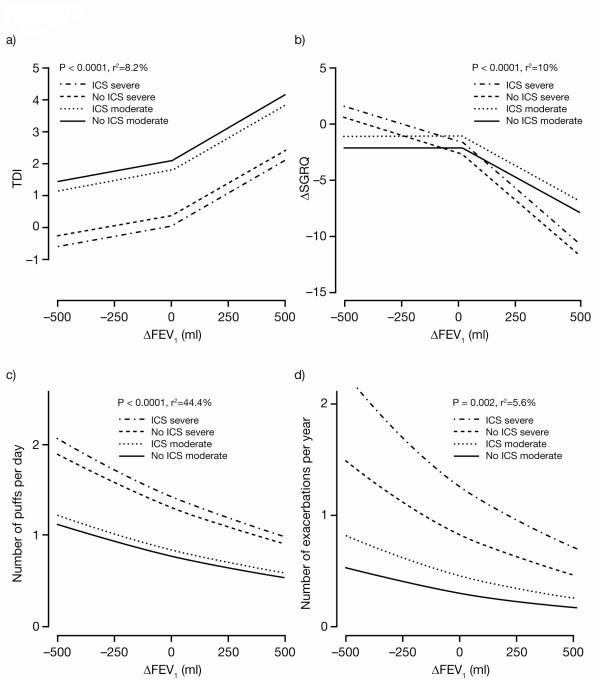
Pooled data from three indacaterol studies (n = 3313) were analysed. Means and responder rates for outcomes including change from baseline in Transition Dyspnoea Index (TDI), St. George's Respiratory Questionnaire (SGRQ) scores (at 12, 26 and 52 weeks), and COPD exacerbation frequency (rate/year) were tabulated across categories of ΔFEV(1). Also, generalised linear modelling was performed adjusting for covariates such as baseline severity and inhaled corticosteroid use.
With increasing positive ΔFEV(1), TDI and ΔSGRQ improved at all timepoints, exacerbation rate over the study duration declined (P < 0.001). Individual-level correlations were 0.03-0.18, but cohort-level correlations were 0.79-0.95. At 26 weeks, a 100 ml increase in FEV(1) was associated with improved TDI (0.46 units), ΔSGRQ (1.3-1.9 points) and exacerbation rate (12% decrease). Overall, adjustments for baseline covariates had little impact on the relationship between ΔFEV(1) and outcomes.
These results suggest that larger improvements in FEV(1) are likely to be associated with larger patient-reported benefits across a range of clinical outcomes.
ClinicalTrials.gov NCT00393458, NCT00463567, and NCT00624286.
在慢性阻塞性肺疾病(COPD)中,肺功能的改善与其他临床结果之间的关系尚未得到充分记录。我们研究了 1 秒用力呼气量(FEV1)的谷值变化是否与患者报告的结果变化相关。
对三种印达特罗研究(n=3313)的汇总数据进行了分析。在 TDI(呼吸困难过渡指数)、SGRQ(圣乔治呼吸问卷)评分(基线、12、26 和 52 周)以及 COPD 加重频率(年发生率)方面,从 FEV1 的变化情况中对各项结果的平均值和应答率进行了分类。此外,还进行了广义线性模型分析,对基线严重程度和吸入皮质激素使用等协变量进行了调整。
随着 FEV1 的增加,TDI 和 SGRQ 在所有时间点都得到了改善,研究期间的加重率下降(P<0.001)。个体水平的相关性为 0.03-0.18,而队列水平的相关性为 0.79-0.95。在 26 周时,FEV1 增加 100 毫升与 TDI(0.46 个单位)、SGRQ(1.3-1.9 分)和加重率(降低 12%)的改善相关。总体而言,对基线协变量的调整对 FEV1 与结果之间的关系影响不大。
这些结果表明,FEV1 的较大改善可能与一系列临床结果中的更大患者报告获益相关。
ClinicalTrials.gov NCT00393458、NCT00463567 和 NCT00624286。