Obesity and Diabetes Clinical Research Section, NIDDK-NIH, DHHS, Phoenix, AZ 85016, USA.
Neuroimage. 2012 Mar;60(1):592-600. doi: 10.1016/j.neuroimage.2011.12.023. Epub 2011 Dec 21.
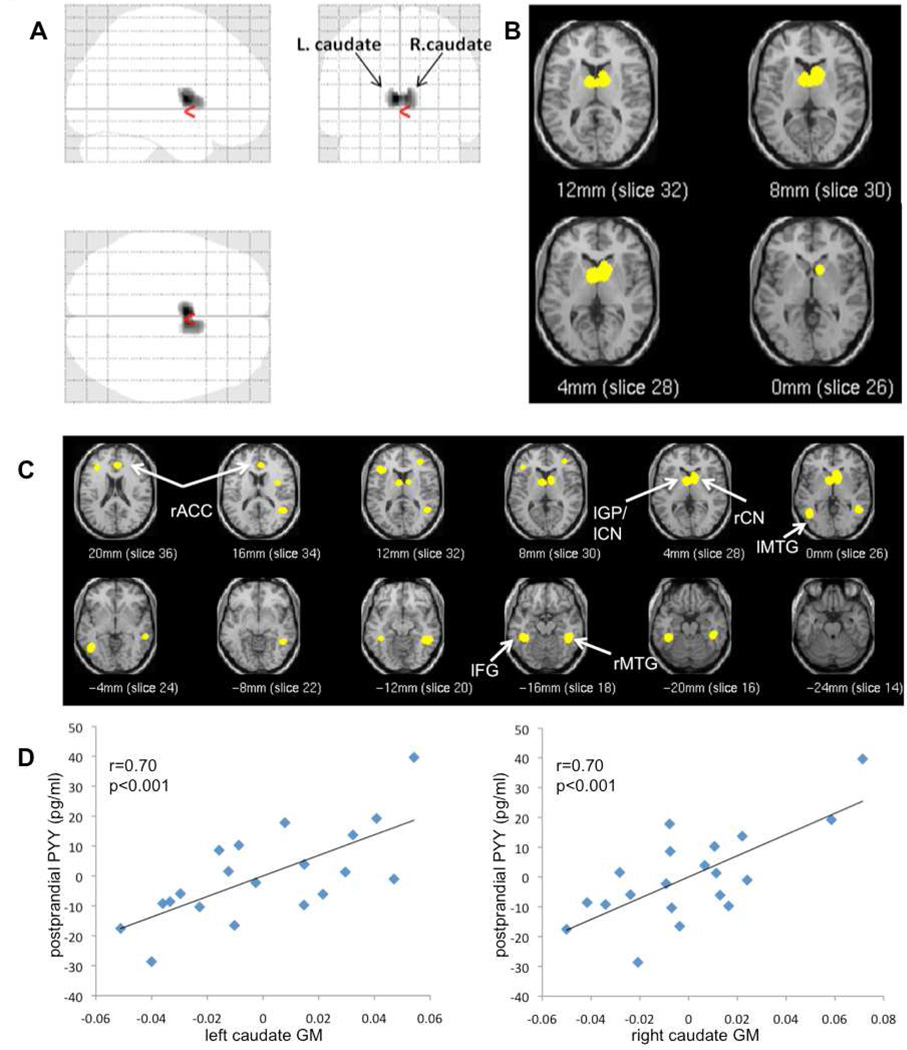
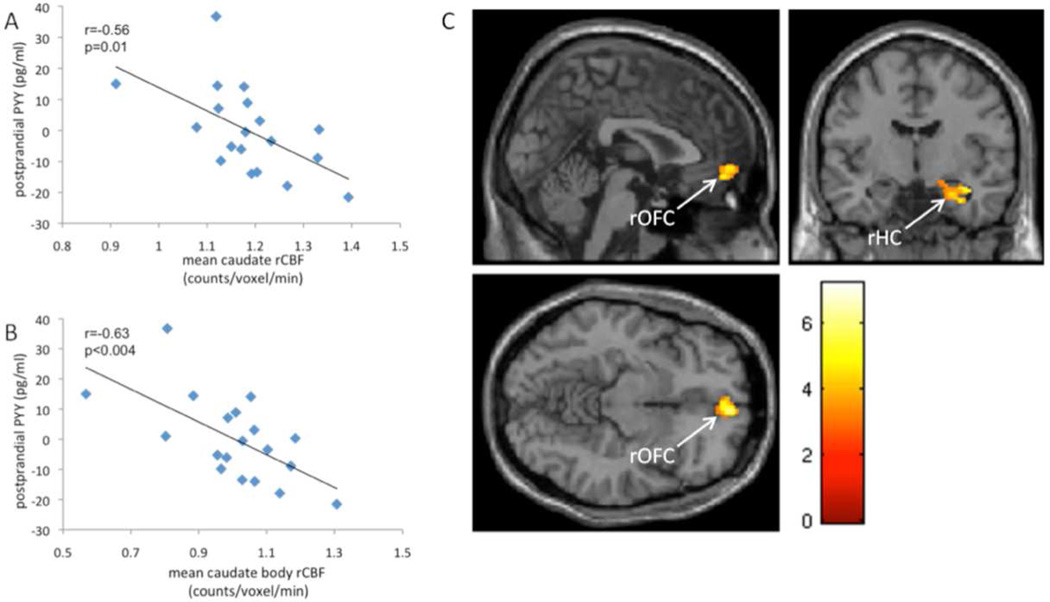
The anorexigenic gastrointestinal hormone Peptide YY plays an important role in the communication between the gastrointestinal tract and the central nervous system. PYY has been shown to modulate brain activity in regions implicated in reward and food related behavior. Its effects on brain structure however, remain unknown. Voxel-based morphometry was used to investigate the relationship between fasting and postprandial plasma PYY concentrations and regional gray matter volume (GMV). For this analysis twenty adult, non diabetic Caucasians were included (18F/2M, age 31±9 y, percentage of body fat [PFAT] 32±8%) who had volumetric brain magnetic resonance images and underwent H(2)(15)O positron emission tomographic (PET) measurements of regional cerebral blood flow (rCBF), a marker of local neuronal activity, and measurements of plasma total PYY, prior to (fasting) and following a satiating liquid meal. Voxel-wise analysis revealed a regional positive association between postprandial PYY and gray matter volume bilaterally in the caudate nuclei. These associations remained significant (p<0.05) after small volume correction for multiple comparisons. Based on these findings we investigated whether postprandial PYY is associated with PET measured rCBF of the caudate nucleus. We found a significant negative association between average postprandial caudate rCBF and postprandial plasma PYY concentrations (r=-0.60, p<0.02, age, sex and PFAT adjusted). Average postprandial caudate rCBF was also negatively associated with rCBF in the right medial orbitofrontal cortex and the right hippocampal formation (p<0.05, corrected for multiple comparisons). Total PYY is positively associated with gray matter but negatively with postprandial activity in the caudate nuclei while caudate activity is negatively associated with rCBF in prefrontal and paralimbic regions implicated in reward behavior. Thus, PYY may act centrally to modulate eating behavior via striatal networks.
摄食抑制性胃肠激素肽 YY(Peptide YY)在胃肠道和中枢神经系统的交流中起着重要作用。研究表明,PYY 可以调节与奖励和食物相关行为相关的大脑区域的脑活动。然而,其对大脑结构的影响尚不清楚。体素形态计量学用于研究空腹和餐后血浆 PYY 浓度与局部灰质体积(GMV)之间的关系。为此,分析纳入了 20 名成年非糖尿病白种人(18 名女性,2 名男性,年龄 31±9 岁,体脂百分比 [PFAT] 32±8%),他们接受了容积式磁共振成像和 H(2)(15)O 正电子发射断层扫描(PET)测量局部脑血流(rCBF),这是局部神经元活动的标志物,以及测量血浆总 PYY,在空腹和饱餐后进行。体素分析显示,餐后 PYY 与双侧尾状核灰质体积呈区域正相关。这些关联在对多个比较进行小体积校正后仍然显著(p<0.05)。基于这些发现,我们研究了餐后 PYY 是否与 PET 测量的尾状核 rCBF 相关。我们发现平均餐后尾状核 rCBF 与餐后血浆 PYY 浓度呈显著负相关(r=-0.60,p<0.02,年龄、性别和 PFAT 校正)。平均餐后尾状核 rCBF 也与右侧内侧眶额皮质和右侧海马结构的 rCBF 呈负相关(p<0.05,多重比较校正)。总 PYY 与灰质呈正相关,但与餐后尾状核活动呈负相关,而尾状核活动与奖赏行为相关的前额叶和边缘区域的 rCBF 呈负相关。因此,PYY 可能通过纹状体网络在中枢神经系统中发挥作用,调节摄食行为。