Department of Physical Therapy, School of Allied Health Professions, Loma Linda University, Loma Linda, CA 92350, USA.
Med Sci Monit. 2012 Jan;18(1):CR1-8. doi: 10.12659/msm.882185.
The reaction of vascular endothelial cells to occlusion and heat in Southeast Asian Indians (SAI) compared to Caucasians (C) has not been studied, although genetic differences are found in endothelial cells between the races.
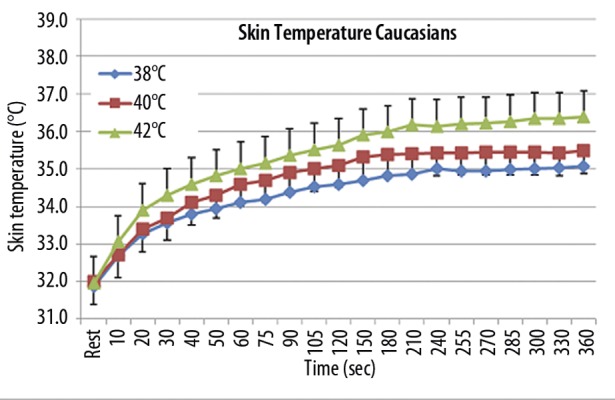
MATERIAL/METHODS: Ten C and Ten SAI (<35 years old) male and female subjects participated. There was no difference in the demographics of the subjects except that the SAI group had been in the United States for 6 months; C was natives to the US. Endothelial function was assessed by the response of the circulation (BF) to local heating and the response to vascular occlusion. The effects of local heat on circulation in the skin on the forearm was assessed by applying heat for 6 minutes at temperatures, 38, 40 and 42°C on 3 separate days. On different days, vascular occlusion was applied for 4 minutes to the same arm and skin blood flow was measured for 2 minutes after occlusion; skin temperature was either 31°C or 42°C.
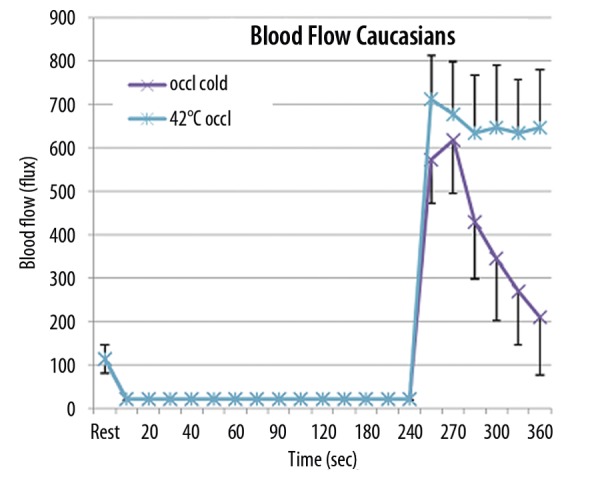
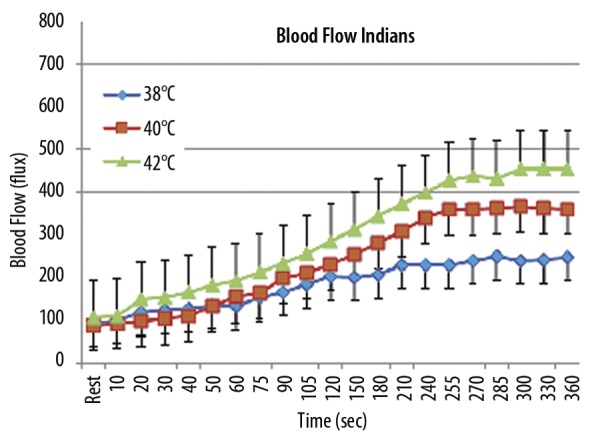
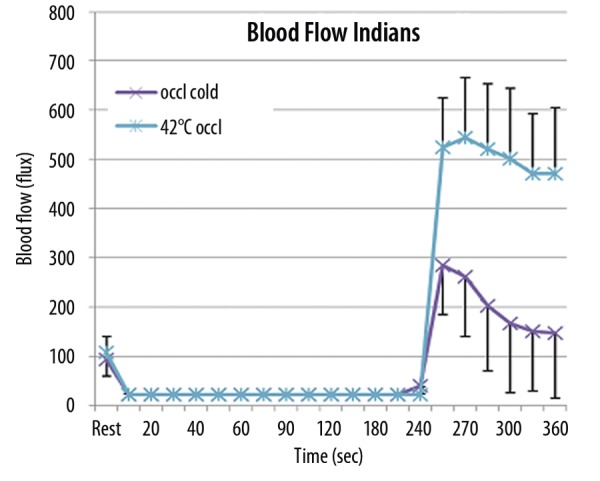
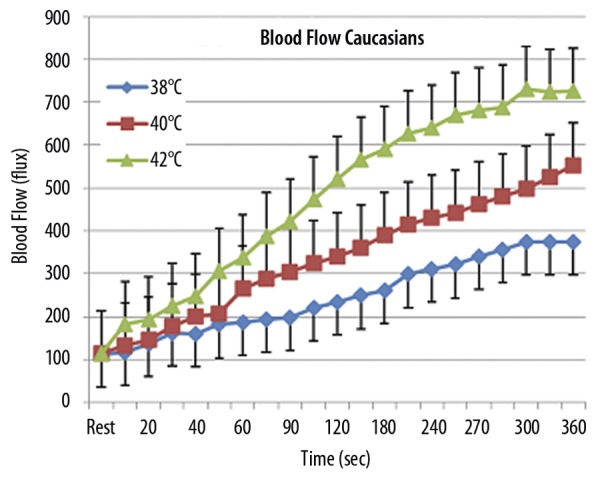
When occlusion was applied at a skin temperature of 31°C, the BF response to occlusion was significantly lower in the SAI cohort compared to C (peak BF C = 617 ± 88.2 flux, SAE = 284 ± 73 flux). The same effect was seen at skin temperatures of 42°C. The circulatory response to heat was also significantly less in SAI compared to C at each temperature examined (p<0.05)(for temperatures of 38, 40 and 42°C, peak blood flow for C was 374.7 ± 81.2, 551.9 ± 91.3 and 725.9 ± 107 flux respectively and 248.5 ± 86.2, 361.4 ± 104.3 and 455.3 ± 109.7 flux respectively for SAI. (p<0.05).
Thus there seems to be big differences in these 2 populations in endothelial response to these stressors. The difference may be due to genetic variations between the 2 groups of subjects.
尽管在种族之间的内皮细胞中发现了遗传差异,但尚未研究东南亚印度人(SAI)与高加索人(C)的血管内皮细胞对闭塞和热量的反应。
材料/方法:十名 C 和十名 SAI(<35 岁)的男性和女性参与者参加了研究。参与者的人口统计学特征没有差异,只是 SAI 组在美国生活了 6 个月;C 是美国本地人。内皮功能通过循环(BF)对局部加热和血管闭塞的反应来评估。通过在 3 天内分别应用 38、40 和 42°C 的温度加热 6 分钟来评估前臂皮肤循环对热量的影响。在不同的日子里,将血管闭塞应用于同一手臂 4 分钟,并在闭塞后 2 分钟测量皮肤血流量;皮肤温度为 31°C 或 42°C。
当皮肤温度为 31°C 时,SAI 队列的 BF 对闭塞的反应明显低于 C(峰值 BF C = 617 ± 88.2 通量,SAE = 284 ± 73 通量)。在皮肤温度为 42°C 时也观察到相同的效果。与 C 相比,SAI 对热的循环反应在每个检查的温度下也明显降低(p<0.05)(对于 38、40 和 42°C 的温度,C 的峰值血流为 374.7 ± 81.2、551.9 ± 91.3 和 725.9 ± 107 通量,分别为 248.5 ± 86.2、361.4 ± 104.3 和 455.3 ± 109.7 通量分别为 SAI。(p<0.05)。
因此,这两个群体的内皮对这些应激源的反应似乎存在很大差异。这种差异可能是由于两组受试者之间的遗传差异。