• 文献检索
  • 文档翻译
  • 深度研究
  • 学术资讯
  • Suppr Zotero 插件Zotero 插件
  • 邀请有礼
  • 套餐&价格
  • 历史记录
应用&插件
Suppr Zotero 插件Zotero 插件浏览器插件Mac 客户端Windows 客户端微信小程序
定价
高级版会员购买积分包购买API积分包
服务
文献检索文档翻译深度研究API 文档MCP 服务
关于我们
关于 Suppr公司介绍联系我们用户协议隐私条款
关注我们

Suppr 超能文献

核心技术专利:CN118964589B侵权必究
粤ICP备2023148730 号-1Suppr @ 2026

文献检索

告别复杂PubMed语法,用中文像聊天一样搜索,搜遍4000万医学文献。AI智能推荐,让科研检索更轻松。

立即免费搜索

文件翻译

保留排版,准确专业,支持PDF/Word/PPT等文件格式,支持 12+语言互译。

免费翻译文档

深度研究

AI帮你快速写综述,25分钟生成高质量综述,智能提取关键信息,辅助科研写作。

立即免费体验

SPINE-D:基于单个神经网络的方法准确预测短和长的无序区域。

SPINE-D: accurate prediction of short and long disordered regions by a single neural-network based method.

机构信息

School of Informatics, Indiana University Purdue University, Indianapolis, IN, USA.

出版信息

J Biomol Struct Dyn. 2012;29(4):799-813. doi: 10.1080/073911012010525022.

DOI:10.1080/073911012010525022
PMID:22208280
原文链接:https://pmc.ncbi.nlm.nih.gov/articles/PMC3297974/
Abstract

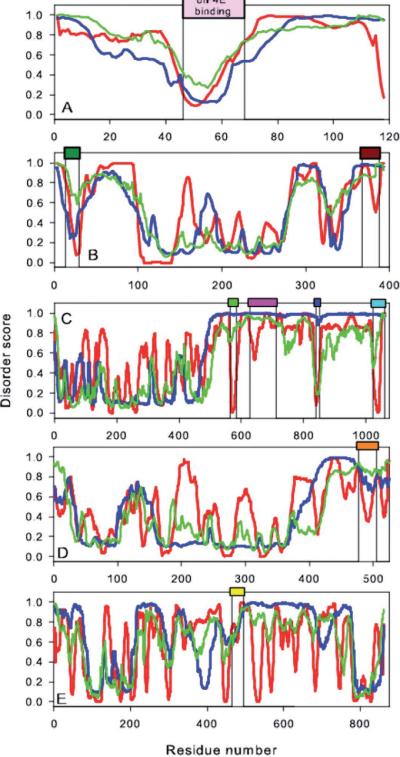
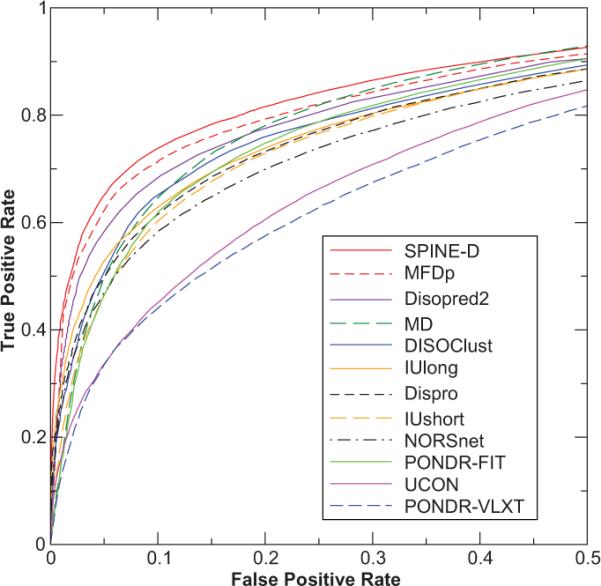
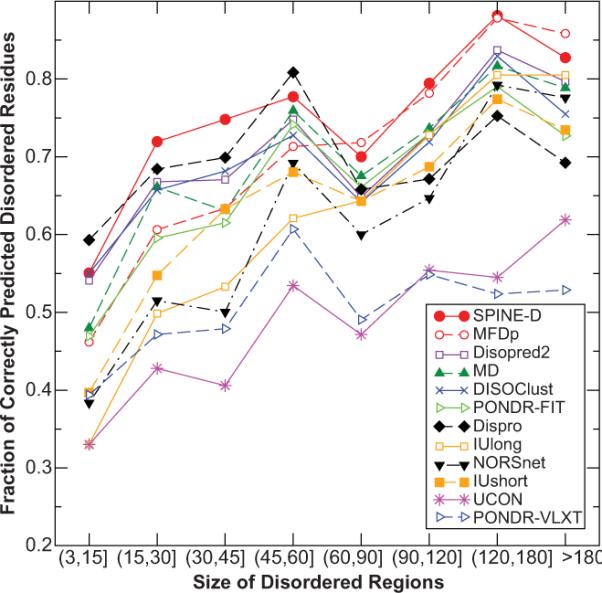
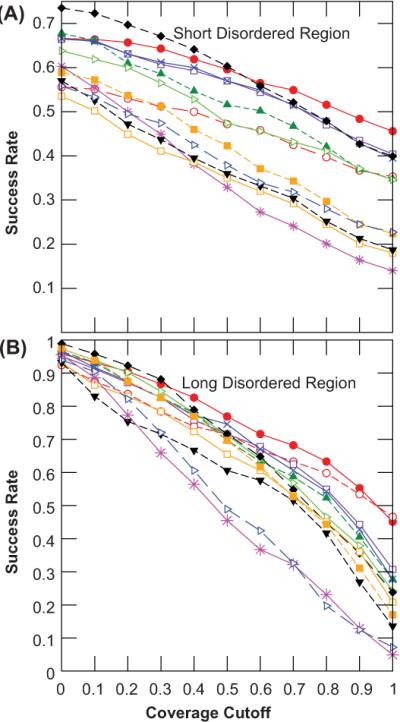
Short and long disordered regions of proteins have different preference for different amino acid residues. Different methods often have to be trained to predict them separately. In this study, we developed a single neural-network-based technique called SPINE-D that makes a three-state prediction first (ordered residues and disordered residues in short and long disordered regions) and reduces it into a two-state prediction afterwards. SPINE-D was tested on various sets composed of different combinations of Disprot annotated proteins and proteins directly from the PDB annotated for disorder by missing coordinates in X-ray determined structures. While disorder annotations are different according to Disprot and X-ray approaches, SPINE-D's prediction accuracy and ability to predict disorder are relatively independent of how the method was trained and what type of annotation was employed but strongly depend on the balance in the relative populations of ordered and disordered residues in short and long disordered regions in the test set. With greater than 85% overall specificity for detecting residues in both short and long disordered regions, the residues in long disordered regions are easier to predict at 81% sensitivity in a balanced test dataset with 56.5% ordered residues but more challenging (at 65% sensitivity) in a test dataset with 90% ordered residues. Compared to eleven other methods, SPINE-D yields the highest area under the curve (AUC), the highest Mathews correlation coefficient for residue-based prediction, and the lowest mean square error in predicting disorder contents of proteins for an independent test set with 329 proteins. In particular, SPINE-D is comparable to a meta predictor in predicting disordered residues in long disordered regions and superior in short disordered regions. SPINE-D participated in CASP 9 blind prediction and is one of the top servers according to the official ranking. In addition, SPINE-D was examined for prediction of functional molecular recognition motifs in several case studies.

摘要

蛋白质的短和长无序区域对不同的氨基酸残基有不同的偏好。通常需要针对它们分别训练不同的方法。在这项研究中,我们开发了一种基于单一神经网络的技术,称为 SPINE-D,它首先进行三状态预测(有序残基和短、长无序区域中的无序残基),然后将其简化为二状态预测。SPINE-D 在各种由不同 Disprot 注释蛋白质和直接从 PDB 中注释的蛋白质组成的集合上进行了测试,这些蛋白质的无序状态是通过 X 射线确定结构中缺失坐标来注释的。虽然 Disprot 和 X 射线方法的无序注释不同,但 SPINE-D 的预测准确性和无序预测能力相对独立于训练方法和使用的注释类型,但强烈依赖于测试集中短和长无序区域中有序和无序残基的相对比例的平衡。对于检测短和长无序区域中的残基,总体特异性大于 85%,在具有 56.5%有序残基的平衡测试数据集(81%的灵敏度)中,长无序区域中的残基更容易预测,但在具有 90%有序残基的测试数据集(65%的灵敏度)中更具挑战性。与其他 11 种方法相比,SPINE-D 在独立测试集上具有最高的曲线下面积(AUC)、基于残基预测的最高 Matthews 相关系数和最低的均方误差,用于预测蛋白质的无序含量。特别是,SPINE-D 在预测长无序区域中的无序残基方面与元预测器相当,在短无序区域中表现更好。SPINE-D 参加了 CASP 9 盲测,根据官方排名,它是排名最高的服务器之一。此外,SPINE-D 还在几个案例研究中用于预测功能分子识别基序。
https://cdn.ncbi.nlm.nih.gov/pmc/blobs/9b07/3297974/ea551564dc3d/nihms-360421-f0005.jpg
https://cdn.ncbi.nlm.nih.gov/pmc/blobs/9b07/3297974/814cd96064b6/nihms-360421-f0001.jpg
https://cdn.ncbi.nlm.nih.gov/pmc/blobs/9b07/3297974/c96efc88fdab/nihms-360421-f0002.jpg
https://cdn.ncbi.nlm.nih.gov/pmc/blobs/9b07/3297974/ef9b68aae3e4/nihms-360421-f0003.jpg
https://cdn.ncbi.nlm.nih.gov/pmc/blobs/9b07/3297974/f82dc424c692/nihms-360421-f0004.jpg
https://cdn.ncbi.nlm.nih.gov/pmc/blobs/9b07/3297974/ea551564dc3d/nihms-360421-f0005.jpg
https://cdn.ncbi.nlm.nih.gov/pmc/blobs/9b07/3297974/814cd96064b6/nihms-360421-f0001.jpg
https://cdn.ncbi.nlm.nih.gov/pmc/blobs/9b07/3297974/c96efc88fdab/nihms-360421-f0002.jpg
https://cdn.ncbi.nlm.nih.gov/pmc/blobs/9b07/3297974/ef9b68aae3e4/nihms-360421-f0003.jpg
https://cdn.ncbi.nlm.nih.gov/pmc/blobs/9b07/3297974/f82dc424c692/nihms-360421-f0004.jpg
https://cdn.ncbi.nlm.nih.gov/pmc/blobs/9b07/3297974/ea551564dc3d/nihms-360421-f0005.jpg

相似文献

1
SPINE-D: accurate prediction of short and long disordered regions by a single neural-network based method.SPINE-D:基于单个神经网络的方法准确预测短和长的无序区域。
J Biomol Struct Dyn. 2012;29(4):799-813. doi: 10.1080/073911012010525022.
2
Length-dependent prediction of protein intrinsic disorder.蛋白质内在无序性的长度依赖性预测。
BMC Bioinformatics. 2006 Apr 17;7:208. doi: 10.1186/1471-2105-7-208.
3
Intrinsic disorder in the Protein Data Bank.蛋白质数据库中的内在无序状态。
J Biomol Struct Dyn. 2007 Feb;24(4):325-42. doi: 10.1080/07391102.2007.10507123.
4
Intrinsic Disorder and Semi-disorder Prediction by SPINE-D.利用SPINE-D进行内在无序和半无序预测。
Methods Mol Biol. 2017;1484:159-174. doi: 10.1007/978-1-4939-6406-2_12.
5
Intrinsically semi-disordered state and its role in induced folding and protein aggregation.固有半无序状态及其在诱导折叠和蛋白质聚集中的作用。
Cell Biochem Biophys. 2013;67(3):1193-205. doi: 10.1007/s12013-013-9638-0.
6
Predicting intrinsic disorder from amino acid sequence.从氨基酸序列预测内在无序性。
Proteins. 2003;53 Suppl 6:566-72. doi: 10.1002/prot.10532.
7
The Ising model for prediction of disordered residues from protein sequence alone.仅基于蛋白质序列预测无序残基的伊辛模型。
Phys Biol. 2011 Jun;8(3):035004. doi: 10.1088/1478-3975/8/3/035004. Epub 2011 May 13.
8
RFPR-IDP: reduce the false positive rates for intrinsically disordered protein and region prediction by incorporating both fully ordered proteins and disordered proteins.RFPR-IDP:通过同时纳入完全有序的蛋白质和无序的蛋白质,降低内在无序蛋白质和区域预测的假阳性率。
Brief Bioinform. 2021 Mar 22;22(2):2000-2011. doi: 10.1093/bib/bbaa018.
9
PredIDR: Accurate prediction of protein intrinsic disorder regions using deep convolutional neural network.PredIDR:使用深度卷积神经网络准确预测蛋白质内在无序区域。
Int J Biol Macromol. 2025 Jan;284(Pt 1):137665. doi: 10.1016/j.ijbiomac.2024.137665. Epub 2024 Nov 19.
10
Improving protein disorder prediction by deep bidirectional long short-term memory recurrent neural networks.通过深度双向长短期记忆循环神经网络改进蛋白质无序预测。
Bioinformatics. 2017 Mar 1;33(5):685-692. doi: 10.1093/bioinformatics/btw678.

引用本文的文献

1
Exploration of Comprehensive Structural and Functional Potential of Recombinant Proteins Using Cutting-Edge Bioinformatics Tools.使用前沿生物信息学工具探索重组蛋白的综合结构和功能潜力。
Appl Biochem Biotechnol. 2025 Sep 9. doi: 10.1007/s12010-025-05366-2.
2
FusionEncoder: identification of intrinsically disordered regions based on multi-feature fusion.融合编码器:基于多特征融合的内在无序区域识别
Bioinformatics. 2025 Jul 1;41(7). doi: 10.1093/bioinformatics/btaf362.
3
IDP-EDL: enhancing intrinsically disordered protein prediction by combining protein language model and ensemble deep learning.

本文引用的文献

1
SPINE X: improving protein secondary structure prediction by multistep learning coupled with prediction of solvent accessible surface area and backbone torsion angles.SPINE X:通过多步骤学习与溶剂可及表面积和骨架扭转角预测相结合来改进蛋白质二级结构预测。
J Comput Chem. 2012 Jan 30;33(3):259-67. doi: 10.1002/jcc.21968. Epub 2011 Nov 2.
2
Evaluation of disorder predictions in CASP9.评估 CASP9 中的无序预测。
Proteins. 2011;79 Suppl 10(S10):107-18. doi: 10.1002/prot.23161. Epub 2011 Sep 16.
3
In-silico prediction of disorder content using hybrid sequence representation.
IDP-EDL:通过结合蛋白质语言模型和集成深度学习增强内在无序蛋白质预测
Brief Bioinform. 2025 Mar 4;26(2). doi: 10.1093/bib/bbaf182.
4
Precise prediction of phase-separation key residues by machine learning.通过机器学习准确预测相分离关键残基。
Nat Commun. 2024 Mar 26;15(1):2662. doi: 10.1038/s41467-024-46901-9.
5
DisoFLAG: accurate prediction of protein intrinsic disorder and its functions using graph-based interaction protein language model.DisoFLAG:基于图的互作蛋白语言模型准确预测蛋白质固有无序及其功能。
BMC Biol. 2024 Jan 2;22(1):3. doi: 10.1186/s12915-023-01803-y.
6
Protein intrinsically disordered region prediction by combining neural architecture search and multi-objective genetic algorithm.通过结合神经结构搜索和多目标遗传算法进行蛋白质无规则区域预测。
BMC Biol. 2023 Sep 7;21(1):188. doi: 10.1186/s12915-023-01672-5.
7
ADOPT: intrinsic protein disorder prediction through deep bidirectional transformers.ADOPT:通过深度双向变压器进行内在蛋白质无序预测。
NAR Genom Bioinform. 2023 May 1;5(2):lqad041. doi: 10.1093/nargab/lqad041. eCollection 2023 Jun.
8
Computational Prediction of Protein Intrinsically Disordered Region Related Interactions and Functions.计算预测蛋白质无规卷曲区域相关相互作用和功能。
Genes (Basel). 2023 Feb 8;14(2):432. doi: 10.3390/genes14020432.
9
TransDFL: Identification of Disordered Flexible Linkers in Proteins by Transfer Learning.基于迁移学习的蛋白质无序柔性连接子识别
Genomics Proteomics Bioinformatics. 2023 Apr;21(2):359-369. doi: 10.1016/j.gpb.2022.10.004. Epub 2022 Oct 19.
10
Prediction of protein-protein interaction sites in intrinsically disordered proteins.内在无序蛋白质中蛋白质-蛋白质相互作用位点的预测
Front Mol Biosci. 2022 Sep 30;9:985022. doi: 10.3389/fmolb.2022.985022. eCollection 2022.
使用混合序列表示进行无规则内容的计算预测。
BMC Bioinformatics. 2011 Jun 17;12:245. doi: 10.1186/1471-2105-12-245.
4
Improved sequence-based prediction of disordered regions with multilayer fusion of multiple information sources.基于多层融合多种信息源的改进序列预测无序区域。
Bioinformatics. 2010 Sep 15;26(18):i489-96. doi: 10.1093/bioinformatics/btq373.
5
Fluctuations of backbone torsion angles obtained from NMR-determined structures and their prediction.从 NMR 确定的结构中获得的骨架扭转角的波动及其预测。
Proteins. 2010 Dec;78(16):3353-62. doi: 10.1002/prot.22842.
6
Parameterization of disorder predictors for large-scale applications requiring high specificity by using an extended benchmark dataset.利用扩展基准数据集,对需要高特异性的大规模应用进行无序预测因子的参数化。
BMC Genomics. 2010 Feb 10;11 Suppl 1(Suppl 1):S15. doi: 10.1186/1471-2164-11-S1-S15.
7
Understanding protein non-folding.理解蛋白质的非折叠状态。
Biochim Biophys Acta. 2010 Jun;1804(6):1231-64. doi: 10.1016/j.bbapap.2010.01.017. Epub 2010 Feb 1.
8
PONDR-FIT: a meta-predictor of intrinsically disordered amino acids.PONDR-FIT:一种内在无序氨基酸的元预测器。
Biochim Biophys Acta. 2010 Apr;1804(4):996-1010. doi: 10.1016/j.bbapap.2010.01.011. Epub 2010 Jan 25.
9
The protein kingdom extended: ordered and intrinsically disordered proteins, their folding, supramolecular complex formation, and aggregation.蛋白质王国的扩展:有序和无序蛋白质、它们的折叠、超分子复合物形成和聚集。
Prog Biophys Mol Biol. 2010 Jun-Jul;102(2-3):73-84. doi: 10.1016/j.pbiomolbio.2010.01.003. Epub 2010 Jan 25.
10
Predicting continuous local structure and the effect of its substitution for secondary structure in fragment-free protein structure prediction.预测连续局部结构及其在无片段蛋白质结构预测中取代二级结构的效果。
Structure. 2009 Nov 11;17(11):1515-27. doi: 10.1016/j.str.2009.09.006.