Kenya Medical Research Institute - Wellcome Trust Research Programme, Nairobi, Kenya.
BMC Pediatr. 2012 Jan 1;12:1. doi: 10.1186/1471-2431-12-1.
The development of evidence-based clinical practice guidelines has gained wide acceptance in high-income countries and reputable international organizations. Whereas this approach may be a desirable standard, challenges remain in low-income settings with limited capacity and resources for evidence synthesis and guideline development. We present our experience using the Grading of Recommendations Assessment, Development and Evaluation (GRADE) approach for the recent revision of the Kenyan pediatric clinical guidelines focusing on antibiotic treatment of pneumonia.
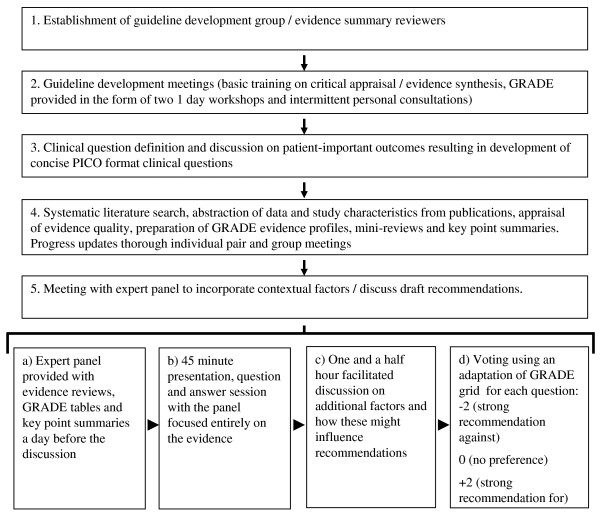
A team of health professionals, many with minimal prior experience conducting systematic reviews, carried out evidence synthesis for structured clinical questions. Summaries were compiled and distributed to a panel of clinicians, academicians and policy-makers to generate recommendations based on best available research evidence and locally-relevant contextual factors.
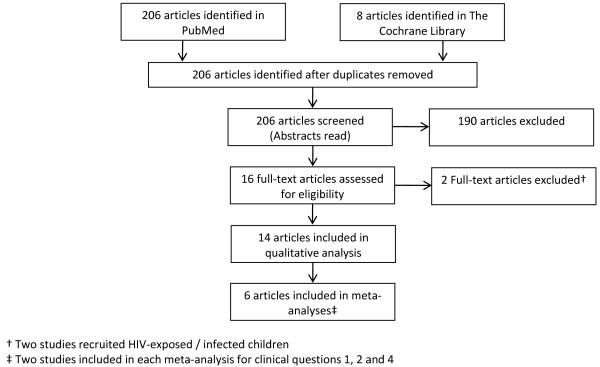
We reviewed six eligible articles on non-severe and 13 on severe/very severe pneumonia. Moderate quality evidence suggesting similar clinical outcomes comparing amoxicillin and cotrimoxazole for non-severe pneumonia received a strong recommendation against adopting amoxicillin. The panel voted strongly against amoxicillin for severe pneumonia over benzyl penicillin despite moderate quality evidence suggesting clinical equivalence between the two and additional factors favoring amoxicillin. Very low quality evidence suggesting ceftriaxone was as effective as the standard benzyl penicillin plus gentamicin for very severe pneumonia received a strong recommendation supporting the standard treatment.
Although this exercise may have fallen short of the rigorous requirements recommended by the developers of GRADE, it was arguably an improvement on previous attempts at guideline development in low-income countries and offers valuable lessons for future similar exercises where resources and locally-generated evidence are scarce.
基于证据的临床实践指南的制定在高收入国家和有声誉的国际组织中得到了广泛认可。虽然这种方法可能是一种理想的标准,但在资源有限、证据综合和指南制定能力有限的低收入环境中,仍然存在挑战。我们介绍了在肯尼亚儿科临床指南最近修订中使用推荐评估、制定和评估(GRADE)方法的经验,重点是肺炎的抗生素治疗。
一组卫生专业人员,其中许多人在进行系统评价方面经验有限,针对结构化临床问题进行了证据综合。总结报告被编制并分发给一组临床医生、学者和决策者,根据最佳现有研究证据和当地相关背景因素生成建议。
我们对 6 篇关于非严重肺炎和 13 篇关于严重/非常严重肺炎的合格文章进行了回顾。质量中等的证据表明,在非严重肺炎中比较阿莫西林和复方磺胺甲噁唑的临床结局相似,强烈反对采用阿莫西林。尽管有中等质量的证据表明两者在临床等效性方面存在差异,并且有其他因素支持阿莫西林,但专家组强烈反对在严重肺炎中使用阿莫西林代替苄青霉素。质量非常低的证据表明头孢曲松与标准的苄青霉素加庆大霉素治疗非常严重的肺炎同样有效,强烈支持使用标准治疗。
尽管这项工作可能没有达到 GRADE 制定者推荐的严格要求,但与低收入国家以前的指南制定尝试相比,可以说是一种改进,并为未来资源和本地生成证据稀缺的类似工作提供了宝贵的经验教训。