Medical Sciences Division, University of Oxford, Oxford, UK; Oxford University Hospitals NHS Foundation Trust, Oxford, UK.
Oxford University Hospitals NHS Foundation Trust, Oxford, UK.
Lancet Child Adolesc Health. 2020 Oct;4(10):750-760. doi: 10.1016/S2352-4642(20)30182-6. Epub 2020 Jul 28.
Background Increasing numbers of neonates are undergoing painful procedures in low-income and middle-income countries, with adequate analgesia seldom used. In collaboration with a multi-disciplinary team in Kenya, we aimed to establish the first evidence-based guidelines for the management of routine procedure-related neonatal pain that consider low-resource hospital settings.
We did a systematic review by searching MEDLINE, Embase, CINAHL, and CENTRAL databases for studies published from Jan 1, 1953, to March 31, 2019. We included data from randomised controlled trials using heart rate, oxygen saturation (SpO), premature infant pain profile (PIPP) score, neonatal infant pain scale (NIPS) score, neonatal facial coding system score, and douleur aiguë du nouveau-né scale score as pain outcome measures. We excluded studies in which neonates were undergoing circumcision or were intubated, studies from which data were unextractable, or when pain was scored by non-trained individuals. We did a narrative synthesis of all studies, and meta-analysis when data were available from multiple studies comparing the same analgesics and controls and using the same outcome measures. 17 Kenyan health-care professionals formed our clinical guideline development panel, and we used the Grading of Recommendations, Assessment, Development and Evaluation framework and the panel's knowledge of the local health-care context to guide the guideline development process. This study is registered with PROSPERO, CRD42019126620.
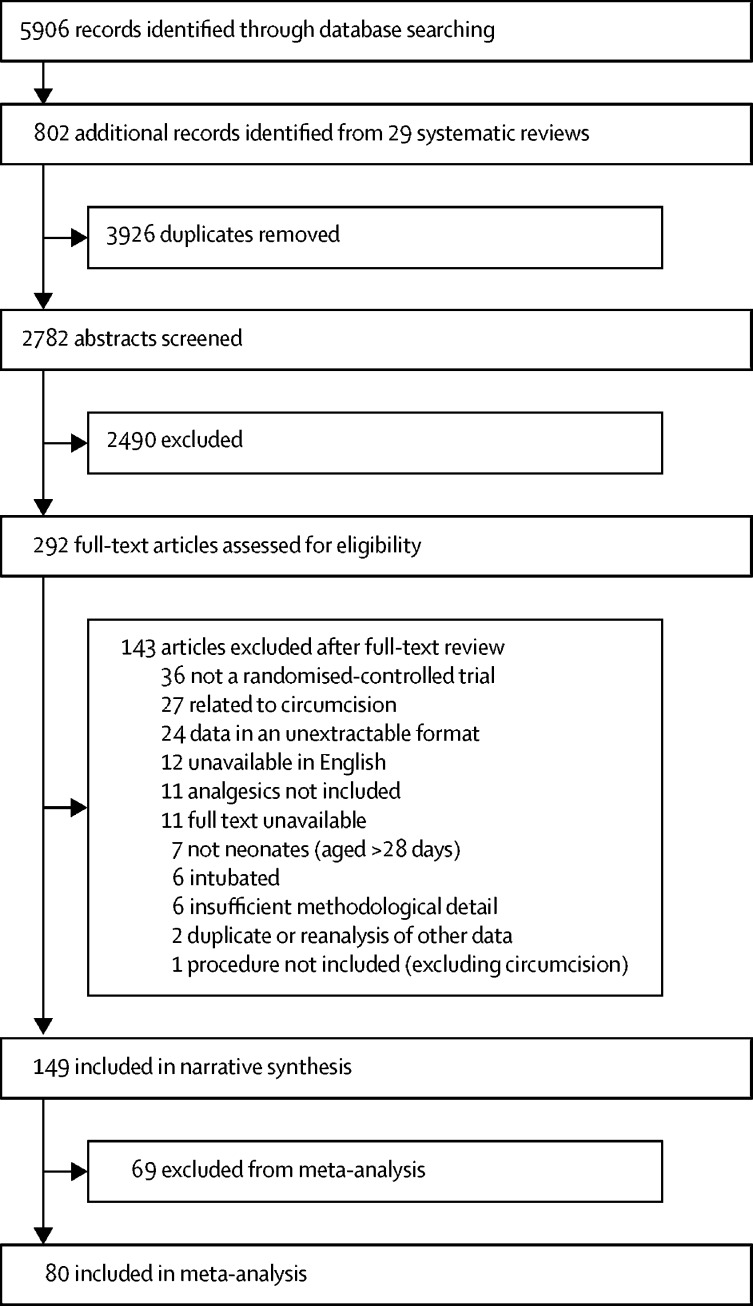
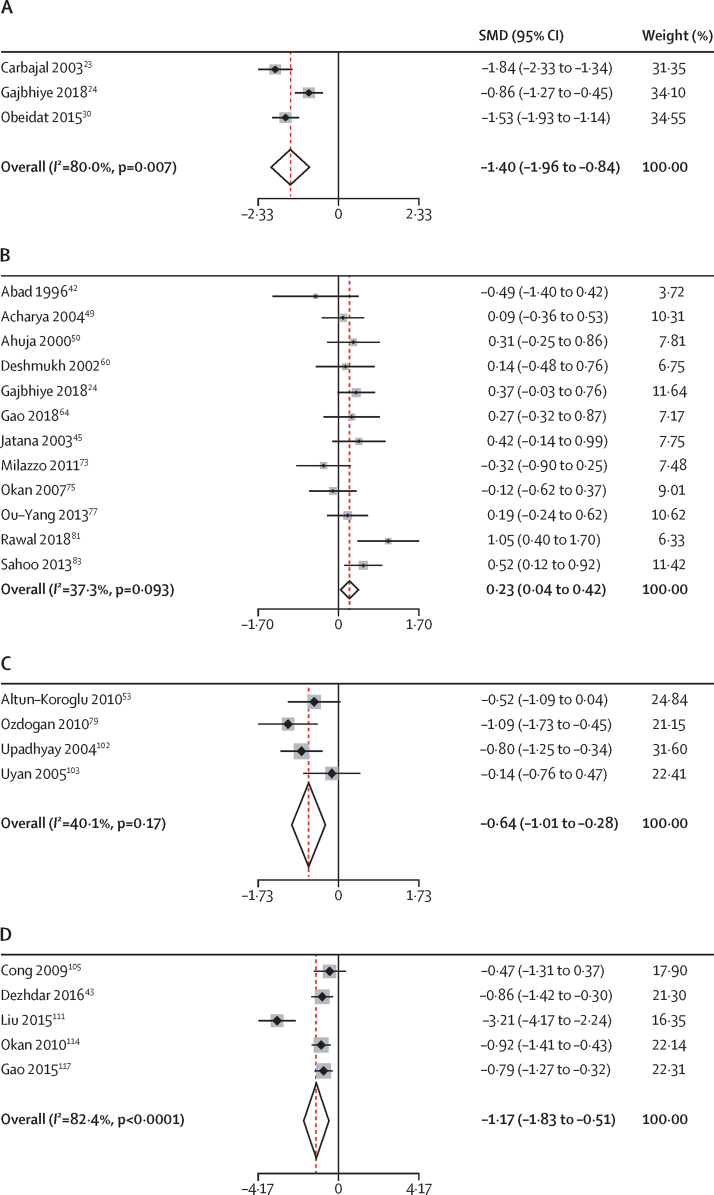
Of 2782 studies assessed for eligibility, data from 149 (5%) were analysed, with 80 (3%) of these further contributing to our meta-analysis. We found a high level of certainty for the superiority of breastfeeding over placebo or no intervention (standardised mean differences [SMDs] were -1·40 [95% CI -1·96 to -0·84] in PIPP score and -2·20 [-2·91 to -1·48] in NIPS score), and the superiority of oral sugar solutions over placebo or no intervention (SMDs were -0·38 [-0·61 to -0·16] in heart rate and 0·23 [0·04 to 0·42] in SpO). We found a moderate level of certainty for the superiority for expressed breastmilk over placebo or no intervention (SMDs were -0·46 [95% CI -0·87 to -0·05] in heart rate and 0·48 [0·20 to 0·75] in SpO). Therefore, the panel recommended that breastfeeding should be given as first-line analgesic treatment, initiated at least 2 min pre-procedure. Given contextual factors, for neonates who are unable to breastfeed, 1-2 mL of expressed breastmilk should be given as first-line analgesic, or 1-2 mL of oral sugar (≥10% concentration) as second-line analgesic. The panel also recommended parental presence during procedures with adjunctive provision of skin-to-skin care, or non-nutritive sucking when possible.
We have generated Kenya's first neonatal analgesic guidelines for routine procedures, which have been adopted by the Kenyan Ministry of Health, and have shown a framework for clinical guideline development that is applicable to other low-income and middle-income health-care settings.
Wellcome Trust Research Programme, and the Africa-Oxford Initiative.
在低收入和中等收入国家,越来越多的新生儿要接受有创性操作,但充分的镇痛措施却很少使用。我们与肯尼亚的一个多学科团队合作,旨在为常规操作相关的新生儿疼痛管理制定首份循证指南,这些指南将考虑到资源有限的医院环境。
我们对 1953 年 1 月 1 日至 2019 年 3 月 31 日期间发表的 MEDLINE、Embase、CINAHL 和 CENTRAL 数据库中的研究进行了系统检索。我们纳入了使用心率、氧饱和度(SpO2)、早产儿疼痛行为量表(PIPP)评分、新生儿疼痛量表(NIPS)评分、新生儿面部编码系统评分和新生儿疼痛评分量表(DNPS)评分作为疼痛结局指标的随机对照试验的数据。我们排除了接受包皮环切术或气管插管的新生儿、数据不可提取的研究,以及非专业人员评分的研究。我们对所有研究进行了叙述性综合分析,并在多个研究比较相同镇痛药物和对照且使用相同结局指标时进行了荟萃分析。17 名肯尼亚医疗保健专业人员组成了我们的临床指南制定小组,我们使用了推荐分级的评估、制定与评价(Grading of Recommendations,Assessment,Development and Evaluation,GRADE)框架和小组对当地医疗保健背景的了解来指导指南的制定过程。本研究已在 PROSPERO 注册,注册号为 CRD42019126620。
在评估的 2782 项研究中,有 149 项(5%)符合纳入标准,其中 80 项(3%)进一步纳入我们的荟萃分析。我们发现母乳喂养优于安慰剂或不干预的证据等级很高(PIPP 评分的标准化均数差[standardised mean differences,SMD]为-1.40[95%CI-1.96 至-0.84],NIPS 评分的 SMD 为-2.20[-2.91 至-1.48]),口服糖水优于安慰剂或不干预的证据等级也很高(心率的 SMD 为-0.38[-0.61 至-0.16],SpO2 的 SMD 为 0.23[0.04 至 0.42])。我们发现表达母乳优于安慰剂或不干预的证据等级为中度(心率的 SMD 为-0.46[95%CI-0.87 至-0.05],SpO2 的 SMD 为 0.48[0.20 至 0.75])。因此,专家组建议母乳喂养应作为一线镇痛治疗,至少在操作前 2 分钟开始。考虑到具体情况,对于无法母乳喂养的新生儿,应给予 1-2 mL 表达母乳作为一线镇痛治疗,或给予 1-2 mL 口服糖水(浓度≥10%)作为二线镇痛治疗。专家组还建议在操作过程中让父母陪伴,并辅助进行皮肤接触或在可能的情况下进行非营养性吸吮。
我们制定了肯尼亚首份常规操作的新生儿镇痛指南,该指南已被肯尼亚卫生部采纳,并展示了一种适用于其他低收入和中等收入国家医疗保健环境的临床指南制定框架。
英国惠康信托基金会研究项目和牛津非洲倡议。