Department of Chemical Engineering, Bogazici University, Istanbul, Turkey.
PLoS One. 2011;6(12):e29284. doi: 10.1371/journal.pone.0029284. Epub 2011 Dec 21.
Cellular mechanisms leading to aging and therefore increasing susceptibility to age-related diseases are a central topic of research since aging is the ultimate, yet not understood mechanism of the fate of a cell. Studies with model organisms have been conducted to ellucidate these mechanisms, and chronological aging of yeast has been extensively used as a model for oxidative stress and aging of postmitotic tissues in higher eukaryotes.
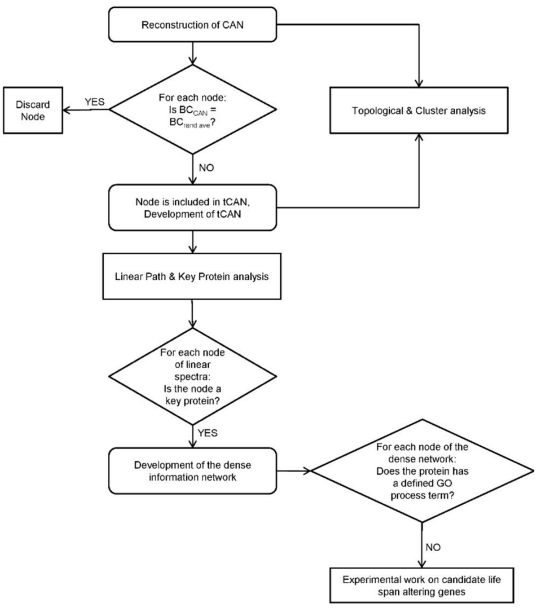
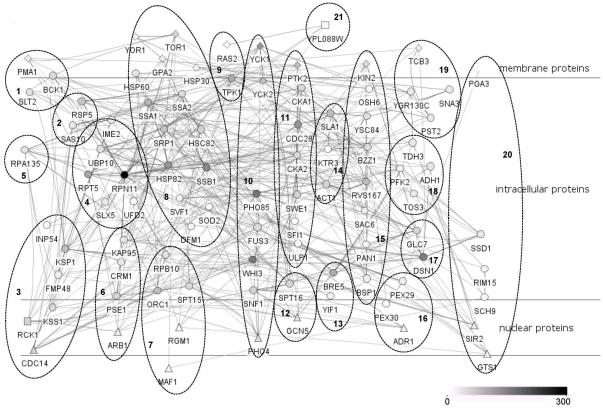
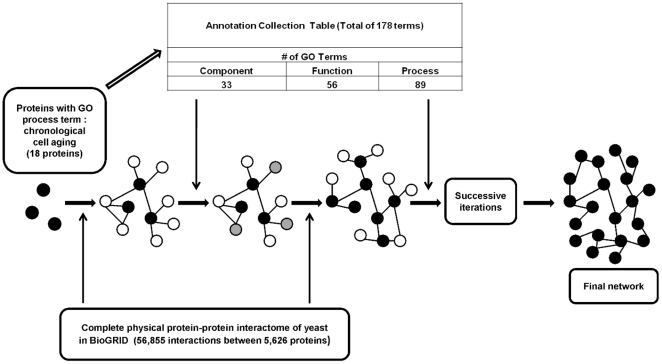
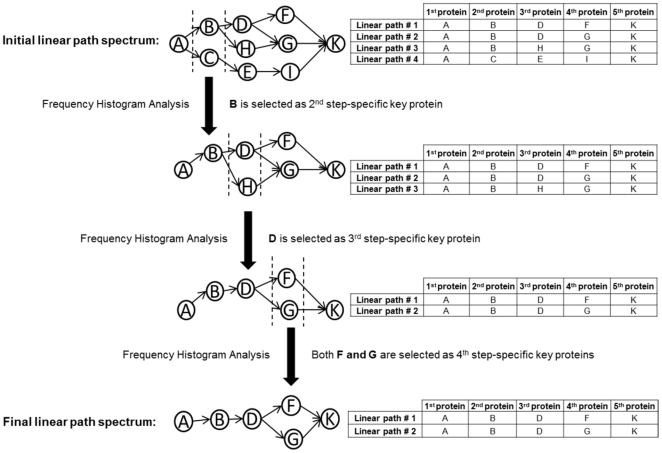
METHODOLOGY/PRINCIPAL FINDINGS: The chronological aging network of yeast was reconstructed by integrating protein-protein interaction data with gene ontology terms. The reconstructed network was then statistically "tuned" based on the betweenness centrality values of the nodes to compensate for the computer automated method. Both the originally reconstructed and tuned networks were subjected to topological and modular analyses. Finally, an ultimate "heart" network was obtained via pooling the step specific key proteins, which resulted from the decomposition of the linear paths depicting several signaling routes in the tuned network.
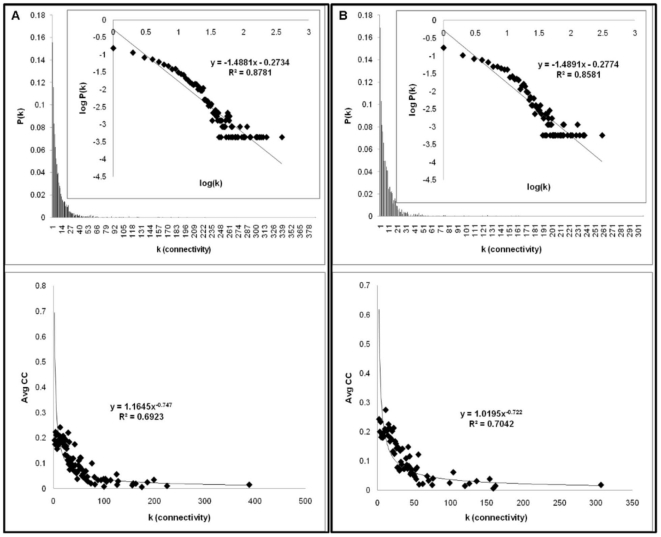
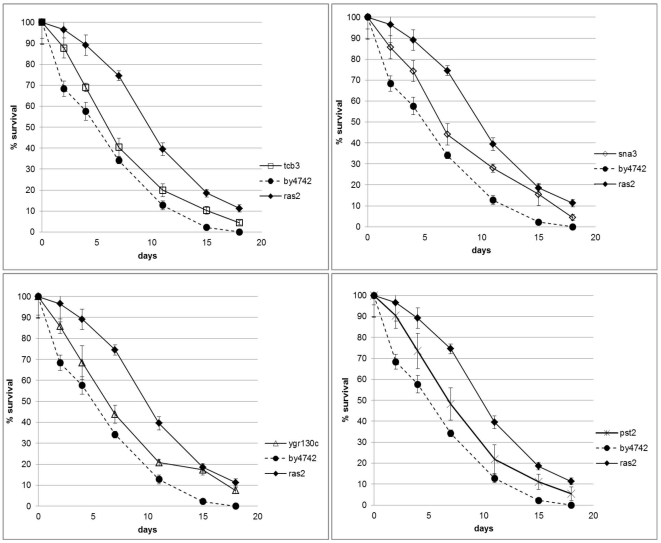
CONCLUSIONS/SIGNIFICANCE: The reconstructed networks are of scale-free and hierarchical nature, following a power law model with γ = 1.49. The results of modular and topological analyses verified that the tuning method was successful. The significantly enriched gene ontology terms of the modular analysis confirmed also that the multifactorial nature of chronological aging was captured by the tuned network. The interplay between various signaling pathways such as TOR, Akt/PKB and cAMP/Protein kinase A was summarized in the "heart" network originated from linear path analysis. The deletion of four genes, TCB3, SNA3, PST2 and YGR130C, was found to increase the chronological life span of yeast. The reconstructed networks can also give insight about the effect of other cellular machineries on chronological aging by targeting different signaling pathways in the linear path analysis, along with unraveling of novel proteins playing part in these pathways.
导致衰老和因此增加与年龄相关疾病易感性的细胞机制是研究的核心主题,因为衰老是细胞命运的最终但尚未被理解的机制。已经进行了使用模式生物的研究以阐明这些机制,并且酵母的时序老化已被广泛用作高等真核生物氧化应激和有丝分裂后组织衰老的模型。
方法/主要发现:通过将蛋白质-蛋白质相互作用数据与基因本体论术语集成,重建了酵母的时序老化网络。然后,根据节点的介数中心值对重建的网络进行了统计“调整”,以补偿计算机自动方法。最初重建和调整的网络都进行了拓扑和模块分析。最后,通过汇集来自调整网络中描绘几条信号通路的线性路径的特定关键蛋白质,获得了最终的“核心”网络。
结论/意义:重建的网络具有无标度和分层的性质,遵循幂律模型,γ=1.49。模块和拓扑分析的结果验证了调整方法是成功的。模块分析中显著富集的基因本体论术语也证实了调整网络捕捉了时序老化的多因素性质。TOR、Akt/PKB 和 cAMP/蛋白激酶 A 等各种信号通路之间的相互作用在源于线性路径分析的“核心”网络中得到了总结。删除四个基因 TCB3、SNA3、PST2 和 YGR130C 被发现可以延长酵母的时序寿命。通过在线性路径分析中靶向不同的信号通路,以及揭示在这些途径中发挥作用的新蛋白质,重建的网络还可以深入了解其他细胞机制对时序老化的影响。