Research Center of Health, Physical Fitness and Sports, Nagoya University, Chikusa, Nagoya, Japan.
PLoS One. 2011;6(12):e29638. doi: 10.1371/journal.pone.0029638. Epub 2011 Dec 28.
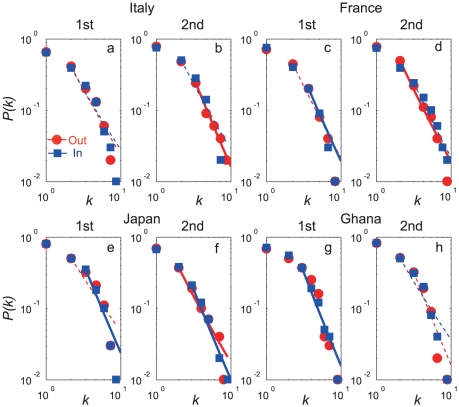
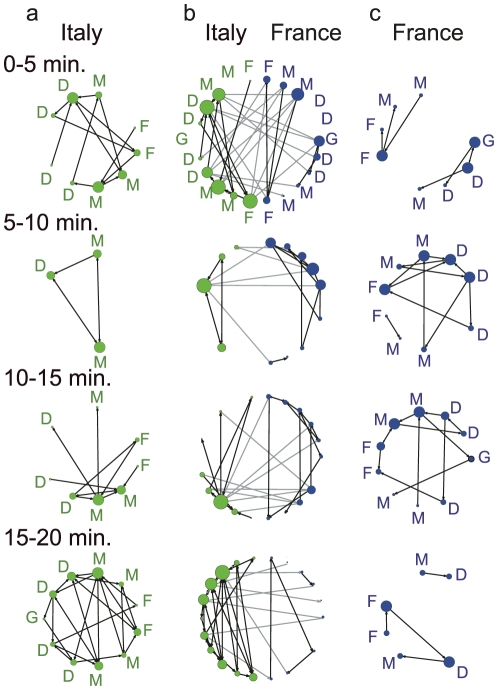
The sport of football is played between two teams of eleven players each using a spherical ball. Each team strives to score by driving the ball into the opposing goal as the result of skillful interactions among players. Football can be regarded from the network perspective as a competitive relationship between two cooperative networks with a dynamic network topology and dynamic network node. Many complex large-scale networks have been shown to have topological properties in common, based on a small-world network and scale-free network models. However, the human dynamic movement pattern of this network has never been investigated in a real-world setting. Here, we show that the power law in degree distribution emerged in the passing behavior in the 2006 FIFA World Cup Final and an international "A" match in Japan, by describing players as vertices connected by links representing passes. The exponent values γ ~ 3.1 are similar to the typical values that occur in many real-world networks, which are in the range of 2<γ<3, and are larger than that of a gene transcription network, γ ~ 1. Furthermore, we reveal the stochastically switched dynamics of the hub player throughout the game as a unique feature in football games. It suggests that this feature could result not only in securing vulnerability against intentional attack, but also in a power law for self-organization. Our results suggest common and unique network dynamics of two competitive networks, compared with the large-scale networks that have previously been investigated in numerous works. Our findings may lead to improved resilience and survivability not only in biological networks, but also in communication networks.
足球运动由两支各有 11 名球员组成的队伍进行,使用一个球形球。每个队都试图通过球员之间的熟练互动将球打入对方球门来得分。从网络的角度来看,足球可以被视为两个合作网络之间的竞争关系,具有动态的网络拓扑和动态的网络节点。许多复杂的大规模网络已经被证明具有共同的拓扑性质,基于小世界网络和无标度网络模型。然而,这个网络的人类动态运动模式从未在真实环境中被调查过。在这里,我们表明,在 2006 年世界杯决赛和日本的一场国际"A"级比赛中,传球行为的度分布呈幂律分布,通过将球员描述为通过代表传球的链接连接的顶点。指数值γ3.1 与许多真实网络中发生的典型值相似,范围在 2<γ<3 之间,并且大于基因转录网络的γ1。此外,我们揭示了游戏中枢纽球员的随机切换动态,这是足球比赛中的一个独特特征。这表明,这种特征不仅可以确保对故意攻击的脆弱性,而且可以实现自我组织的幂律。与之前在众多作品中研究过的大规模网络相比,我们的研究结果表明了两个竞争网络的共同和独特的网络动态。我们的研究结果不仅可能导致生物网络和通信网络的弹性和生存能力的提高。