Steinbeis Transfer Center for Proteome Analysis, Rostock, Germany.
PLoS One. 2011;6(12):e29648. doi: 10.1371/journal.pone.0029648. Epub 2011 Dec 27.
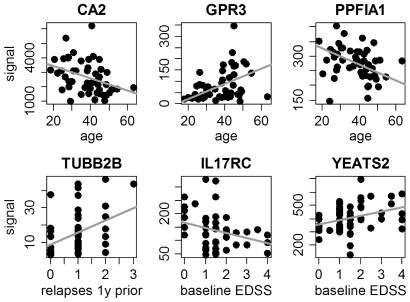
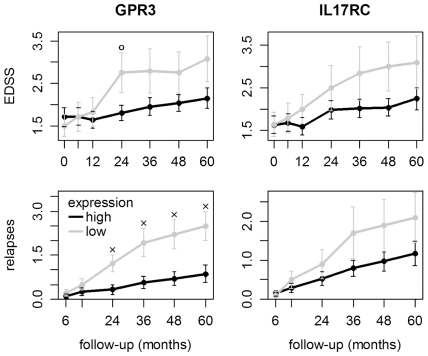
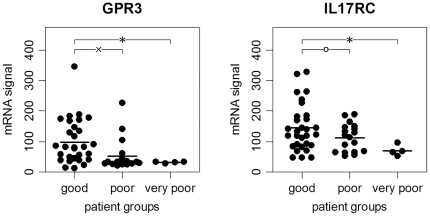
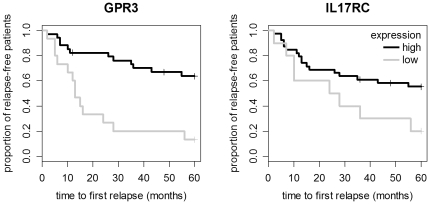
Despite considerable advances in the treatment of multiple sclerosis, current drugs are only partially effective. Most patients show reduced disease activity with therapy, but still experience relapses, increasing disability, and new brain lesions. Since there are no reliable clinical or biological markers of disease progression, long-term prognosis is difficult to predict for individual patients. We identified 18 studies that suggested genes expressed in blood as predictive biomarkers. We validated the prognostic value of those genes with three different microarray data sets comprising 148 patients in total. Using these data, we tested whether the genes were significantly differentially expressed between patients with good and poor courses of the disease. Poor progression was defined by relapses and/or increase of disability during a two-year follow-up, independent of the administered therapy. Of 110 genes that have been proposed as predictive biomarkers, most could not be confirmed in our analysis. However, the G protein-coupled membrane receptor GPR3 was expressed at significantly lower levels in patients with poor disease progression in all data sets. GPR3 has therefore a high potential to be a biomarker for predicting future disease activity. In addition, we examined the IL17 cytokines and receptors in more detail and propose IL17RC as a new, promising, transcript-based biomarker candidate. Further studies are needed to better understand the roles of these receptors in multiple sclerosis and its treatment and to clarify the utility of GPR3 and IL17RC expression levels in the blood as markers of long-term prognosis.
尽管多发性硬化症的治疗取得了相当大的进展,但目前的药物仅部分有效。大多数患者在治疗后疾病活动减少,但仍会出现复发,导致残疾加重和新的脑损伤。由于没有可靠的疾病进展的临床或生物学标志物,因此很难预测个体患者的长期预后。我们确定了 18 项研究,这些研究表明血液中表达的基因可作为预测生物标志物。我们使用三个不同的微阵列数据集(总共包含 148 名患者)验证了这些基因的预后价值。使用这些数据,我们测试了这些基因在疾病进程良好和较差的患者之间是否存在显著差异表达。较差的进展定义为在两年随访期间出现复发和/或残疾加重,与所使用的治疗无关。在被提议作为预测生物标志物的 110 个基因中,大多数在我们的分析中无法得到证实。然而,在所有数据集,G 蛋白偶联膜受体 GPR3 在疾病进展较差的患者中的表达水平显著较低。因此,GPR3 具有成为预测未来疾病活动的生物标志物的高潜力。此外,我们更详细地研究了白细胞介素 17 细胞因子和受体,并提出白细胞介素 17 受体 C(IL17RC)作为新的有前途的基于转录本的生物标志物候选物。需要进一步的研究来更好地了解这些受体在多发性硬化症及其治疗中的作用,并阐明血液中 GPR3 和 IL17RC 表达水平作为长期预后标志物的实用性。