Division of Cardiology, Department of Internal Medicine, Chang Gung Memorial Hospital-Kaohsiung Medical Center, Chang Gung University College of Medicine, Kaohsiung, Taiwan.
J Transl Med. 2012 Jan 5;10:6. doi: 10.1186/1479-5876-10-6.
Currently, no data on the optimal time point after acute ischemic stroke (IS) at which high-sensitivity C-reactive protein (hs-CRP) level is most predictive of unfavorable outcome. We tested the hypothesis that hs-CRP levels during both acute (48 h after IS) and convalescent (21 days after IS) phases are equally important in predicting 90-day clinical outcome after acute IS. We further evaluated the impact of erythropoietin (EPO), an anti-inflammatory agent, on level of hs-CRP after acute IS.
Totally 160 patients were prospectively randomized to receive either EPO therapy (group 1, n = 80) (5,000 IU each time, subcutaneously) at 48 h and 72 h after acute IS, or placebo (group 2, n = 80). Serum level of hs-CRP was determined using ELISA at 48 h and on day 21 after IS and once in 60 healthy volunteers.
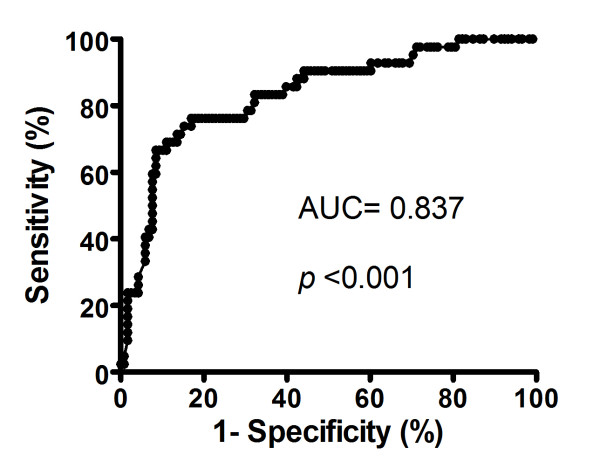
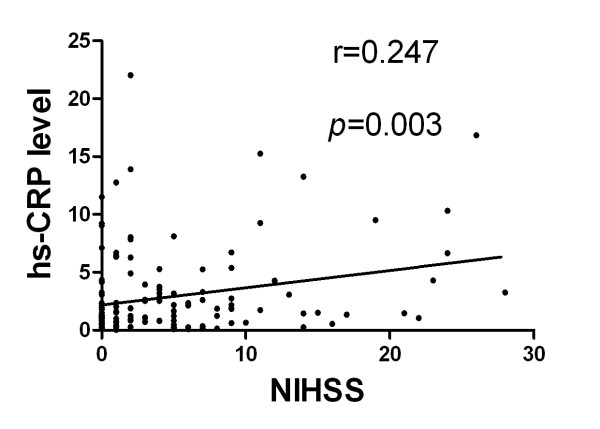
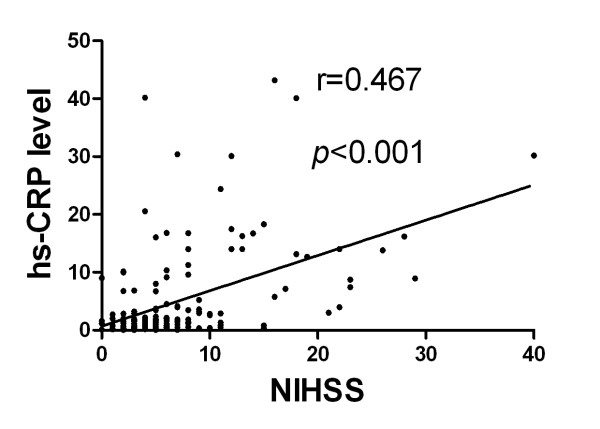
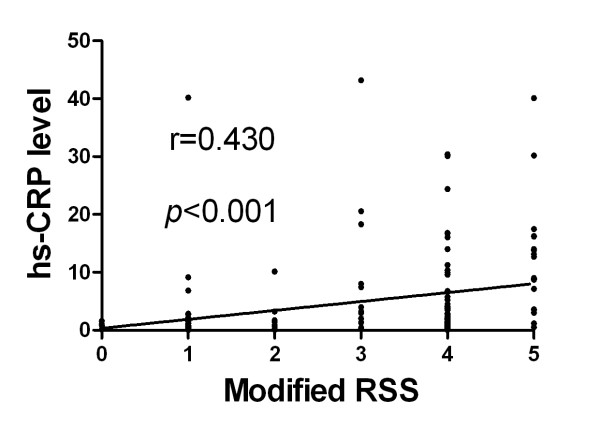
Serum level of hs-CRP was substantially higher in all patients with IS than in healthy controls at 48 h and day 21 after IS (all p < 0.001). Levels of hs-CRP did not differ between group 1 and 2 at 48 h and day 21 after IS (all p > 0.5). Multivariate analysis showed that hs-CRP levels (at 48 h and day 21) were independently predictive of 90-day major adverse neurological event (MANE) (defined as recurrent stroke, NIHSS≥8, or death) (all p < 0.03), whereas EPO therapy was independently predictive of reduced 90-day MANE (all p < 0.02).
EPO therapy which was independently predictive of freedom from 90-day MANE did not alter the crucial role of hs-CRP levels measured at 48 h and 21-day in predicting unfavorable clinical outcome after IS.
目前,尚无数据表明急性缺血性脑卒中(IS)后最佳时间点的高敏 C 反应蛋白(hs-CRP)水平对不良结局的预测价值最高。我们检验了以下假说,即在急性(IS 后 48 小时)和恢复期(IS 后 21 天)两个阶段,hs-CRP 水平对急性 IS 后 90 天临床结局的预测均具有同等重要性。我们进一步评估了促红细胞生成素(EPO),一种抗炎药物,对急性 IS 后 hs-CRP 水平的影响。
共 160 例患者前瞻性随机分为 EPO 治疗组(第 1 组,n = 80)(IS 后 48 小时和 72 小时各给予 5000IU,皮下注射)或安慰剂组(第 2 组,n = 80)。采用 ELISA 法在 IS 后 48 小时和 21 天以及 60 例健康志愿者中一次测定 hs-CRP 血清水平。
IS 患者在 IS 后 48 小时和 21 天的 hs-CRP 血清水平明显高于健康对照组(均 p < 0.001)。第 1 组和第 2 组在 IS 后 48 小时和 21 天的 hs-CRP 水平无差异(均 p > 0.5)。多变量分析显示,hs-CRP 水平(在 48 小时和 21 天)是 90 天主要不良神经事件(MANE)(定义为复发性中风、NIHSS≥8 或死亡)的独立预测因素(均 p < 0.03),而 EPO 治疗是 90 天 MANE 降低的独立预测因素(均 p < 0.02)。
EPO 治疗可独立预测 90 天 MANE 发生率降低,但不会改变 hs-CRP 水平在预测 IS 后不良临床结局中的关键作用,该作用在 IS 后 48 小时和 21 天测定时均具有重要意义。