Division of Cardiology, Department of Internal Medicine, Chang Gung Memorial Hospital - Kaohsiung Medical Center, Chang Gung University College of Medicine, 123 Ta-Pei Road, Niaosong District, Kaohsiung City 833, Taiwan.
Crit Care. 2011;15(1):R40. doi: 10.1186/cc10002. Epub 2011 Jan 26.
Erythropoietin (EPO) enhances the circulating level of endothelial progenitor cells (EPCs), which has been reported to be associated with prognostic outcome in ischemic stroke (IS) patients. The aim of this study was to evaluate the time course of circulating EPC level and the impact of EPO therapy on EPC level and clinical outcome in patients after acute IS.
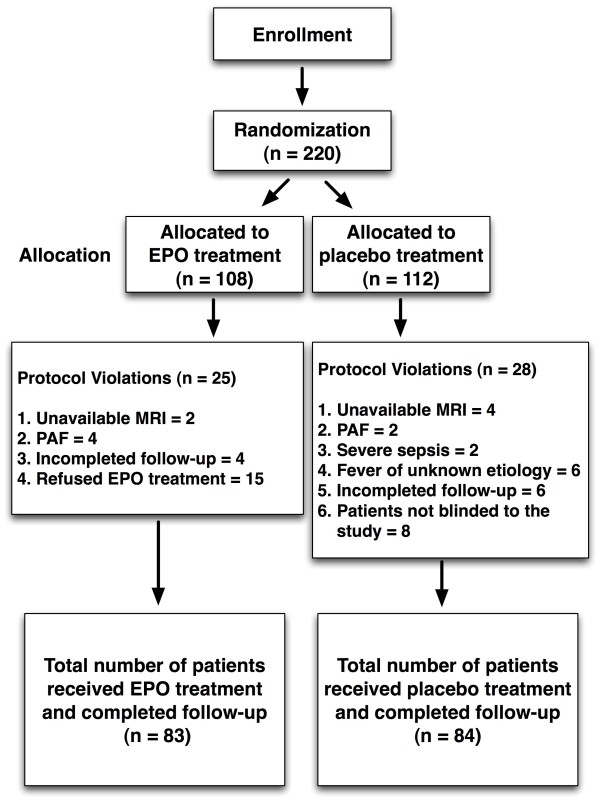
In total, 167 patients were prospectively randomized to receive either EPO therapy (group 1) (5,000 IU each time, subcutaneously) at 48 h and 72 h after acute IS, or serve as placebo (group 2). The circulating level of EPCs (double-stained markers: CD31/CD34 (E1), CD62E/CD34 (E2) and KDR/CD34 (E3)) was determined using flow cytometry at 48 h and on days 7 and 21 after IS. EPC level was also evaluated once in 60 healthy volunteers.
Circulating EPC (E1 to E3) level at 48 h after IS was remarkably higher in patients than in control subjects (P < 0.02). At 48 h and on Day 7 after IS, EPC (E1 to E3) level did not differ between groups 1 and 2 (all P > 0.1). However, by Day 21, EPC (E1 to E3) level was significantly higher in group 1 than in group 2 (all P < 0.03). Additionally, 90-day recurrent stroke rate was notably lower in group 1 compared with group 2 (P = 0.022). Multivariate analysis demonstrated that EPO therapy (95% confidence interval (CI), 0.153 to 0.730; P = 0.006) and EPC (E3) (95% CI, 0.341 to 0.997; P = 0.049) levels were significantly and independently predictive of a reduced 90-day major adverse neurological event (MANE) (defined as recurrent stroke, National Institutes of Health Stroke scale ≥8, or death).
EPO therapy significantly improved circulating EPC level and 90-day MANE.
ISRCTN: ISRCTN96340690.
促红细胞生成素(EPO)可提高内皮祖细胞(EPC)的循环水平,据报道,EPC 水平与缺血性脑卒中(IS)患者的预后结局相关。本研究旨在评估急性 IS 后患者循环 EPC 水平的时间过程,以及 EPO 治疗对 EPC 水平和临床结局的影响。
共 167 例患者前瞻性随机分为两组,分别于急性 IS 后 48 小时和 72 小时接受 EPO 治疗(组 1)(每次 5000IU,皮下注射)或作为安慰剂(组 2)。采用流式细胞术于 IS 后 48 小时及 7 天和 21 天分别检测循环 EPC 水平(双染色标记物:CD31/CD34(E1)、CD62E/CD34(E2)和 KDR/CD34(E3))。还在 60 名健康志愿者中评估了一次 EPC 水平。
IS 后 48 小时,患者的循环 EPC(E1 至 E3)水平明显高于对照组(P<0.02)。IS 后 48 小时和 7 天,组 1 和组 2 之间的 EPC(E1 至 E3)水平无差异(均 P>0.1)。然而,到第 21 天,组 1 的 EPC(E1 至 E3)水平明显高于组 2(均 P<0.03)。此外,与组 2 相比,组 1 的 90 天复发性卒中率显著降低(P=0.022)。多变量分析表明,EPO 治疗(95%置信区间(CI),0.153 至 0.730;P=0.006)和 EPC(E3)水平(95%CI,0.341 至 0.997;P=0.049)是 90 天主要不良神经事件(MANE)(定义为复发性卒中、美国国立卫生研究院卒中量表≥8 分或死亡)降低的显著独立预测因素。
EPO 治疗可显著改善循环 EPC 水平和 90 天 MANE。
ISRCTN: ISRCTN86656455。