Department of Experimental Hematooncology, Medical University of Lublin, 4a Chodzki Street, 20-950 Lublin, Poland.
Br J Cancer. 2012 Jan 31;106(3):546-52. doi: 10.1038/bjc.2011.575. Epub 2012 Jan 5.
Multiple myeloma (MM) is an immunoproliferative disease characterised by the uncontrolled proliferation of plasma cells, which is accompanied by defects in the immune system.
This study aimed to characterise the frequency of T regulatory cells (Tregs), dendritic cells (DCs) as well as sub-populations of T cells bearing regulatory properties like CD4(+)GITR(+), CD4(+)CD62L(+), CD3(+)TCRγδ(+) along with the concentrations of IL-10, TGFβ, IL-6 in 66 patients with MM. Subsequently, the influence of therapy on those components of immune system was assessed.
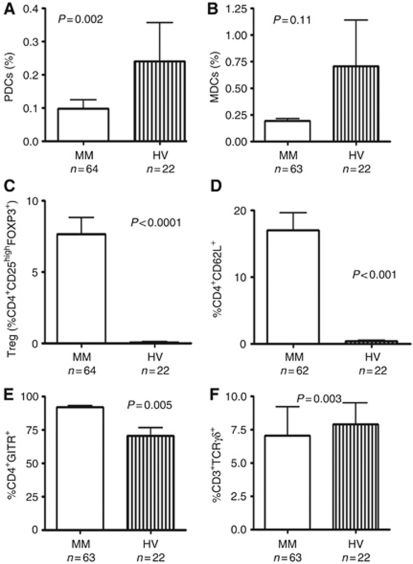
The percentage of both myeloid and plasmacytoid DC was lower in MM compared with control group while Treg (CD4(+)CD25(high)FOXP3(+)) frequencies were significantly higher in MM patients compared with healthy control (6.16% vs 0.05%, respectively). Also, the percentages of CD4(+)GITR(+), CD4(+)CD62L(+) were increased compared with healthy volunteers. We found that patients with higher percentages of Treg live shorter (median overall survival 21 months vs not-reached, P=0.013).
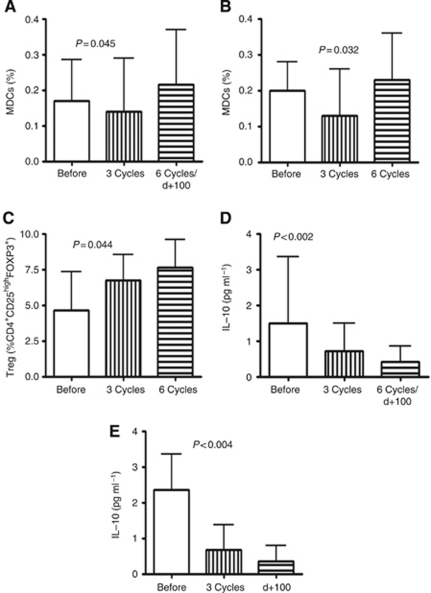
This study identifies several abnormalities of immune system in MM, which only partly could be normalised after successful therapy. The dysfunction of immune system such as decreased antigen presentation along with increased frequencies of suppressive cells and cytokines might facilitate progression of the disease and infectious complications limiting survival of MM patients.
多发性骨髓瘤(MM)是一种免疫增殖性疾病,其特征是浆细胞不受控制地增殖,同时伴有免疫系统缺陷。
本研究旨在描述 66 例 MM 患者中 T 调节细胞(Tregs)、树突状细胞(DC)以及具有调节特性的 T 细胞亚群(如 CD4(+)GITR(+)、CD4(+)CD62L(+)、CD3(+)TCRγδ(+))的频率以及白细胞介素-10(IL-10)、转化生长因子-β(TGFβ)、白细胞介素-6(IL-6)的浓度。随后,评估了治疗对这些免疫系统成分的影响。
与对照组相比,MM 患者的髓样和浆细胞样 DC 百分比较低,而 Treg(CD4(+)CD25(high)FOXP3(+))频率明显高于健康对照组(分别为 6.16%和 0.05%)。此外,与健康志愿者相比,CD4(+)GITR(+)和 CD4(+)CD62L(+)的百分比增加。我们发现,Treg 百分比较高的患者生存期较短(中位总生存期 21 个月与未达到,P=0.013)。
本研究确定了 MM 患者免疫系统的几种异常,这些异常在成功治疗后仅部分得到纠正。免疫系统功能障碍,如抗原呈递减少,同时抑制性细胞和细胞因子频率增加,可能促进疾病进展和感染并发症,限制 MM 患者的生存。