Shasha Carolyn, Glass David R, Moelhman Ernest, Islas Laura, Tian Yuan, Szeto Gregory L, Peng Tao, Song Xiaoling, Wurscher Michelle, Bumol Thomas F, Torgerson Troy R, Greenberg Philip D, Green Damian J, Newell Evan W
Vaccine and Infectious Disease Division, Fred Hutchinson Cancer Center, Seattle, WA, USA.
Immunotherapy Integrated Research Center, Fred Hutchinson Cancer Center, Seattle, WA, USA.
bioRxiv. 2024 Jun 4:2024.06.03.597178. doi: 10.1101/2024.06.03.597178.
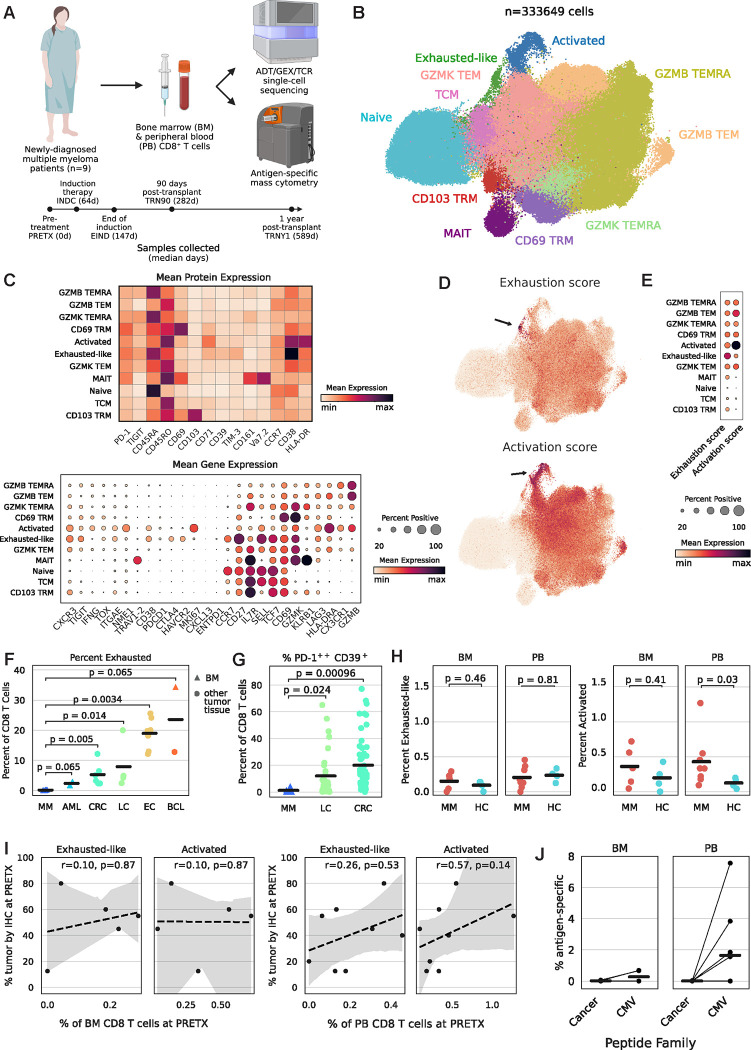
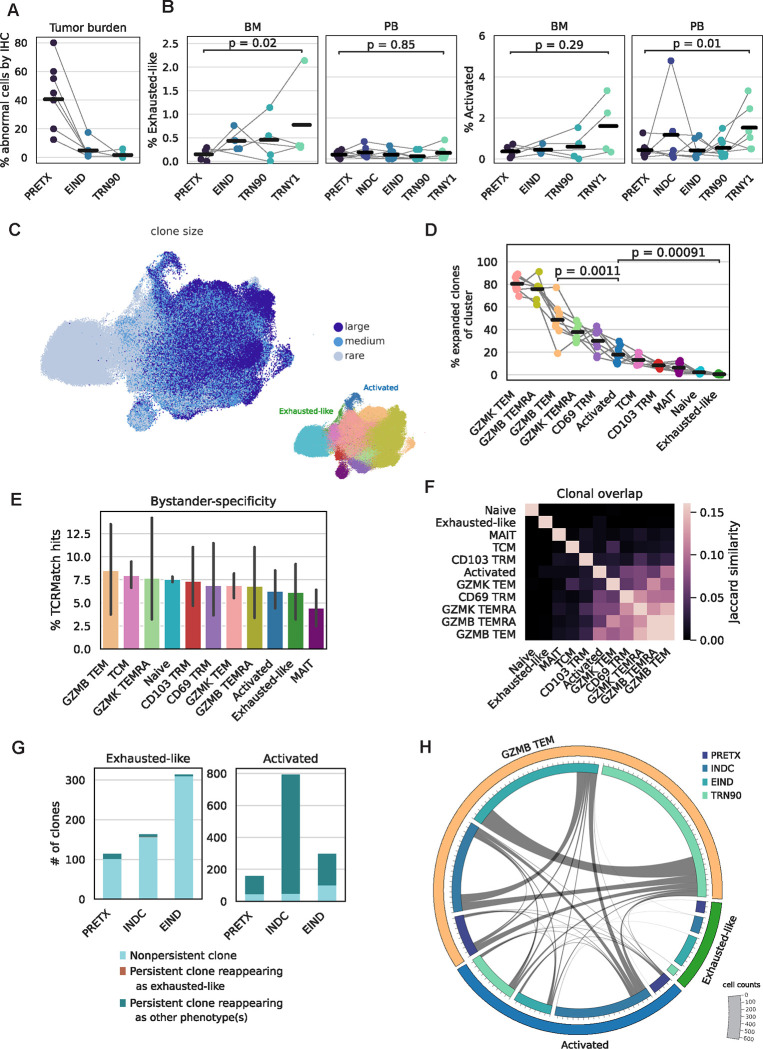
Dysregulation of the bone marrow (BM) niche in multiple myeloma (MM) alters the composition and state of resident immune cells, potentially impeding anti-tumor immunity. One common mechanism of immune inhibition in solid tumors is the induction of exhaustion in tumor-specific T cells. However, the extent of T cell tumor recognition and exhaustion is not well-characterized in MM. As the specific mechanisms of immune evasion are critical for devising effective therapeutic strategies, we deeply profiled the CD8 T cell compartment of newly-diagnosed MM (NDMM) patients for evidence of tumor reactivity and T cell exhaustion. We applied single-cell multi-omic sequencing and antigen-specific mass cytometry to longitudinal BM and peripheral blood (PB) samples taken from timepoints spanning from diagnosis through induction therapy, autologous stem cell transplant (ASCT), and maintenance therapy. We identified an exhausted-like population that lacked several canonical exhaustion markers, was not significantly enriched in NDMM patients, and consisted of small, nonpersistent clones. We also observed an activated population with increased frequency in the PB of NDMM patients exhibiting phenotypic and clonal features consistent with homeostatic, antigen-nonspecific activation. However, there was no evidence of "tumor-experienced" T cells displaying hallmarks of terminal exhaustion and/or tumor-specific activation/expansion in NDMM patients at any timepoint.
多发性骨髓瘤(MM)中骨髓(BM)微环境的失调会改变驻留免疫细胞的组成和状态,可能会阻碍抗肿瘤免疫。实体瘤中免疫抑制的一种常见机制是诱导肿瘤特异性T细胞耗竭。然而,MM中T细胞肿瘤识别和耗竭的程度尚未得到充分表征。由于免疫逃逸的具体机制对于制定有效的治疗策略至关重要,我们对新诊断的MM(NDMM)患者的CD8 T细胞区室进行了深入分析,以寻找肿瘤反应性和T细胞耗竭的证据。我们对从诊断到诱导治疗、自体干细胞移植(ASCT)和维持治疗等时间点采集的纵向BM和外周血(PB)样本应用了单细胞多组学测序和抗原特异性质谱流式细胞术。我们鉴定出一个类似耗竭的群体,该群体缺乏几种典型的耗竭标志物,在NDMM患者中没有显著富集,并且由小的、非持久性的克隆组成。我们还观察到一个活化群体,在NDMM患者的PB中频率增加,表现出与稳态、抗原非特异性活化一致的表型和克隆特征。然而,在任何时间点的NDMM患者中,均没有证据表明“肿瘤经历过的”T细胞表现出终末耗竭和/或肿瘤特异性活化/扩增的特征。