• 文献检索
  • 文档翻译
  • 深度研究
  • 学术资讯
  • Suppr Zotero 插件Zotero 插件
  • 邀请有礼
  • 套餐&价格
  • 历史记录
应用&插件
Suppr Zotero 插件Zotero 插件浏览器插件Mac 客户端Windows 客户端微信小程序
定价
高级版会员购买积分包购买API积分包
服务
文献检索文档翻译深度研究API 文档MCP 服务
关于我们
关于 Suppr公司介绍联系我们用户协议隐私条款
关注我们

Suppr 超能文献

核心技术专利:CN118964589B侵权必究
粤ICP备2023148730 号-1Suppr @ 2026

文献检索

告别复杂PubMed语法,用中文像聊天一样搜索,搜遍4000万医学文献。AI智能推荐,让科研检索更轻松。

立即免费搜索

文件翻译

保留排版,准确专业,支持PDF/Word/PPT等文件格式,支持 12+语言互译。

免费翻译文档

深度研究

AI帮你快速写综述,25分钟生成高质量综述,智能提取关键信息,辅助科研写作。

立即免费体验

不丹的疟疾控制:一个国家开始消除疟疾的案例研究。

Malaria control in Bhutan: case study of a country embarking on elimination.

机构信息

Vector-Borne Disease Control Programme, Ministry of Health, Royal Government of Bhutan, Gelephu, Bhutan.

出版信息

Malar J. 2012 Jan 9;11:9. doi: 10.1186/1475-2875-11-9.

DOI:10.1186/1475-2875-11-9
PMID:22230355
原文链接:https://pmc.ncbi.nlm.nih.gov/articles/PMC3278342/
Abstract

BACKGROUND

Bhutan has achieved a major reduction in malaria incidence amid multiple challenges. This case study seeks to characterize the Bhutan malaria control programme over the last 10 years.

METHODS

A review of the malaria epidemiology, control strategies, and elimination strategies employed in Bhutan was carried out through a literature review of peer-reviewed and grey national and international literature with the addition of reviewing the surveillance and vector control records of the Bhutan Vector-Borne Disease Control Programme (VDCP). Data triangulation was used to identify trends in epidemiology and key strategies and interventions through analysis of the VDCP surveillance and programme records and the literature review. Enabling and challenging factors were identified through analysis of socio-economic and health indicators, corroborated through a review of national and international reports and peer-review articles.

FINDINGS

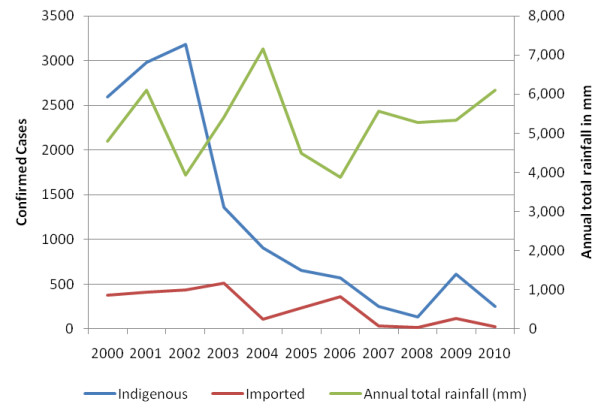
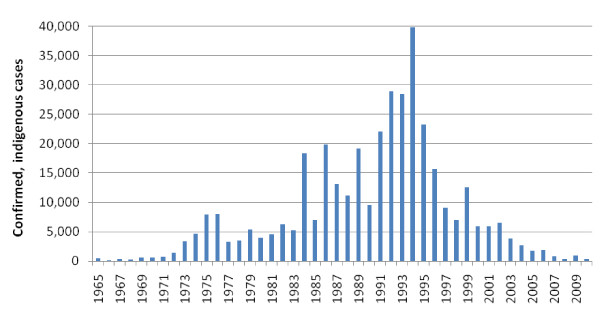
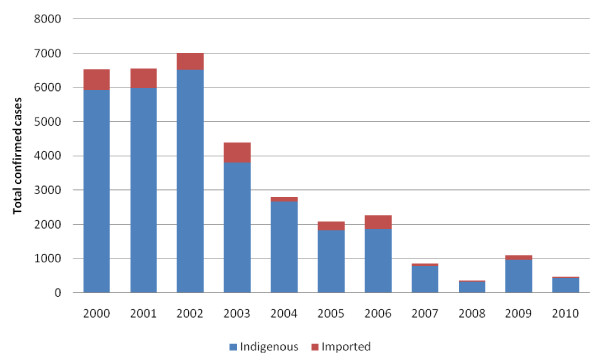
Confirmed malaria cases in Bhutan declined by 98.7% from 1994 to 2010. The majority of indigenous cases were due to Plasmodium vivax (59.9%) and adult males are most at-risk of malaria. Imported cases, or those in foreign nationals, varied over the years, reaching 21.8% of all confirmed cases in 2006. Strategies implemented by the VDCP are likely to be related to the decline in cases over the last 10 years. Access to malaria diagnosis in treatment was expanded throughout the country and evidence-based case management, including the introduction of artemisinin-based combination therapy (ACT) for P. falciparum, increasing coverage of high risk areas with Indoor Residual Spraying, insecticide-treated bed nets, and long-lasting insecticidal nets are likely to have contributed to the decline alongside enabling factors such as economic development and increasing access to health services.

CONCLUSION

Bhutan has made significant strides towards elimination and has adopted a goal of national elimination. A major challenge in the future will be prevention and management of imported malaria infections from neighbouring Indian states. Bhutan plans to implement screening at border points to prevent importation of malaria and to targeted prevention and surveillance efforts towards at-risk Bhutanese and migrant workers in construction sites.

摘要

背景

在面临多重挑战的情况下,不丹已成功大幅降低疟疾发病率。本案例研究旨在描述过去 10 年不丹的疟疾控制规划。

方法

通过对同行评议和灰色的国内外文献进行文献回顾,审查不丹的疟疾流行病学、控制策略和消除策略,并补充审查不丹病媒传播疾病控制规划(VDCP)的监测和病媒控制记录。通过分析 VDCP 监测和规划记录以及文献综述,采用数据三角法确定流行病学和主要战略及干预措施的趋势。通过分析社会经济和卫生指标,以及对国内外报告和同行评议文章的审查,确定有利和不利因素。

发现

1994 年至 2010 年,不丹确诊疟疾病例减少了 98.7%。大多数本土病例是由间日疟原虫(59.9%)引起的,成年男性是疟疾的高危人群。输入病例,或外国国民的病例,多年来有所波动,2006 年达到所有确诊病例的 21.8%。不丹病媒传播疾病控制规划实施的策略可能与过去 10 年来病例减少有关。在全国范围内扩大疟疾诊断治疗的获取途径,实施循证病例管理,包括引入针对恶性疟原虫的青蒿素为基础的联合疗法(ACT),扩大高危地区的室内滞留喷洒、经杀虫剂处理的蚊帐和长效驱虫蚊帐的覆盖范围,以及经济发展和增加获得卫生服务的机会等有利因素可能促成了病例的减少。

结论

不丹在消除疟疾方面取得了重大进展,并制定了国家消除疟疾的目标。未来的主要挑战将是预防和管理来自邻国印度的输入性疟疾感染。不丹计划在边境点实施筛查,以防止疟疾输入,并针对建筑工地的高危不丹人和移民工人开展有针对性的预防和监测工作。
https://cdn.ncbi.nlm.nih.gov/pmc/blobs/de13/3278342/34e33fed42b4/1475-2875-11-9-4.jpg
https://cdn.ncbi.nlm.nih.gov/pmc/blobs/de13/3278342/d5518742593c/1475-2875-11-9-1.jpg
https://cdn.ncbi.nlm.nih.gov/pmc/blobs/de13/3278342/8b6f1eb07b19/1475-2875-11-9-2.jpg
https://cdn.ncbi.nlm.nih.gov/pmc/blobs/de13/3278342/425eb59e59a2/1475-2875-11-9-3.jpg
https://cdn.ncbi.nlm.nih.gov/pmc/blobs/de13/3278342/34e33fed42b4/1475-2875-11-9-4.jpg
https://cdn.ncbi.nlm.nih.gov/pmc/blobs/de13/3278342/d5518742593c/1475-2875-11-9-1.jpg
https://cdn.ncbi.nlm.nih.gov/pmc/blobs/de13/3278342/8b6f1eb07b19/1475-2875-11-9-2.jpg
https://cdn.ncbi.nlm.nih.gov/pmc/blobs/de13/3278342/425eb59e59a2/1475-2875-11-9-3.jpg
https://cdn.ncbi.nlm.nih.gov/pmc/blobs/de13/3278342/34e33fed42b4/1475-2875-11-9-4.jpg

相似文献

1
Malaria control in Bhutan: case study of a country embarking on elimination.不丹的疟疾控制:一个国家开始消除疟疾的案例研究。
Malar J. 2012 Jan 9;11:9. doi: 10.1186/1475-2875-11-9.
2
Malaria burden and costs of intensified control in Bhutan, 2006-14: an observational study and situation analysis.2006-2014 年不丹强化疟疾控制的负担和成本:观察性研究和情况分析。
Lancet Glob Health. 2016 May;4(5):e336-43. doi: 10.1016/S2214-109X(16)00083-8.
3
Malaria prevention and control in Bhutan: successes and challenges.不丹的疟疾预防与控制:成就与挑战。
Acta Trop. 2011 Mar;117(3):225-8. doi: 10.1016/j.actatropica.2010.11.008. Epub 2010 Nov 27.
4
Malaria control and elimination in Sri Lanka: documenting progress and success factors in a conflict setting.斯里兰卡的疟疾控制和消除:在冲突环境中记录进展和成功因素。
PLoS One. 2012;7(8):e43162. doi: 10.1371/journal.pone.0043162. Epub 2012 Aug 29.
5
Potential threat of malaria epidemics in a low transmission area, as exemplified by São Tomé and Príncipe.低传播地区疟疾流行的潜在威胁,以圣多美和普林西比为例。
Malar J. 2010 Sep 29;9:264. doi: 10.1186/1475-2875-9-264.
6
Rapid assessment of the performance of malaria control strategies implemented by countries in the Amazon subregion using adequacy criteria: case study.使用适宜性标准快速评估亚马逊次区域各国实施的疟疾控制策略的效果:案例研究。
Malar J. 2011 Dec 20;10:379. doi: 10.1186/1475-2875-10-379.
7
Malaria epidemiology and stratification of incidence in the malaria elimination setting in Harari Region, Eastern Ethiopia.在埃塞俄比亚东部哈拉里地区消除疟疾背景下的疟疾流行病学和发病率分层。
Infect Dis Poverty. 2020 Nov 22;9(1):160. doi: 10.1186/s40249-020-00773-5.
8
Malaria in the Greater Mekong Subregion: heterogeneity and complexity.大湄公河次区域的疟疾:异质性和复杂性。
Acta Trop. 2012 Mar;121(3):227-39. doi: 10.1016/j.actatropica.2011.02.016. Epub 2011 Mar 5.
9
Repeated mosquito net distributions, improved treatment, and trends in malaria cases in sentinel health facilities in Papua New Guinea.巴布亚新几内亚哨点医疗机构中重复发放蚊帐、改进治疗以及疟疾发病趋势
Malar J. 2019 Nov 12;18(1):364. doi: 10.1186/s12936-019-2993-6.
10
Reviewing South Africa's malaria elimination strategy (2012-2018): progress, challenges and priorities.审视南非疟疾消除战略(2012 - 2018年):进展、挑战与优先事项
Malar J. 2016 Aug 27;15(1):438. doi: 10.1186/s12936-016-1497-x.

引用本文的文献

1
Malaria elimination challenges in countries approaching the last mile: a discussion among regional stakeholders.接近疟疾消除最后阶段国家面临的挑战:地区利益相关者之间的讨论
Malar J. 2024 Dec 26;23(1):401. doi: 10.1186/s12936-024-05215-3.
2
Two decades of malaria control in Malawi: Geostatistical Analysis of the changing malaria prevalence from 2000-2022.马拉维二十年疟疾防治:对2000年至2022年疟疾患病率变化的地统计学分析
Wellcome Open Res. 2024 Jan 8;8:264. doi: 10.12688/wellcomeopenres.19390.2. eCollection 2023.
3
Factors Contributing to the Pre-Elimination of Malaria from Hainan Island, China, 1986-2009.

本文引用的文献

1
Preventing the reintroduction of malaria in Mauritius: a programmatic and financial assessment.在毛里求斯预防疟疾的再次传入:一项规划和财务评估。
PLoS One. 2011;6(9):e23832. doi: 10.1371/journal.pone.0023832. Epub 2011 Sep 2.
2
Malaria elimination in Isabel Province, Solomon Islands: establishing a surveillance-response system to prevent introduction and reintroduction of malaria.在索罗门群岛伊莎贝尔省消除疟疾:建立监测-应对系统以防止疟疾的输入和再输入。
Malar J. 2011 Aug 11;10:235. doi: 10.1186/1475-2875-10-235.
3
Establishing the extent of malaria transmission and challenges facing pre-elimination in the Republic of Djibouti.
1986-2009 年中国海南岛消除疟疾前的影响因素。
Am J Trop Med Hyg. 2023 Oct 9;109(5):1063-1071. doi: 10.4269/ajtmh.23-0303. Print 2023 Nov 1.
4
Four decades of epidemiological data reveal trajectories towards malaria elimination in Kheda district (Gujarat), western part of India.四十年来的流行病学数据显示,印度西部古吉拉特邦赫达区(Kheda district)正在朝着消除疟疾的方向发展。
BMJ Glob Health. 2021 Dec;6(12). doi: 10.1136/bmjgh-2021-005815.
5
The changing epidemiology of Plasmodium vivax: Insights from conventional and novel surveillance tools.《间日疟原虫流行病学的变化:传统和新型监测工具的启示》。
PLoS Med. 2021 Apr 23;18(4):e1003560. doi: 10.1371/journal.pmed.1003560. eCollection 2021 Apr.
6
Reactive Case Detection (RACD) and foci investigation strategies in malaria control and elimination: a review.疟疾控制和消除中的反应性病例检测(RACD)和焦点调查策略:综述。
Malar J. 2020 Nov 10;19(1):401. doi: 10.1186/s12936-020-03478-0.
7
Malaria elimination in Bhutan: asymptomatic malaria cases in the Bhutanese population living in malaria-risk areas and in migrant workers from India.不丹的疟疾消除:居住在疟疾风险地区的不丹人口及来自印度的 migrant workers 中的无症状疟疾病例。 注:原文中“migrant workers”直接保留英文未翻译,可能是特定术语或有误,正常应翻译为“外来务工人员”之类更合适的表述。
Rev Inst Med Trop Sao Paulo. 2019 Sep 12;61:e52. doi: 10.1590/S1678-9946201961052.
8
Challenges and the Path Forward on Malaria Elimination Intervention: A Systematic Review.疟疾消除干预措施面临的挑战与未来之路:一项系统综述
Iran J Public Health. 2019 Jun;48(6):1004-1013.
9
Epidemiology of Malaria Infection in Nepal.尼泊尔疟疾感染的流行病学。
Am J Trop Med Hyg. 2018 Sep;99(3):680-687. doi: 10.4269/ajtmh.18-0373. Epub 2018 Jul 12.
10
Factors Associated with the Rapid and Durable Decline in Malaria Incidence in El Salvador, 1980-2017.与 1980-2017 年萨尔瓦多疟疾发病率快速和持久下降相关的因素。
Am J Trop Med Hyg. 2018 Jul;99(1):33-42. doi: 10.4269/ajtmh.17-0629. Epub 2018 May 10.
评估吉布提共和国消除疟疾传播的程度和面临的挑战。
BMC Infect Dis. 2011 May 11;11:121. doi: 10.1186/1471-2334-11-121.
4
Spatio-temporal patterns of malaria infection in Bhutan: a country embarking on malaria elimination.不丹的疟疾感染时空模式:一个正在开展消除疟疾工作的国家。
Malar J. 2011 Apr 16;10:89. doi: 10.1186/1475-2875-10-89.
5
Malaria prevention and control in Bhutan: successes and challenges.不丹的疟疾预防与控制:成就与挑战。
Acta Trop. 2011 Mar;117(3):225-8. doi: 10.1016/j.actatropica.2010.11.008. Epub 2010 Nov 27.
6
Shrinking the malaria map: progress and prospects.缩小疟疾地图:进展与展望。
Lancet. 2010 Nov 6;376(9752):1566-78. doi: 10.1016/S0140-6736(10)61270-6. Epub 2010 Oct 28.
7
Operational strategies to achieve and maintain malaria elimination.实现和维持消除疟疾的策略。
Lancet. 2010 Nov 6;376(9752):1592-603. doi: 10.1016/S0140-6736(10)61269-X. Epub 2010 Oct 28.
8
Development of temporal modelling for forecasting and prediction of malaria infections using time-series and ARIMAX analyses: a case study in endemic districts of Bhutan.使用时间序列和 ARIMAX 分析进行疟疾感染的预测和预报的时间模型开发:来自不丹流行地区的案例研究。
Malar J. 2010 Sep 3;9:251. doi: 10.1186/1475-2875-9-251.
9
Public health triangulation: approach and application to synthesizing data to understand national and local HIV epidemics.公共卫生三角分析法:一种综合数据以了解国家和地方 HIV 疫情的方法及应用。
BMC Public Health. 2010 Jul 29;10:447. doi: 10.1186/1471-2458-10-447.
10
Malaria perceptions and practices in Bhutan.不丹对疟疾的认知与做法
Southeast Asian J Trop Med Public Health. 2010 Mar;41(2):274-9.