Institute for Medical Microbiology, Immunology and Parasitology, University Hospital Bonn, Sigmund-Freud-Str, 25, D-53105 Bonn, Germany.
Parasit Vectors. 2012 Jan 11;5:12. doi: 10.1186/1756-3305-5-12.
The human parasite Onchocerca volvulus harbours Wolbachia endosymbionts essential for worm embryogenesis, larval development and adult survival. In this study, the development of Wolbachia-depleted microfilariae (first stage larvae) to infective third stage larvae (L3) in the insect vector Simulium damnosum was analysed.
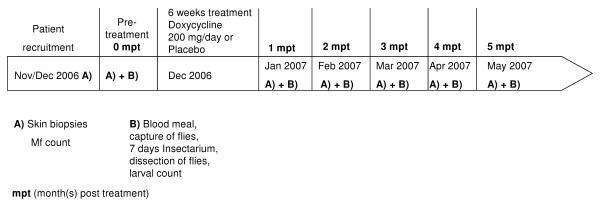
Infected volunteers in Cameroon were randomly and blindly allocated into doxycycline (200 mg/day for 6 weeks) or placebo treatment groups. After treatment, blackflies were allowed to take a blood meal on the volunteers, captured and dissected for larval counting and DNA extraction for quantitative real-time PCR analysis.
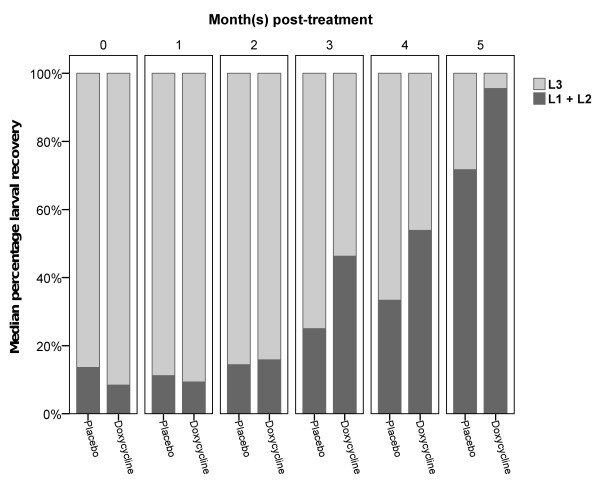
PCR results showed a clear reduction in Wolbachia DNA after doxycycline treatment in microfilariae from human skin biopsies with > 50% reduction at one month post-treatment, eventually reaching a reduction of > 80%. Larval stages recovered from the insect vector had similar levels of reduction of endosymbiotic bacteria. Larval recoveries were analysed longitudinally after treatment to follow the kinetics of larval development. Beginning at three months post-treatment, significantly fewer L3 were seen in the blackflies that had fed on doxycycline treated volunteers. Concomitant with this, the proportion of second stage larvae (L2) was significantly increased in this group.
Doxycycline treatment and the resulting decline of Wolbachia endobacteria from the microfilaria resulted in retarded development of larvae in the insect vector. Thus, anti-wolbachial treatment could have an additive effect for interrupting transmission by reducing the number of L3 that can be transmitted by blackflies.
人体寄生虫旋盘尾丝虫(Onchocerca volvulus)携带有沃尔巴克氏体(Wolbachia)内共生菌,这些共生菌对蠕虫胚胎发生、幼虫发育和成虫存活至关重要。本研究分析了沃尔巴克氏体缺失的微丝蚴(第一期幼虫)在昆虫媒介冈比亚按蚊(Simulium damnosum)中发育为感染性第三期幼虫(L3)的情况。
喀麦隆的受感染志愿者被随机和盲目分配到多西环素(200mg/天,持续 6 周)或安慰剂治疗组。治疗后,让黑蝇吸食志愿者的血液,然后捕获并解剖以进行幼虫计数和 DNA 提取,用于定量实时 PCR 分析。
PCR 结果显示,多西环素治疗后,人类皮肤活检中的微丝蚴中的沃尔巴克氏体 DNA 明显减少,治疗后一个月减少超过 50%,最终减少超过 80%。从昆虫媒介中回收的幼虫阶段也有类似水平的共生菌减少。在治疗后进行纵向分析以跟踪幼虫发育的动力学。从治疗后三个月开始,在吸食多西环素治疗志愿者血液的黑蝇中,明显看到更少的 L3。与此相伴的是,该组的第二期幼虫(L2)的比例显著增加。
多西环素治疗和微丝蚴中沃尔巴克氏体内共生菌的减少导致幼虫在昆虫媒介中的发育迟缓。因此,抗沃尔巴克氏体治疗可能通过减少黑蝇传播的 L3 数量而具有阻断传播的附加效果。