Department of Molecular Biosciences, IBIS Program, Northwestern University, Evanston, IL 60201, USA.
Cell Death Dis. 2012 Jan 12;3(1):e249. doi: 10.1038/cddis.2011.134.
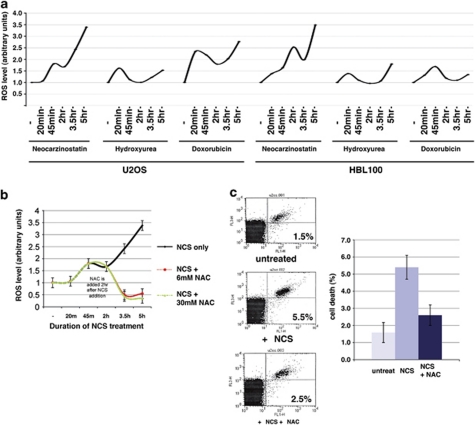
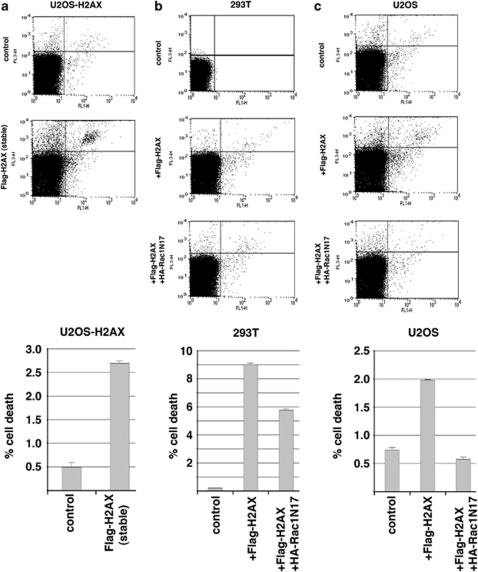
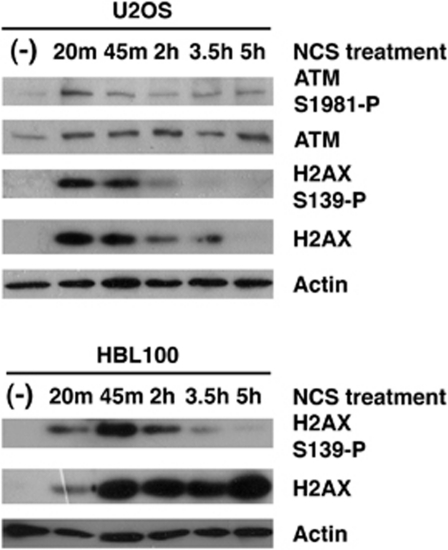
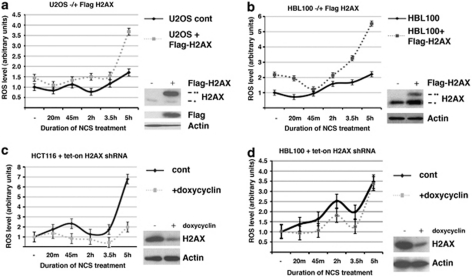
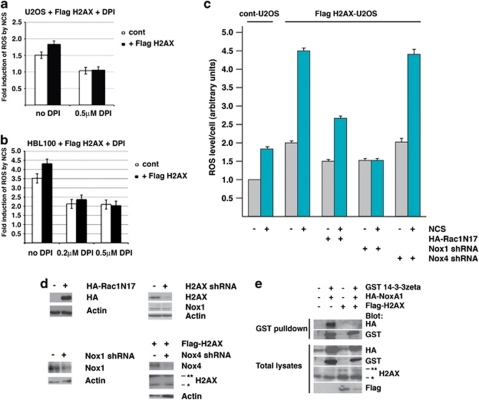
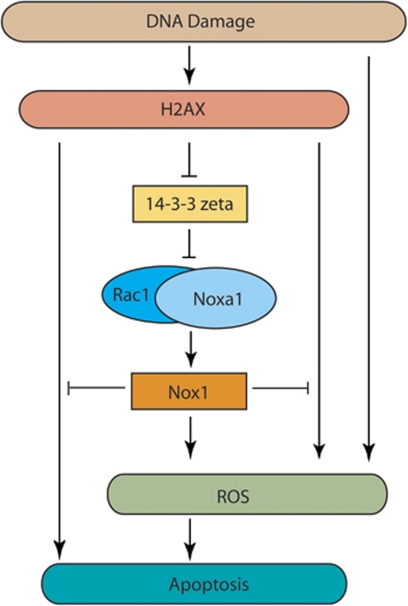
The DNA damage response (DDR) cascade and ROS (reactive oxygen species) signaling are both involved in the induction of cell death after DNA damage, but a mechanistic link between these two pathways has not been clearly elucidated. This study demonstrates that ROS induction after treatment of cells with neocarzinostatin (NCS), an ionizing radiation mimetic, is at least partly mediated by increasing histone H2AX. Increased levels of ROS and cell death induced by H2AX overexpression alone or DNA damage leading to H2AX accumulation are reduced by treating cells with the antioxidant N-Acetyl-L-Cysteine (NAC), the NADP(H) oxidase (Nox) inhibitor DPI, expression of Rac1N17, and knockdown of Nox1, but not Nox4, indicating that induction of ROS by H2AX is mediated through Nox1 and Rac1 GTPase. H2AX increases Nox1 activity partly by reducing the interaction between a Nox1 activator NOXA1 and its inhibitor 14-3-3zeta. These results point to a novel role of histone H2AX that regulates Nox1-mediated ROS generation after DNA damage.
DNA 损伤反应 (DDR) 级联和 ROS(活性氧)信号都参与了 DNA 损伤后细胞死亡的诱导,但这两种途径之间的机制联系尚未明确阐明。本研究表明,在用类放射菌素新制癌菌素 (NCS) 处理细胞后,ROS 的诱导至少部分是通过增加组蛋白 H2AX 介导的。单独过表达 H2AX 或导致 H2AX 积累的 DNA 损伤引起的 ROS 水平增加和细胞死亡,可通过用抗氧化剂 N-乙酰-L-半胱氨酸 (NAC)、NADP(H) 氧化酶 (Nox) 抑制剂 DPI、Rac1N17 的表达和 Nox1 的敲低来降低,但 Nox4 不行,表明 H2AX 诱导的 ROS 是通过 Nox1 和 Rac1 GTPase 介导的。H2AX 通过减少 Nox1 激活剂 NOXA1 与其抑制剂 14-3-3zeta 之间的相互作用,部分增加了 Nox1 活性。这些结果指出了组蛋白 H2AX 的一个新作用,它调节 DNA 损伤后 Nox1 介导的 ROS 生成。