School of Biological Sciences, Victoria University of Wellington, Wellington, New Zealand.
PLoS One. 2012;7(1):e29569. doi: 10.1371/journal.pone.0029569. Epub 2012 Jan 4.
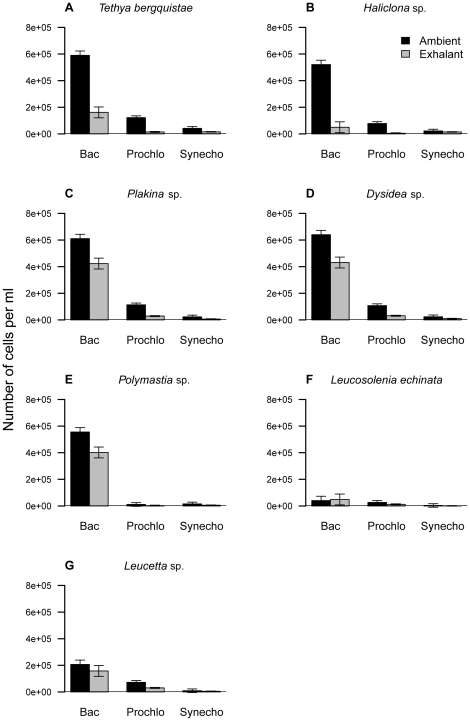
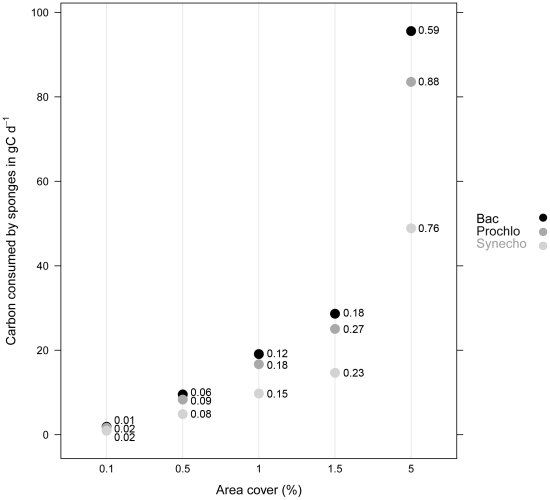
Despite the importance of trophic interactions between organisms, and the relationship between primary production and benthic diversity, there have been few studies that have quantified the carbon flow from pelagic to benthic environments as a result of the assemblage level activity of suspension-feeding organisms. In this study, we examine the feeding activity of seven common sponge species from the Taputeranga marine reserve on the south coast of Wellington in New Zealand. We analysed the diet composition, feeding efficiency, pumping rates, and the number of food particles (specifically picoplanktonic prokaryotic cells) retained by sponges. We used this information, combined with abundance estimates of the sponges and estimations of the total amount of food available to sponges in a known volume of water (89,821 m(3)), to estimate: (1) particulate organic carbon (POC) fluxes through sponges as a result of their suspension-feeding activities on picoplankton; and (2) the proportion of the available POC from picoplankton that sponges consume. The most POC acquired by the sponges was from non-photosynthetic bacterial cells (ranging from 0.09 to 4.69 g C d(-1) with varying sponge percentage cover from 0.5 to 5%), followed by Prochlorococcus (0.07 to 3.47 g C d(-1)) and then Synechococcus (0.05 to 2.34 g C d(-1)) cells. Depending on sponge abundance, the amount of POC that sponges consumed as a proportion of the total POC available was 0.2-12.1% for Bac, 0.4-21.3% for Prochlo, and 0.3-15.8% for Synecho. The flux of POC for the whole sponge assemblage, based on the consumption of prokaryotic picoplankton, ranged from 0.07-3.50 g C m(2) d(-1). This study is the first to estimate the contribution of a sponge assemblage (rather than focusing on individual sponge species) to POC flow from three groups of picoplankton in a temperate rocky reef through the feeding activity of sponges and demonstrates the importance of sponges to energy flow in rocky reef environments.
尽管生物之间的营养相互作用以及初级生产与底栖生物多样性之间的关系非常重要,但很少有研究从浮游生物到底栖环境定量研究由于悬浮生物的聚集水平活动而产生的碳流。在这项研究中,我们检查了新西兰惠灵顿南部塔普特朗加海洋保护区的七种常见海绵物种的摄食活动。我们分析了饮食组成、摄食效率、泵送率以及海绵保留的食物颗粒数量(特别是原核细胞的微微型浮游生物)。我们利用这些信息,结合海绵的丰度估计和在已知体积的水中(89,821 立方米)可用于海绵的总食物量的估计,来估计:(1)由于其对微微型浮游生物的摄食活动而通过海绵的颗粒有机碳(POC)通量;(2)海绵消耗的微微型浮游生物可利用 POC 的比例。海绵获得的最多 POC 来自非光合细菌细胞(范围从 0.09 到 4.69 g C d(-1),海绵的百分比覆盖率从 0.5 到 5%不等),其次是聚球藻(0.07 到 3.47 g C d(-1)),然后是蓝藻(0.05 到 2.34 g C d(-1))。根据海绵的丰度,海绵消耗的 POC 占总 POC 的比例为 Bac 的 0.2-12.1%,Prochlo 的 0.4-21.3%,Synecho 的 0.3-15.8%。基于原核微微型浮游生物的消耗,整个海绵组合的 POC 通量范围为 0.07-3.50 g C m(2) d(-1)。这项研究首次估计了一个海绵组合(而不是专注于单个海绵物种)对通过海绵摄食活动从三种微微型浮游生物群到 POC 流的贡献,并证明了海绵对岩石礁环境中能量流动的重要性。