Department of Biological Oceanography, Royal Netherlands Institute for Sea Research, Den Hoorn, The Netherlands ; CARMABI, Willemstad, Curaçao ; Department of Earth Sciences, Utrecht University, Utrecht, The Netherlands.
CARMABI, Willemstad, Curaçao ; Department of Aquatic Ecology and Ecotoxicology, University of Amsterdam, Amsterdam, The Netherlands.
PLoS One. 2014 Feb 25;9(2):e90152. doi: 10.1371/journal.pone.0090152. eCollection 2014.
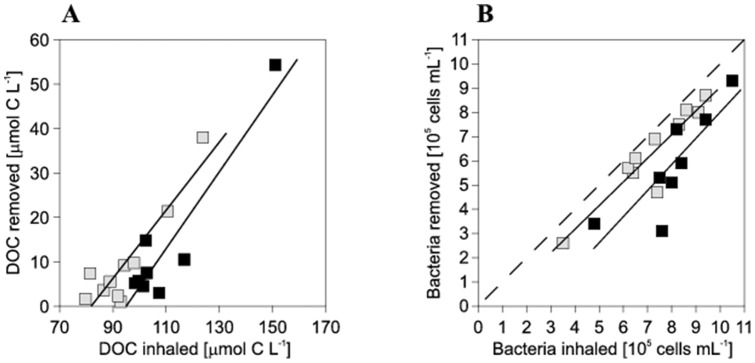
Coral-excavating sponges are the most important bioeroders on Caribbean reefs and increase in abundance throughout the region. This increase is commonly attributed to a concomitant increase in food availability due to eutrophication and pollution. We therefore investigated the uptake of organic matter by the two coral-excavating sponges Siphonodictyon sp. and Cliona delitrix and tested whether they are capable of consuming dissolved organic carbon (DOC) as part of their diet. A device for simultaneous sampling of water inhaled and exhaled by the sponges was used to directly measure the removal of DOC and bacteria in situ. During a single passage through their filtration system 14% and 13% respectively of the total organic carbon (TOC) in the inhaled water was removed by the sponges. 82% (Siphonodictyon sp.; mean ± SD; 13 ± 17 μmol L(-1)) and 76% (C. delitrix; 10 ± 12 μmol L(-1)) of the carbon removed was taken up in form of DOC, whereas the remainder was taken up in the form of particulate organic carbon (POC; bacteria and phytoplankton) despite high bacteria retention efficiency (72 ± 15% and 87 ± 10%). Siphonodictyon sp. and C. delitrix removed DOC at a rate of 461 ± 773 and 354 ± 562 μmol C h(-1) respectively. Bacteria removal was 1.8 ± 0.9 × 10(10) and 1.7 ± 0.6 × 10(10) cells h(-1), which equals a carbon uptake of 46.0 ± 21.2 and 42.5 ± 14.0 μmol C h(-1) respectively. Therefore, DOC represents 83 and 81% of the TOC taken up by Siphonodictyon sp. and C. delitrix per hour. These findings suggest that similar to various reef sponges coral-excavating sponges also mainly rely on DOC to meet their carbon demand. We hypothesize that excavating sponges may also benefit from an increasing production of more labile algal-derived DOC (as compared to coral-derived DOC) on reefs as a result of the ongoing coral-algal phase shift.
珊瑚挖掘海绵是加勒比海礁区最重要的生物侵蚀者,其数量在整个地区都有所增加。这种增加通常归因于由于富营养化和污染导致的食物供应增加。因此,我们研究了两种珊瑚挖掘海绵 Siphonodictyon sp. 和 Cliona delitrix 对有机物质的吸收,并测试了它们是否能够作为其饮食的一部分消耗溶解有机碳 (DOC)。我们使用一种同时采集海绵吸入和呼出的水的装置来直接测量原位 DOC 和细菌的去除。在单次通过其过滤系统时,海绵分别去除了吸入水中总有机碳 (TOC) 的 14%和 13%。被去除的碳中,82%(Siphonodictyon sp.;平均值±标准差;13±17 μmol L(-1))和 76%(C. delitrix;10±12 μmol L(-1))以 DOC 的形式被吸收,而其余部分则以颗粒有机碳(POC;细菌和浮游植物)的形式被吸收,尽管细菌保留效率很高(72±15%和 87±10%)。Siphonodictyon sp. 和 C. delitrix 以 461±773 和 354±562 μmol C h(-1) 的速度去除 DOC。细菌去除量为 1.8±0.9×10(10)和 1.7±0.6×10(10)个细胞 h(-1),这相当于 Siphonodictyon sp. 和 C. delitrix 每小时吸收的碳量分别为 46.0±21.2 和 42.5±14.0 μmol C h(-1)。因此,DOC 占 Siphonodictyon sp. 和 C. delitrix 每小时吸收的 TOC 的 83%和 81%。这些发现表明,与各种礁海绵一样,珊瑚挖掘海绵也主要依赖于 DOC 来满足其碳需求。我们假设,由于珊瑚-藻类相转变的持续进行,珊瑚挖掘海绵可能也受益于在珊瑚礁上藻类来源的更易降解的 DOC(与珊瑚来源的 DOC 相比)产量的增加。