Department of Oral and Maxillofacial Surgery, University of Regensburg, Franz-Josef-Strauss-Allee 11, 93053 Regensburg, Germany.
Br J Cancer. 2012 Feb 14;106(4):719-26. doi: 10.1038/bjc.2011.605. Epub 2012 Jan 12.
Activity of the tumour-suppressor gene PTEN is reduced in different types of cancer and implicates non-responsiveness to targeted therapy. This study evaluates the gene and protein status of PTEN in salivary gland carcinomas.
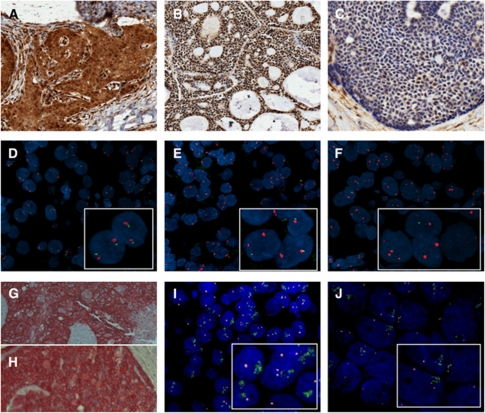
A total of 287 carcinomas of the major and minor salivary glands were investigated for phosphatase and tensin homologue located on chromosome 10 (PTEN) deletion and loss of PTEN expression using fluorescence in situ hybridisation (FISH) and immunohistochemistry (IHC), respectively. Results were correlated to clinicopathological parameters, long-term survival, epidermal growth factor receptor (EGFR) and human epidermal growth factor receptor 2 (HER2) (IHC and FISH) status of the tumours.
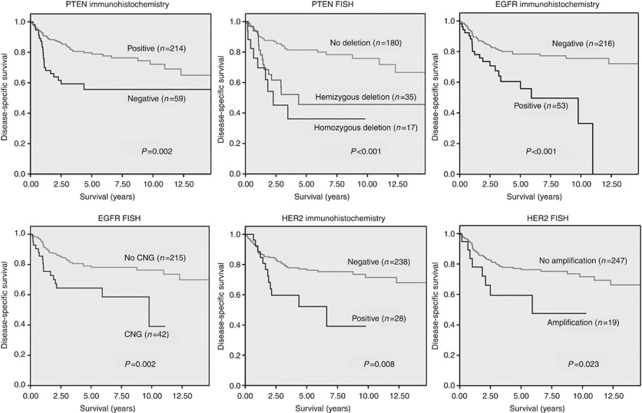
Hemizygous deletions of PTEN were found in 35 out of 232 (15.1%) carcinomas, while homozygous deletions were observed in 17 out of 232 (7.3%) tumours. Phosphatase and tensin homologue located on chromosome 10 deletion was common in certain histological subtypes and especially homozygous deletion was associated with high-grade malignancy, lymph node metastases and unfavourable long-term prognosis (P<0.001). Loss of PTEN expression was present in 59 out of 273 (21.6%) carcinomas and was significantly correlated to genomic PTEN deletion, high-grade malignancy (P<0.001), increased tumour size (P=0.036), lymph node metastases (P=0.007) and worse disease-specific survival (P=0.002). Genomic PTEN deletion, in particular homogenous deletion (P<0.001) predominantly occurred in tumours with increased gene copy number of EGFR (60.0%) and/or amplification of HER2 (63.6%). Loss of PTEN expression was frequently found in tumours overexpressing EGFR (28.6%) and/or HER2 (52.6%).
PTEN function is reduced in different types of salivary gland cancer indicating unfavourable prognosis. Its association with EGFR and HER2 signalling might affect targeted therapy.
抑癌基因 PTEN 的活性在不同类型的癌症中降低,提示其对靶向治疗无反应。本研究评估了唾液腺癌中 PTEN 的基因和蛋白状态。
使用荧光原位杂交(FISH)和免疫组织化学(IHC)分别检测 287 例大、小唾液腺癌中磷酸酶和张力蛋白同源物(PTEN)缺失和 PTEN 表达缺失情况。结果与临床病理参数、长期生存、表皮生长因子受体(EGFR)和人表皮生长因子受体 2(HER2)(IHC 和 FISH)状态相关。
232 例肿瘤中发现 35 例(15.1%)存在 PTEN 杂合性缺失,232 例肿瘤中发现 17 例(7.3%)存在 PTEN 纯合性缺失。PTEN 缺失在某些组织学亚型中较为常见,尤其是纯合性缺失与高级别恶性肿瘤、淋巴结转移和不良的长期预后相关(P<0.001)。273 例肿瘤中有 59 例(21.6%)存在 PTEN 表达缺失,与基因组 PTEN 缺失、高级别恶性肿瘤(P<0.001)、肿瘤体积增大(P=0.036)、淋巴结转移(P=0.007)和疾病特异性生存较差(P=0.002)显著相关。基因组 PTEN 缺失,特别是纯合性缺失(P<0.001)主要发生在 EGFR 基因拷贝数增加(60.0%)和/或 HER2 扩增(63.6%)的肿瘤中。PTEN 表达缺失在 EGFR 过表达(28.6%)和/或 HER2 过表达(52.6%)的肿瘤中经常发生。
PTEN 功能在不同类型的唾液腺癌中降低,提示预后不良。其与 EGFR 和 HER2 信号通路的关系可能影响靶向治疗。