School of Applied Physiology, Georgia Institute of Technology, Atlanta, GA, USA.
J Neuroeng Rehabil. 2012 Jan 13;9:1. doi: 10.1186/1743-0003-9-1.
To provide an alternative motor modality for control, navigation, and communication in individuals suffering from impairment or disability in hand functions, a Tongue Drive System (TDS) has been developed that allows for real time tracking of tongue motion in an unobtrusive, wireless, and wearable device that utilizes the magnetic field generated by a miniature disk shaped magnetic tracer attached to the tip of the tongue. The purpose of the study was to compare the influence of a concurrent motor or cognitive task on various aspects of simple movement control between hand and tongue using the TDS technology.
Thirteen young able-bodied adults performed rapid and slow goal-directed movements of hand and tongue (with TDS) with and without a concurrent motor (hand or tongue) or cognitive (arithmetic and memory) task. Changes in reaction time, completion time, speed, correctness, accuracy, variability of displacement, and variability of time due to the addition of a concurrent task were compared between hand and tongue.
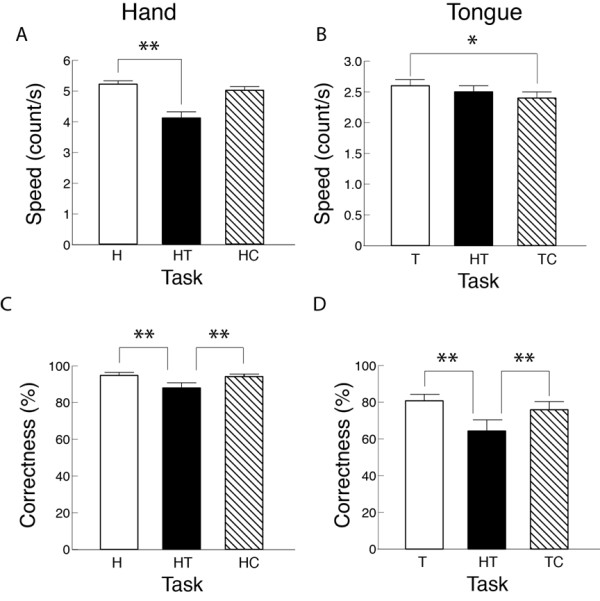
The influence of an additional concurrent task on motor performance was similar between the hand and tongue for slow movement in controlling their displacement. In rapid movement with a concurrent motor task, most aspects of motor performance were degraded in hand, while tongue speed during rapid continuous task was maintained. With a concurrent cognitive task, most aspects of motor performance were degraded in tongue, while hand accuracy during the rapid discrete task and hand speed during the rapid continuous task were maintained.
Rapid goal-directed hand and tongue movements were more consistently susceptible to interference from concurrent motor and cognitive tasks, respectively, compared with the other movement.
为了给手部功能受损或残疾的个体提供一种替代的运动模式,用于控制、导航和交流,开发了一种舌驱动系统(TDS),它允许在不引人注目的、无线的和可穿戴的设备中实时跟踪舌运动,该设备利用附着在舌尖的微型圆盘形磁示踪器产生的磁场。该研究的目的是比较使用 TDS 技术在手和舌之间进行简单运动控制的各种方面,在存在或不存在并发运动(手或舌)或认知(算术和记忆)任务的情况下,对各种方面的影响。
13 名年轻健康的成年人在手和舌(使用 TDS)上进行快速和慢速目标导向运动,并在手和舌上进行了伴有或不伴有并发运动(手或舌)或认知(算术和记忆)任务的情况下进行了快速和慢速目标导向运动。比较了在添加并发任务后,手和舌之间的反应时间、完成时间、速度、正确性、准确性、位移变异性和时间变异性的变化。
在控制位移方面,在慢速运动中,附加并发任务对运动表现的影响在手和舌之间相似。在手和舌的快速运动中,当有并发运动任务时,大多数运动表现方面都有所下降,而在快速连续任务中,舌的速度保持不变。在进行并发认知任务时,大多数运动表现方面在舌中都有所下降,而在快速离散任务中手的准确性和快速连续任务中的手速保持不变。
与其他运动相比,快速目标导向的手和舌运动分别更容易受到并发运动和认知任务的干扰。