Department of Neurobiology, Caring Sciences and Society, The Karolinska Institute, Stockholm, Sweden.
J Multidiscip Healthc. 2011;4:433-9. doi: 10.2147/JMDH.S27180. Epub 2011 Dec 13.
Parkinson's disease (PD) patients' own knowledge and experience and access to information, in relation to advanced treatment methods, are very limited. The aim of this study was to map out PD patients' perception about various advanced treatment methods, their availability and regional differences in medical care, and to investigate patients' experience of their medication and quality of life.
A survey was sent to 4886 PD patients of the Swedish Parkinson's Disease Association covering demography, the patient's illness, current treatment, received information about advanced treatment alternatives, and health status. Advanced PD was considered as patients diagnosed >5 years ago, using PD medication >5 times/day, and experiencing motor complications >2 hours/day.
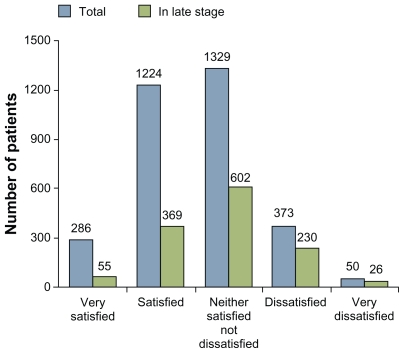
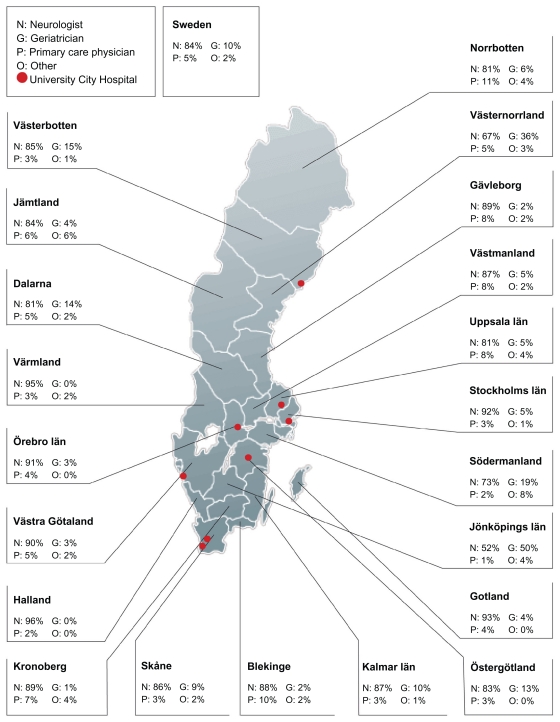
In total, 3327/4886 persons (68%) responded (57% men) of which 1300 (39%) were classified as having advanced PD. Mean age was 71 years with a median disease duration of 8 years. The treating physician was a neurologist (86%) but varied between counties (96% to 52%) and was most frequent in urban areas. Doctor appointments were 1.7 times/year with regional variation (2.1 to 1.1). Three out of four patients had heard of advanced treatment options and were interested, but were denied treatment. Only a small proportion of patients were informed of these by their physician. Nine percent were satisfied with their medication (including 4% of advanced patients). One third of patients experienced their general health as poor or very poor.
The majority of Swedish PD patients are treated by neurologists. Annual numbers of doctors' appointments were low in an international context and can partly be explained by the shortage of neurologists and other trained specialists. Doctors only provided a small proportion of patients with advanced therapy information, despite patients' interest. Hence, improvement is warranted regarding doctor appointments, information about various advanced treatment options, and their availability.
帕金森病(PD)患者自身对先进治疗方法的了解和经验以及获取信息的途径非常有限。本研究旨在描绘 PD 患者对各种先进治疗方法的看法、这些方法在医疗保健中的可及性和地区差异,并调查患者对自身药物治疗的体验和生活质量。
向瑞典帕金森病协会的 4886 名 PD 患者发送了一份调查问卷,内容涉及人口统计学、患者疾病、当前治疗、接受先进治疗替代方案的信息以及健康状况。将晚期 PD 定义为诊断>5 年、每天使用 PD 药物>5 次且每天经历>2 小时运动并发症的患者。
共有 4886 人中的 3327 人(68%)(57%为男性)作出回应,其中 1300 人(39%)被归类为患有晚期 PD。平均年龄为 71 岁,中位疾病持续时间为 8 年。治疗医生为神经科医生(86%),但在不同县之间存在差异(96%至 52%),且在城市地区更为常见。患者每年与医生预约 1.7 次,地区间存在差异(2.1 至 1.1)。四分之三的患者听说过先进的治疗方案并对此感兴趣,但被拒绝治疗。只有少数患者从医生那里得到了相关信息。9%的患者对自身药物治疗感到满意(包括 4%的晚期患者)。三分之一的患者认为自身整体健康状况较差或非常差。
大多数瑞典 PD 患者由神经科医生治疗。在国际范围内,每年看医生的次数较少,这部分原因是神经科医生和其他受过训练的专家短缺。尽管患者感兴趣,但医生只为一小部分患者提供了先进治疗方案的信息。因此,需要改善医生预约、各种先进治疗方案的信息以及这些方案的可及性。