Institute of Biochemical Plant Pathology, Helmholtz Zentrum München, German Research Center for Environmental Health, D-85764 Neuherberg, Germany.
J Exp Bot. 2012 Apr;63(7):2465-78. doi: 10.1093/jxb/err416. Epub 2012 Jan 16.
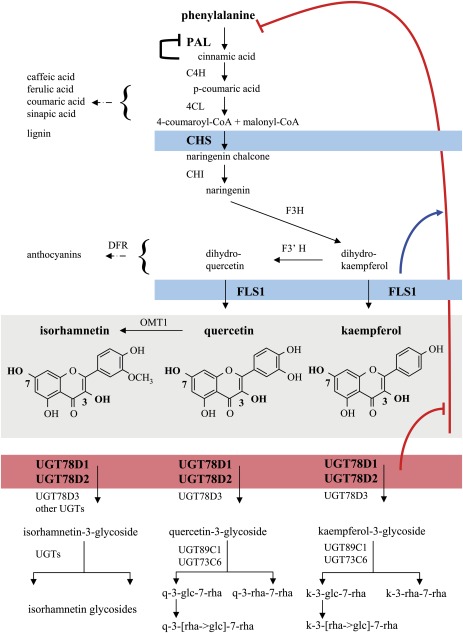
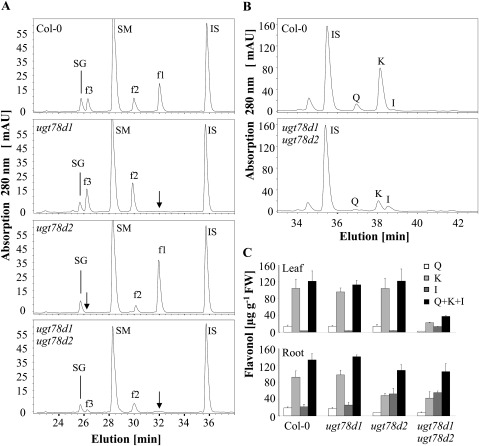
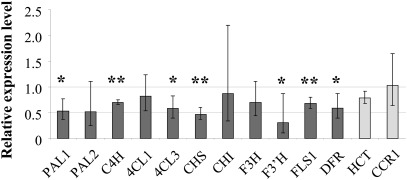
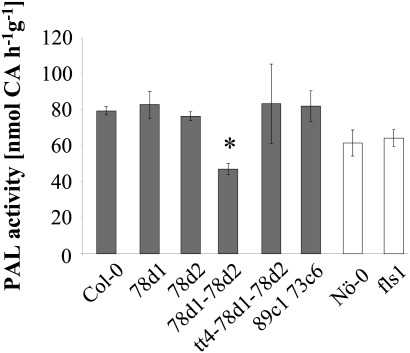
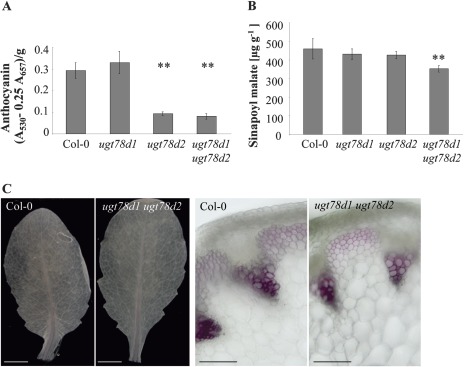
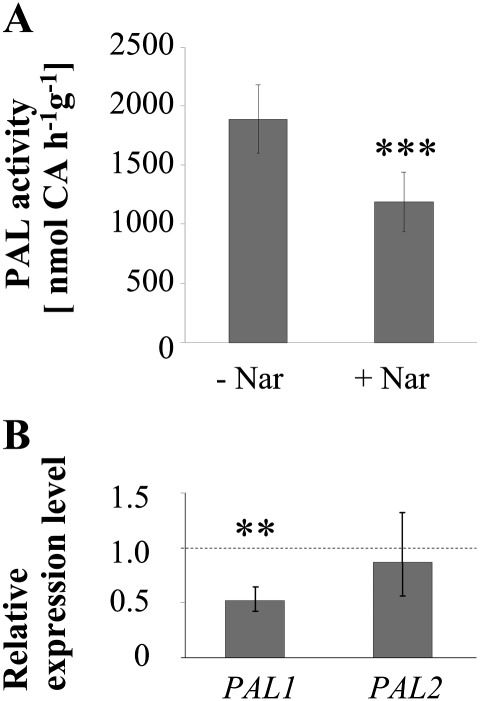
Flavonols, phenylalanine-derived secondary metabolites, have protective and regulatory functions in plants. In Arabidopsis thaliana, they are consecutively glycosylated at their 3-OH and 7-OH groups. UGT78D1 and UGT78D2 are the major flavonol 3-O-glycosyltransferases in Arabidopsis leaves. The ugt78d1 ugt78d2 double mutant, which was strongly compromised in the initial 3-O-glycosylation, showed a severe and specific repression of flavonol biosynthesis, retaining only one-third of the wild-type level. This metabolic phenotype was associated with a repressed transcription of several flavonol biosynthetic genes including the committed step chalcone synthase [(CHS) or TRANSPARENT TESTA 4 (TT4)]. Furthermore, the committed step of the upstream, general phenylpropanoid pathway, phenylalanine ammonia-lyase (PAL), was down-regulated in its enzyme activity and in the transcription of the flavonol-related PAL1 and PAL2. However, a complete blocking of flavonoid biosynthesis at CHS released PAL inhibition in a tt4 ugt78d1 ugt78d2 line. PAL activity was even enhanced in the flavonol synthase 1 mutant, which compromises the final formation of flavonol aglycones. The dependence of the PAL feedback inhibition on flavonols was confirmed by chemical complementation of tt4 ugt78d1 ugt78d2 using naringenin, a downstream flavonoid intermediate, which restored the PAL repression. Although aglycones were not analytically detectable, this study provides genetic evidence for a novel, flavonol-dependent feedback inhibition of the flavonol biosynthetic pathway and PAL. It was conditioned by the compromised flavonol-3-O-conjugation and a decrease in flavonol content, yet dependent on a residual, flavonol synthase 1 (FLS1)-related capacity to form flavonol aglycones. Thus, this regulation would not react to a reduced metabolic flux into flavonol biosynthesis, but it might prevent the accumulation of non-glycosylated, toxic flavonols.
类黄酮是苯丙氨酸衍生的次生代谢物,在植物中具有保护和调节功能。在拟南芥中,它们在 3-OH 和 7-OH 基团上连续发生糖基化。UGT78D1 和 UGT78D2 是拟南芥叶片中主要的类黄酮 3-O-糖基转移酶。ugt78d1 ugt78d2 双突变体在初始 3-O-糖基化中受到严重损害,表现出类黄酮生物合成的严重和特异性抑制,仅保留野生型水平的三分之一。这种代谢表型与几种类黄酮生物合成基因的转录受到抑制有关,包括关键步骤查尔酮合酶(CHS)或透明种皮 4(TT4)。此外,上游一般苯丙烷途径的关键步骤苯丙氨酸解氨酶(PAL)的酶活性和类黄酮相关 PAL1 和 PAL2 的转录均受到下调。然而,在 CHS 处完全阻断类黄酮生物合成会在 tt4 ugt78d1 ugt78d2 系中释放 PAL 抑制。PAL 活性甚至在类黄酮合酶 1 突变体中增强,该突变体损害了类黄酮苷元的最终形成。tt4 ugt78d1 ugt78d2 用柚皮素(一种下游类黄酮中间产物)进行化学互补证实了 PAL 反馈抑制对类黄酮的依赖性,柚皮素恢复了 PAL 的抑制。尽管苷元无法进行分析检测,但这项研究提供了遗传证据,证明了类黄酮生物合成途径和 PAL 的新型、类黄酮依赖性反馈抑制。它是由受损的类黄酮 3-O 缀合和类黄酮含量降低引起的,但依赖于残留的、与类黄酮合酶 1(FLS1)相关的形成类黄酮苷元的能力。因此,这种调节不会对进入类黄酮生物合成的代谢通量减少做出反应,但它可能防止非糖基化、有毒类黄酮的积累。