Molecular Pathology Team, The Breakthrough Breast Cancer Research Centre, The Institute of Cancer Research, London SW3 6JB, UK.
Department of Anatomic Pathology, Hospital Universitario 12 de Octubre, Madrid, Spain.
J Pathol. 2012 May;227(1):42-52. doi: 10.1002/path.3990. Epub 2012 Mar 21.
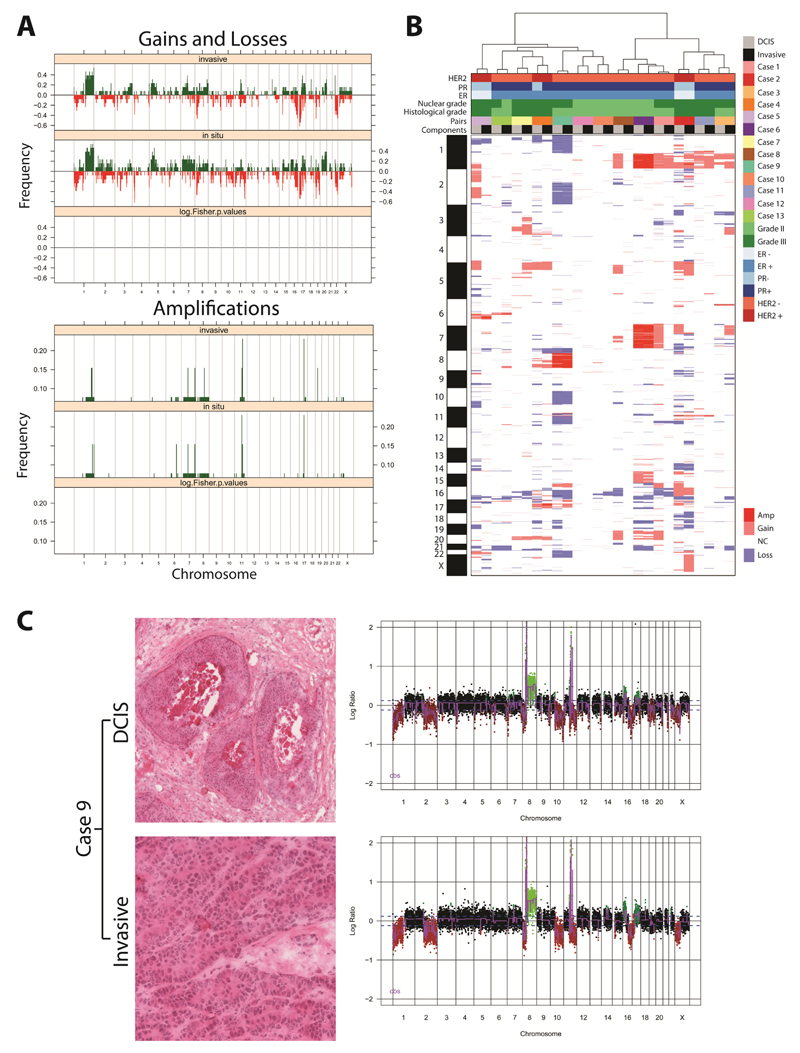
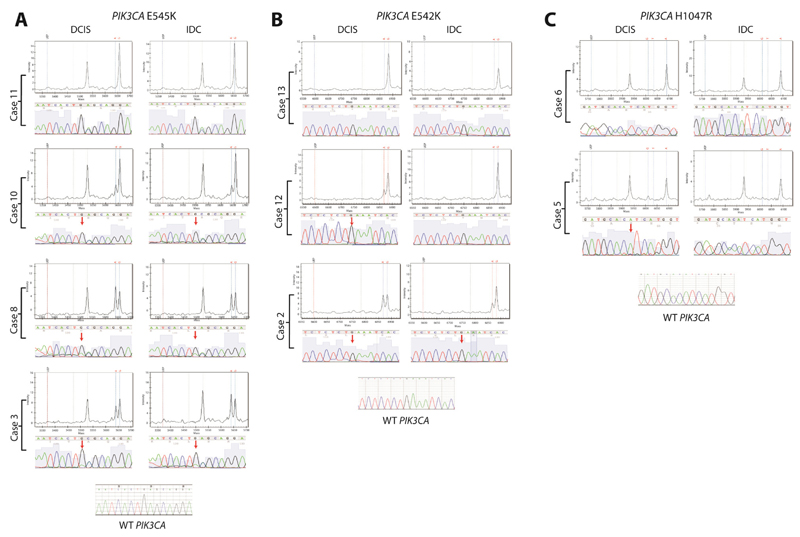
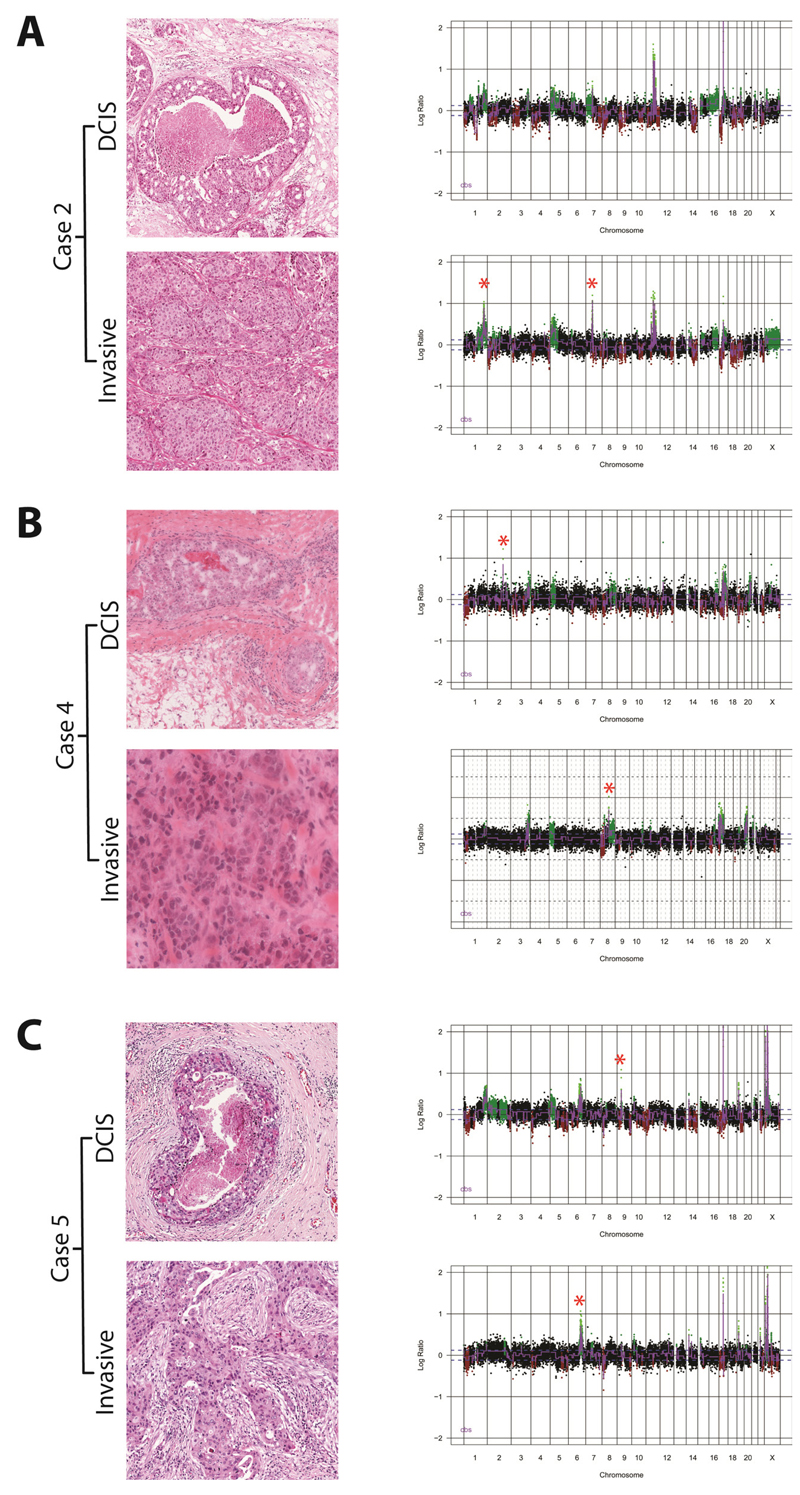
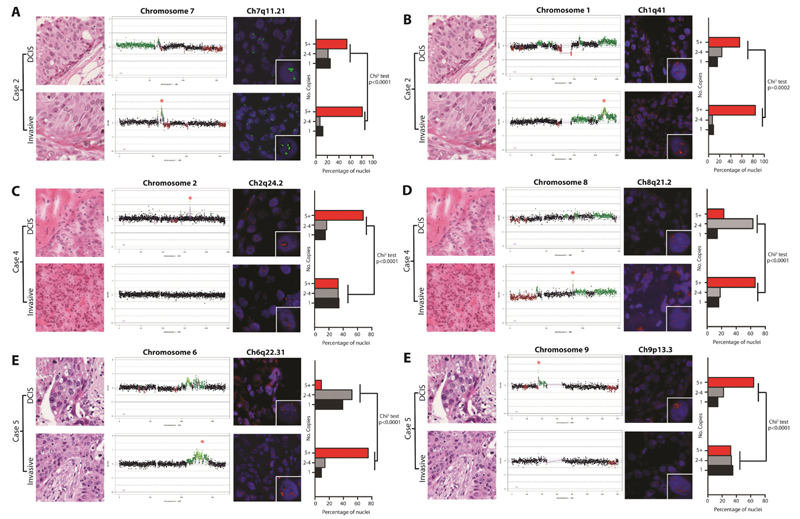
The mechanisms underlying the progression from ductal carcinoma in situ (DCIS) to invasive ductal carcinoma (IDC) of the breast are yet to be fully elucidated. Several hypotheses have been put forward to explain the progression from DCIS to IDC, including the selection of a subpopulation of cancer cells with specific genetic aberrations, and the acquisition of new genetic aberrations or non-genetic mechanisms mediated by the tumour microenvironment. To determine whether synchronously diagnosed ipsilateral DCI and IDCs have modal populations with distinct repertoires of gene copy number aberrations and mutations in common oncogenes, matched frozen samples of DCIS and IDC were retrieved from 13 patients and subjected to microarray-based comparative genomic hybridization (aCGH) and Sequenom MassARRAY (Oncocarta v 1.0 panel). Fluorescence in situ hybridization and Sanger sequencing were employed to validate the aCGH and Sequenom findings, respectively. Although the genomic profiles of matched DCI and IDCs were similar, in three of 13 matched pairs amplification of distinct loci (ie 1q41, 2q24.2, 6q22.31, 7q11.21, 8q21.2 and 9p13.3) was either restricted to, or more prevalent in, the modal population of cancer cells of one of the components. Sequenom MassARRAY identified PIK3CA mutations restricted to the DCIS component in two cases, and in a third case the frequency of the PIK3CA mutant allele reduced from 49% in the DCIS to 25% in the IDC component. Despite the genomic similarities between synchronous DCIS and IDC, our data provide strong circumstantial evidence to suggest that in some cases the progression from DCIS to IDC is driven by the selection of non-modal clones that harbour a specific repertoire of genetic aberrations.
乳腺癌从导管原位癌(DCIS)进展为浸润性导管癌(IDC)的机制尚未完全阐明。已经提出了几种假说来解释从 DCIS 到 IDC 的进展,包括选择具有特定遗传异常的癌细胞亚群,以及通过肿瘤微环境获得新的遗传异常或非遗传机制。为了确定同时诊断的同侧 DCIS 和 IDC 是否具有模态群体,这些群体具有共同致癌基因中不同基因拷贝数异常和突变的特征,从 13 名患者中检索了 DCIS 和 IDC 的匹配冷冻样本,并进行了基于微阵列的比较基因组杂交(aCGH)和 Sequenom MassARRAY(Oncocarta v1.0 面板)。荧光原位杂交和 Sanger 测序分别用于验证 aCGH 和 Sequenom 的发现。尽管匹配的 DCIS 和 IDC 的基因组图谱相似,但在 13 对匹配的对中,有三个对中,不同部位(即 1q41、2q24.2、6q22.31、7q11.21、8q21.2 和 9p13.3)的扩增仅限于或更常见于其中一个成分的肿瘤细胞的模态群体中。Sequenom MassARRAY 在两种情况下鉴定了仅局限于 DCIS 成分的 PIK3CA 突变,在第三种情况下,PIK3CA 突变等位基因的频率从 DCIS 中的 49%降低到 IDC 成分中的 25%。尽管同步 DCIS 和 IDC 的基因组相似,但我们的数据提供了强有力的间接证据,表明在某些情况下,从 DCIS 到 IDC 的进展是由携带特定遗传异常谱的非模态克隆的选择驱动的。