Department of Microbiology and Molecular Genetics, IMRIC, Faculty of Medicine, The Hebrew University of Jerusalem, Jerusalem, Israel.
PLoS Comput Biol. 2012 Jan;8(1):e1002341. doi: 10.1371/journal.pcbi.1002341. Epub 2012 Jan 12.
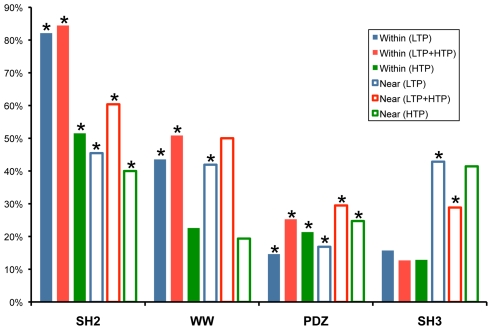
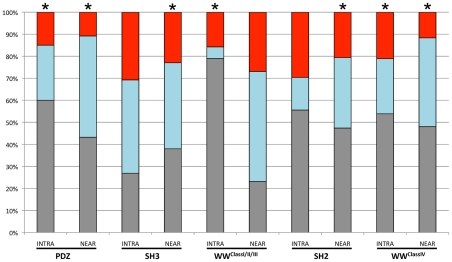
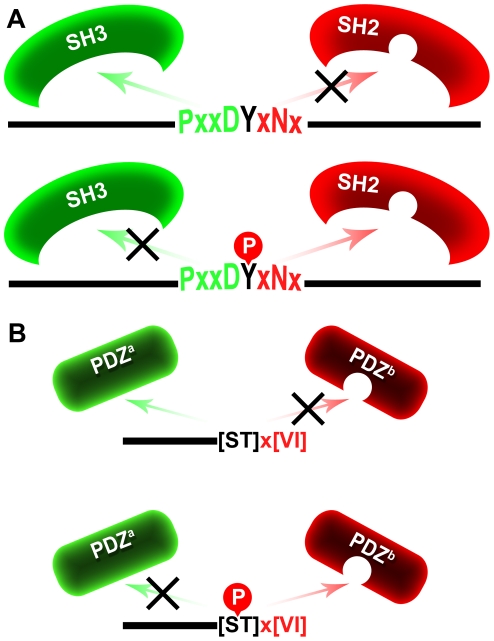
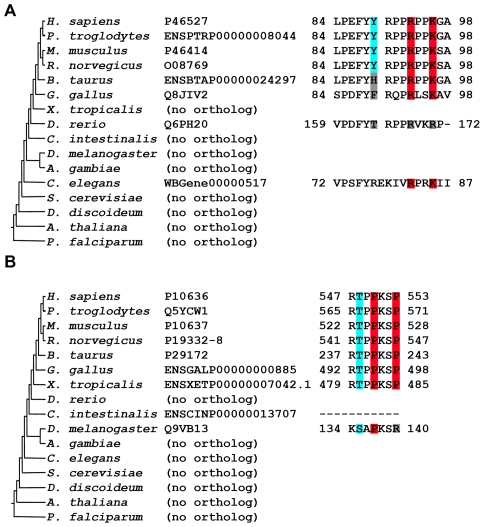
Many protein-protein interactions are mediated by domain-motif interaction, where a domain in one protein binds a short linear motif in its interacting partner. Such interactions are often involved in key cellular processes, necessitating their tight regulation. A common strategy of the cell to control protein function and interaction is by post-translational modifications of specific residues, especially phosphorylation. Indeed, there are motifs, such as SH2-binding motifs, in which motif phosphorylation is required for the domain-motif interaction. On the contrary, there are other examples where motif phosphorylation prevents the domain-motif interaction. Here we present a large-scale integrative analysis of experimental human data of domain-motif interactions and phosphorylation events, demonstrating an intriguing coupling between the two. We report such coupling for SH3, PDZ, SH2 and WW domains, where residue phosphorylation within or next to the motif is implied to be associated with switching on or off domain binding. For domains that require motif phosphorylation for binding, such as SH2 domains, we found coupled phosphorylation events other than the ones required for domain binding. Furthermore, we show that phosphorylation might function as a double switch, concurrently enabling interaction of the motif with one domain and disabling interaction with another domain. Evolutionary analysis shows that co-evolution of the motif and the proximal residues capable of phosphorylation predominates over other evolutionary scenarios, in which the motif appeared before the potentially phosphorylated residue, or vice versa. Our findings provide strengthening evidence for coupled interaction-regulation units, defined by a domain-binding motif and a phosphorylated residue.
许多蛋白质-蛋白质相互作用是通过结构域-基序相互作用介导的,其中一个蛋白质中的结构域与相互作用伙伴中的短线性基序结合。这种相互作用通常涉及关键的细胞过程,需要对其进行严格的调节。细胞控制蛋白质功能和相互作用的常见策略是通过特定残基的翻译后修饰,特别是磷酸化。事实上,存在一些基序,如 SH2 结合基序,其中基序磷酸化是结构域-基序相互作用所必需的。相反,也有其他例子表明基序磷酸化会阻止结构域-基序相互作用。在这里,我们对实验性人类数据的结构域-基序相互作用和磷酸化事件进行了大规模的综合分析,证明了这两者之间存在着有趣的联系。我们报告了 SH3、PDZ、SH2 和 WW 结构域中的这种偶联,其中基序内或附近残基的磷酸化被暗示与结构域结合的开启或关闭有关。对于需要基序磷酸化才能结合的结构域,如 SH2 结构域,我们发现了除了与结构域结合所需的磷酸化事件之外的偶联磷酸化事件。此外,我们还表明,磷酸化可能作为一个双开关,同时使基序与一个结构域相互作用,并使基序与另一个结构域相互作用失活。进化分析表明,基序和能够磷酸化的近端残基的共同进化占主导地位,而不是其他进化情景,其中基序出现在潜在磷酸化残基之前,或者反之。我们的研究结果为通过结构域结合基序和磷酸化残基定义的偶联相互作用调节单元提供了有力的证据。