
肯尼亚性活跃成年人中艾滋病毒感染的相关因素:一项基于全国人口的调查。
Correlates of HIV Infection Among Sexually Active Adults in Kenya: A National Population-Based Survey.
作者信息
Oluoch Tom, Mohammed Ibrahim, Bunnell Rebecca, Kaiser Reinhard, Kim Andrea A, Gichangi Anthony, Mwangi Mary, Dadabhai Sufia, Marum Lawrence, Orago Alloys, Mermin Jonathan
机构信息
US Centers for Disease Control and Prevention - Division of Global HIV/AIDS, Nairobi, Kenya.
出版信息
Open AIDS J. 2011;5:125-34. doi: 10.2174/1874613601105010125. Epub 2011 Dec 30.
OBJECTIVE
To identify factors associated with prevalent HIV in a national HIV survey in Kenya.
METHODS
The Kenya AIDS Indicator Survey was a nationally representative population-based sero-survey that examined demographic and behavioral factors and serologic testing for HIV, HSV-2 and syphilis in adults aged 15-64 years. We analyzed questionnaire and blood testing data to identify significant correlates of HIV infection among sexually active adults.
RESULTS
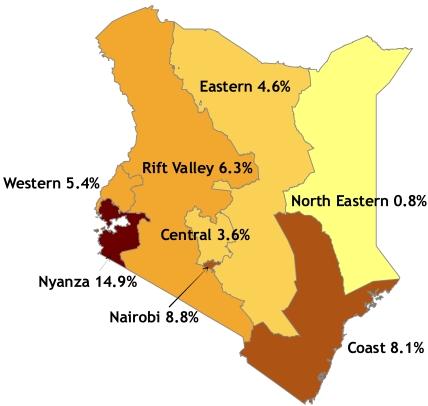
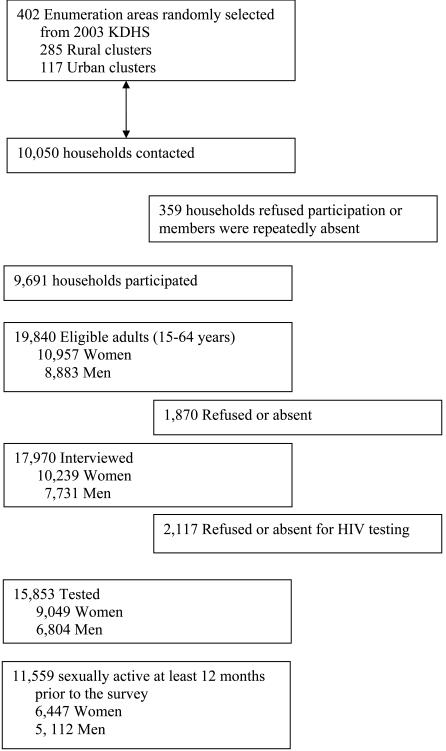
Of 10,957 eligible women and 8,883 men, we interviewed 10,239 (93%) women and 7,731 (87%) men. We collected blood specimens from 9,049 women and 6,804 men of which 6,447 women and 5,112 men were sexually active during the 12 months prior to the survey. HIV prevalence among sexually active adults was 7.4%. Factors independently associated with HIV among women were region (Nyanza vs Nairobi: adjusted OR [AOR] 1.6, 95%CI 1.1-2.3), number of lifetime sex partners (6-9 vs 0-1 partners: AOR 3.0, 95%CI 1.6-5.9), HSV-2 (AOR 6.5, 95%CI 4.9-8.8), marital status (widowed vs never married: AOR 2.7, 95%CI 1.5-4.8) and consistent condom use with last sex partner (AOR 2.3, 95%CI 1.6-3.4). Among men, correlates of HIV infection were 30-to-39-year-old age group (AOR 5.2, 95%CI 2.6-10.5), number of lifetime sex partners (10+ vs 0-1 partners, AOR 3.5, 95%CI 1.4-9.0), HSV-2 (AOR 4.7, 95%CI 3.2-6.8), syphilis (AOR 2.4, 95%CI 1.4-4.0), consistent condom use with last sex partner (AOR 2.1, 95% CI 1.5-3.1) and lack of circumcision (AOR 4.0, 95%CI 2.8 - 5.5).
CONCLUSION
Kenya's heterogeneous epidemic will require regional and gender-specific prevention approaches.
目的
在肯尼亚的一项全国性艾滋病毒调查中确定与艾滋病毒流行相关的因素。
方法
肯尼亚艾滋病指标调查是一项具有全国代表性的基于人群的血清学调查,调查了15 - 64岁成年人的人口统计学和行为因素以及艾滋病毒、单纯疱疹病毒2型和梅毒的血清学检测情况。我们分析了问卷和血液检测数据,以确定性活跃成年人中艾滋病毒感染的显著相关因素。
结果
在10957名符合条件的女性和8883名男性中,我们采访了10239名(93%)女性和7731名(87%)男性。我们从9049名女性和6804名男性中采集了血液样本,其中6447名女性和5112名男性在调查前12个月内有性行为。性活跃成年人中的艾滋病毒流行率为7.4%。女性中与艾滋病毒独立相关的因素包括地区(尼扬扎与内罗毕:调整后的比值比[AOR]为1.6,95%置信区间为1.1 - 2.3)、终身性伴侣数量(6 - 9个伴侣与0 - 1个伴侣:AOR为3.0,95%置信区间为1.6 - 5.9)、单纯疱疹病毒2型(AOR为6.5,95%置信区间为4.9 - 8.8)、婚姻状况(丧偶与未婚:AOR为2.7,95%置信区间为1.5 - 4.8)以及与最后一次性伴侣始终使用避孕套(AOR为2.3,95%置信区间为1.6 - 3.4)。在男性中,艾滋病毒感染的相关因素包括30至39岁年龄组(AOR为5.2,95%置信区间为2.6 - 10.5)、终身性伴侣数量(10个及以上伴侣与0 - 1个伴侣,AOR为3.5,95%置信区间为1.4 - 9.0)、单纯疱疹病毒2型(AOR为4.7,95%置信区间为3.2 - 6.8)、梅毒(AOR为2.4,95%置信区间为1.4 - 4.0)、与最后一次性伴侣始终使用避孕套(AOR为2.1,95%置信区间为1.5 - 3.1)以及未行包皮环切术(AOR为4.0,95%置信区间为2.8 - 5.5)。
结论
肯尼亚的艾滋病疫情具有异质性,需要采取针对地区和性别的预防措施。
 Zotero 插件